Always the horses, seldom the jockey...
Daily Commentary on the Dallas Sports Scene - By Bob Sturm - Sportsradio 1310, The Ticket - The Athletic Dallas - The Athletic - Bob Sturm
Showing posts with label Personnel Groupings. Show all posts
Showing posts with label Personnel Groupings. Show all posts
Dallas Cowboys tight end Jason Witten (82) makes a catch in the first quarter of a game against the Oakland Raiders at Oakland-Alameda County Coliseum in Oakland, Calif., on Sunday, Dec. 17, 2017. (Rose Baca/The Dallas Morning News)
Decoding Linehan
We have been writing these offensive summaries on Tuesday mornings since the 2008 season. The study has certainly evolved over the years, but when it started, the sole purpose was to try to figure out a little more about what is going on based on what the screen is telling us. We know the announcers are not treating the game like a teaching clinic because most of the audience is not interested in the Xs and Os and deep layers of football. We know that following the ball is how most people watch the game, and that seems to satisfy the majority of the audience. Great.
But the reason I started attempting to unlock layers of the NFL game was that I wasn't satisfied with the simplistic explanations we often get. I don't appreciate the catch-all phrases like "halftime adjustments" or "throw it deep," or even "call the touchdown play." I wanted to try to understand the game in terms of what each team is trying to do to the other and actually turn it into the mental chess game as it actually appears to the participants and coaches.
I do confess, however, that I assume the readers of this series have been with me for 10 seasons, too. And I am wrong. The point of this exercise should be to bring those along who are joining in along the way. I shouldn't assume that personnel grouping concepts are obvious to all involved, so at the risk of some reading this for the 10th time, allow me to review one of the most important concepts of enjoying football at a deeper level:
Offenses are attempting to gain advantages by showing defenses something, and then doing something different. Just like in baseball, in the showdown between a pitcher and a batter, deception is a massive way to overcome your opponent.
In football, we do that with formations and personnel groupings. I highly recommend you learn personnel groupings so they become second nature as you watch a team line up. Formations are important, too, but in my opinion, lesser so. Formations affect the 11 men on the field. Personnel groupings generally affect the entire opposing sideline.
Between every play, as you look at your phone or say something to your buddy, the teams are running guys on or off the field. The offense goes first and the defense studies its moves to counter with its own. That is why we track personnel groupings so carefully each week. We want to see what the offensive coordinator is trying, and in what situations he is trying it. The defense wants to know, too, so it puts the proper personnel out there to counter. To review, six players never change on the offense. The five offensive linemen and the quarterback. The other five players rotate quite a bit. Most every team passes with "11" personnel -- one running back, one tight end and three wide receivers -- so that would be their two-minute and third-down offense. Across the league, this is pretty uniform. Defenses see this and will bring on 5-6 defensive backs to defend it. Short yardage on the goal line is often "23" personnel -- two running backs and three tight ends. This screams run, so a defense will go get its big group to defend. Those are the two ends of the spectrum and there are a number of options in-between that try to tell the world either: we are definitely running, we are likely to run, we might run here, we are probably passing, or we are definitely passing.
And that is where deception gets involved. You tell the opponent one thing, and then you do something completely different.
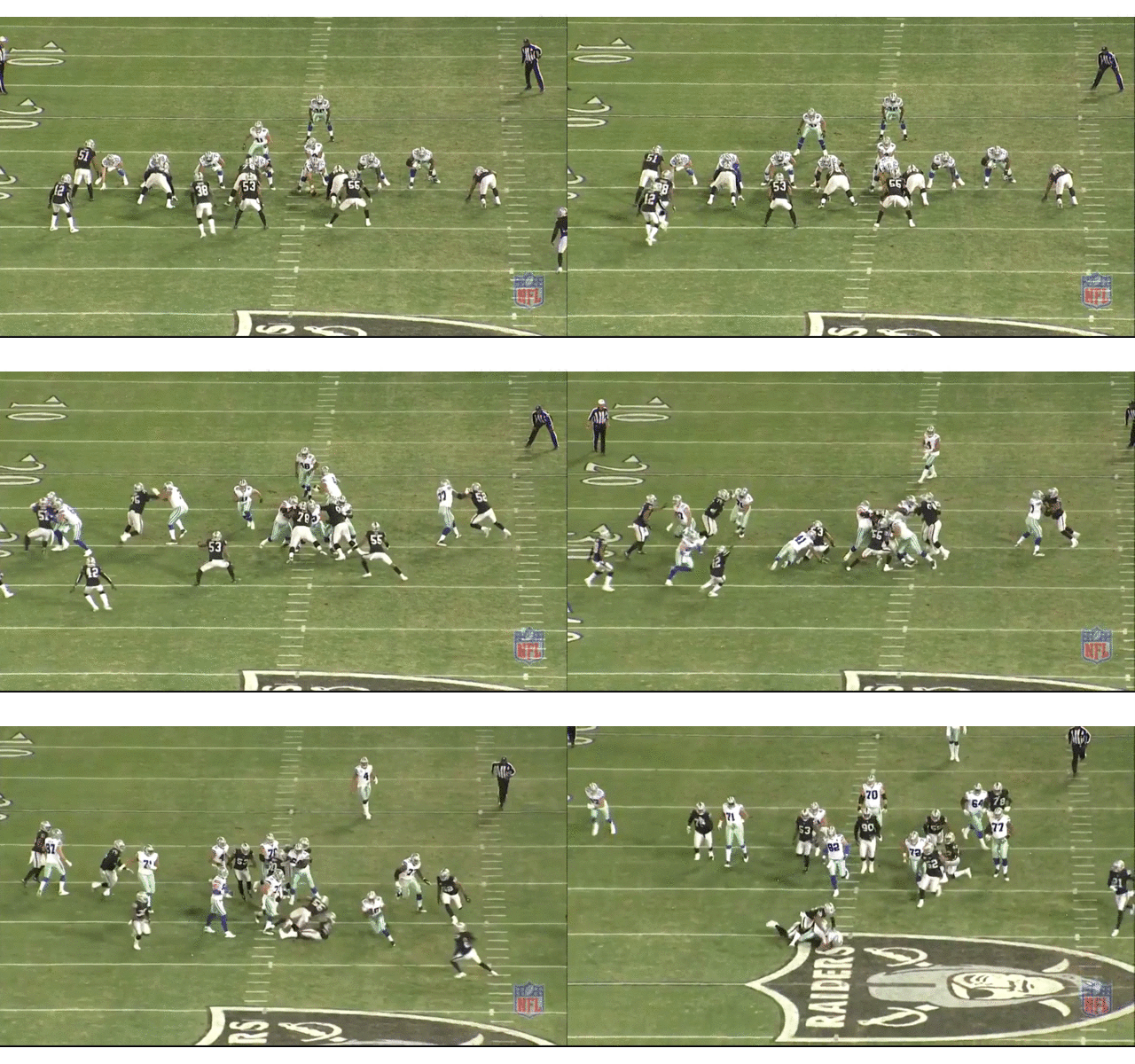
The Cowboys have been finding success with this by using "13" personnel -- one running back, three tight ends and one wide receiver -- which is something they have historically run out of about 75-80 percent of the time, in addition to "22" personnel -- two running backs, two tight ends and one wide receiver -- and throwing passes when they think the defense has sucked too far up. When you want to see adjustments that have come to the front in the past few games during this win streak, I would say this one quickly comes to mind. First and 10, pound the rock, use play-action and see openings in the secondary with only one wide receiver in the game.
This is an example in the first quarter of showing personnel. This is 22 personnel. The Cowboys show run, then they right into the teeth of the Raiders and gash them. Alfred Morris does a great job of waiting on his cutback and completely fools Marquel Lee (No. 55) in the hole, then ends up with a 16-yard gain. This is what power football feels like when it is coming right at you.
So, here is the next play.
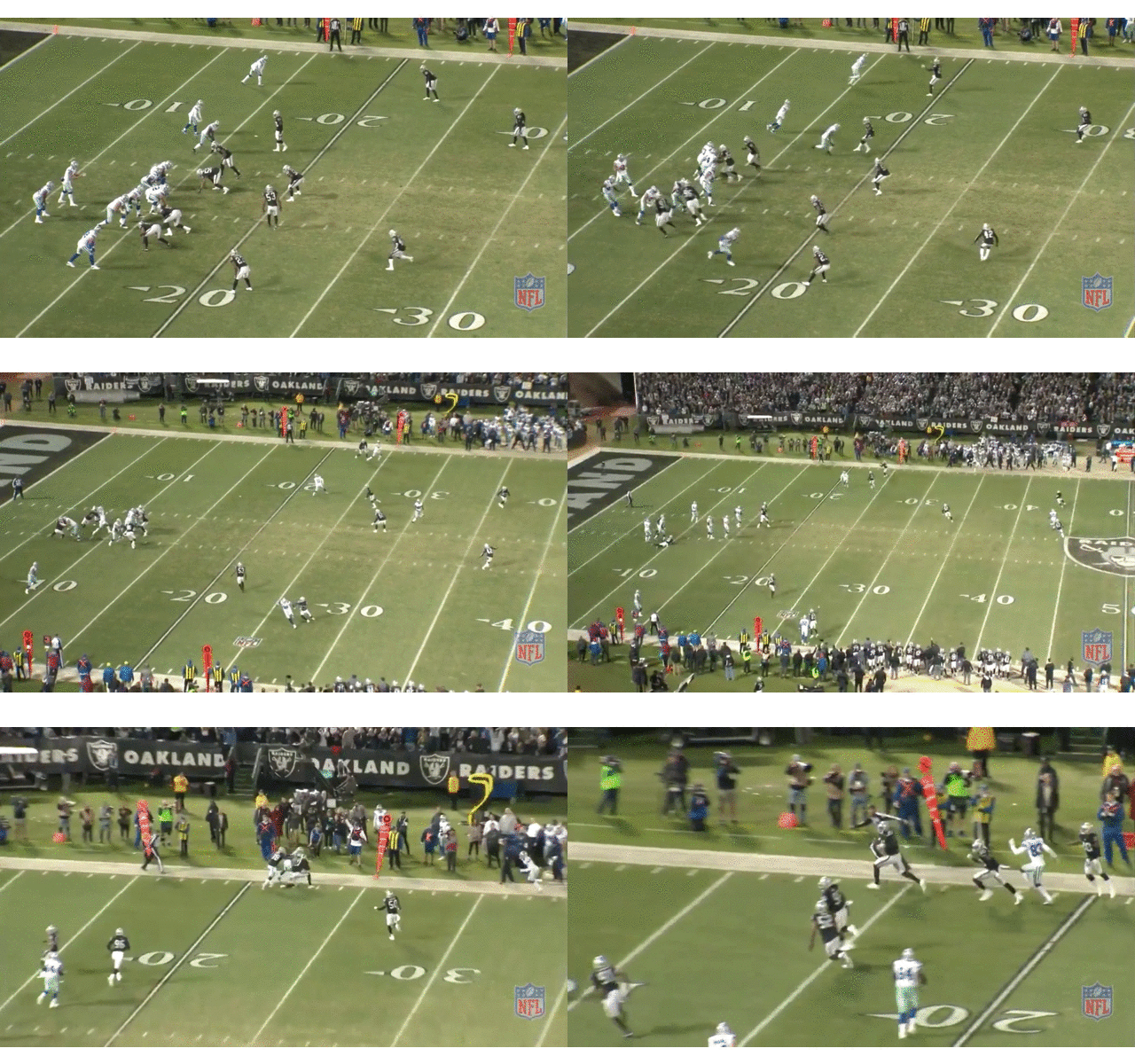
You are the linebacker. You tell me if this is a run or pass at first. You are looking at all of the same keys as the last snap. You see the personnel grouping -- 12 personnel this time. You are thinking, "This is now first and 10 and they just had success on the ground. We better get ready because they have seven run blockers up front." And that is when Dak Prescott can hit you with the play-action pass to a tight end who did not stay to block, but rather got behind your linebackers into a space where he is wide open.
Watch Lee (No. 55) on that video and see how he is sure it is a run again. And that is how you use deception to cross them up. You can't use it on third down because they aren't stupid. They know you have to pass it there or your drive is over. That is why deception on first down is how this game is generally won or lost.
Now let's see why the pass is so much easier from the other angle. If you pass in "run" situations, you accomplish the major goal of getting all the defenders shallow. This allows you to pass into lightly populated secondaries, where you are not outnumbered. You have three guys running vertically and they have three defenders back in a Cover 3. On third down, you often have three against seven. But on first down and in play-action, it can be three against three. When that happens, there are all sorts of route combinations that will easily free a man up. This time, you have Jason Witten running behind a vertical from Terrance Williams that clears out the corner on that side. Now, unless the shallow linebackers get a deep drop, the tight end is going to have the corner to himself. Witten does. Eighteen yards. As easy as you like.
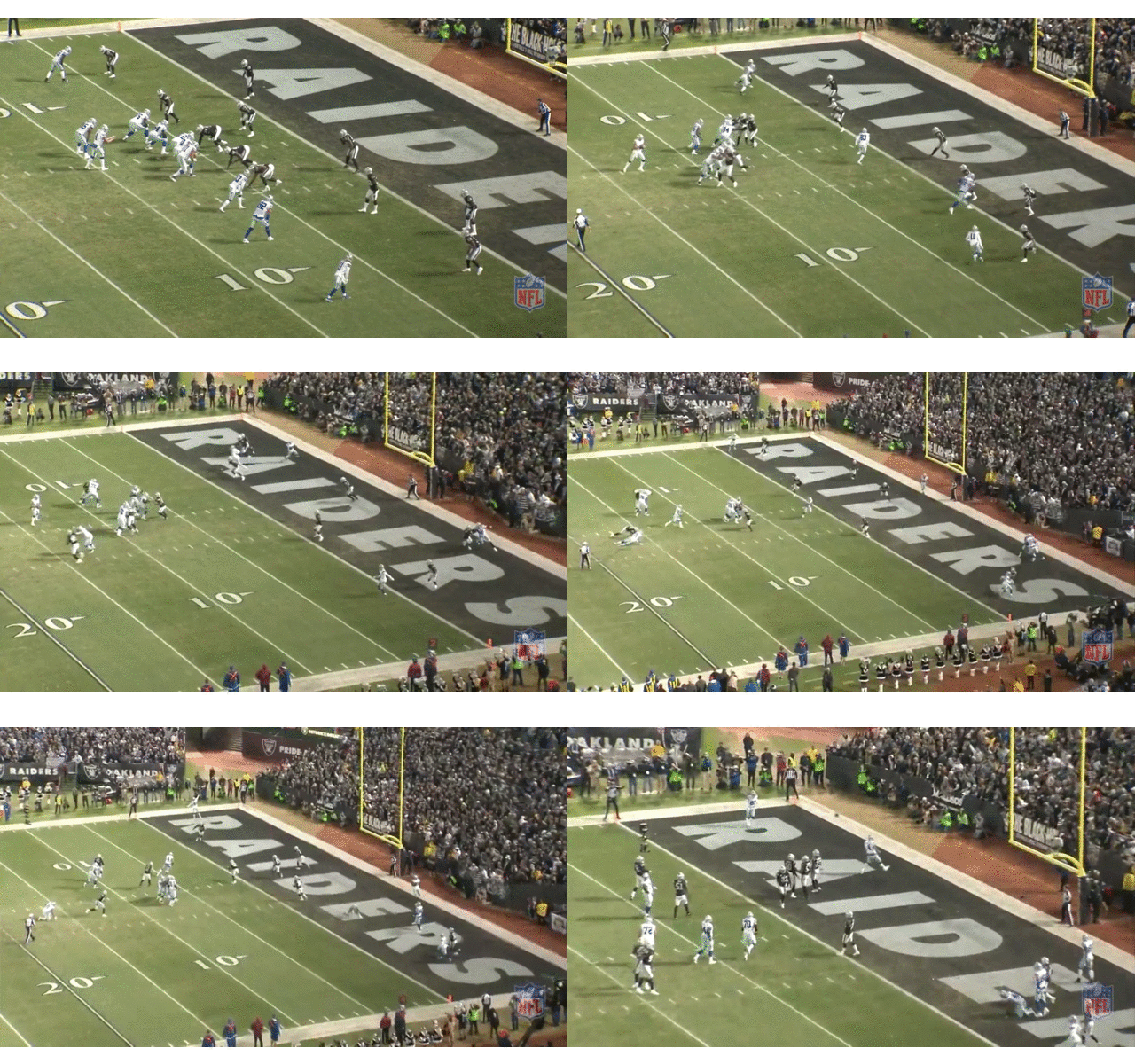
Here is a moment a little later that fed off that same "run tendency" and a similar route combination to open up a similar opening in the Oakland secondary on yet another first-and-10.
This time it is 13 personnel and it is James Hanna leaking out -- just like he did against the Giants.
Again, watch that run fake. Watch the Oakland linebackers. See the window open because of the vertical wide receiver clearing out the corner on that side. And see Prescott hit that window. Passing is so much easier when they think you are going to run. Football 101.
WEEKLY DATA BOX
Here we see the numbers from Sunday night. The offense needed to put up some numbers to win this thriller and it did just enough. The Cowboys really needed a touchdown on that final drive and should have done better at the goal line. They also had a really rough night on third down, but I would remind folks that this is a very good third-down team this season, ranking fifth in the entire league. They don't go 20 percent very often. In a league where the average is 38.9 percent, the Cowboys -- through all the adversity -- still sit at 43.4 percent, which trails only the Falcons, Eagles, Vikings and Steelers. Everyone else looks up at the Cowboys on the money down.
DAK PRESCOTT THROW CHART
Seldom do we see a day when there are 12 passes beyond 10 yards and six beyond 20 yards. The Cowboys saw some downfield opportunities and wanted to force the Raiders to defend them vertically. It caught me a bit off guard, given their reputation lately. It wasn't easy, but Prescott and the targets hooked up for some big moments. There were a few others left out there, too.
PERSONNEL GROUPINGS
As you can see, when you are in "run" groupings, you still are running most of the time. That is the concept of deception again. You must convince the opponent you are doing one thing in order for the ambushes to work. But right now, you can see the Cowboys are most successful with multiple-tight end packages. This is when they give their passing game the best chance to work. The trouble is, that means Cole Beasley isn't even on the field, since he is almost exclusively an 11 personnel weapon. This explains his statistical falloff this year a bit, although in the interest of time, I won't elaborate too much on that right now.
Let's look at some more tape:
If first down is easy pickings for a quarterback, then third and long is just the opposite. The defense is ready for your passing concepts and wants to disguise its coverages to fool a quarterback/wide receiver. This time, it sure looks like there is confusion as Prescott wants Dez Bryant on the slant. The pass is too high and it looks like Bryant sees a zone (he is right) and that there is no chance on that ball. His effort looks bad here and he could have helped his quarterback save an interception, but he likely knows that the slant is against man coverage and this is a zone, so it should be more of a hook into the soft spot. Either way, it is not a great decision by the quarterback and the drive ends.
Bryant does look guilty of self-preservation, which never plays well, but if I were to guess on this one, I think he is correct in not expecting that throw. You can see how quarterback and wide receiver need to be on the same page.
This is Tyron Smith being defeated on a first-down pass-protection bid against Khalil Mack. Mack is very strong, but I think you will agree that this was our first indication that Smith is playing hurt. Remember that play, because it impacts several others later.
Because of the sack, the Cowboys face a third-and-12 that they actually hit on. Tight window to hit Witten at the sticks, but Prescott makes a nice throw. Look at how many Raiders are sitting on these routes, though. It is impossible to make a living on third and long in this league.
Third quarter, third and 9 -- this is when the game got really interesting. I don't think this play was going to get 9 yards, but it really went wrong when Prescott's arm gets hit and Sean Smith ends up with an interception. Beasley gets a touch on him, or it could have been a pick-six. But this is the type of play that loses games and ends seasons. Let's check the protection:
Watch Bruce Irvin fake a stunt on Tyron Smith, who can't even move. He tries, but Irvin is too fast and gets to Prescott's arm, turning the ball into a free interception. Pass protection is a huge part of third-down success and the left tackle spot was not right.
Here is the very next drive. I believe this is Tyron Smith's last play. Prescott wants Beasley deep but is again hit as he throws because Smith has no chance against Irvin. Smith is one of the best in the business, but the Cowboys properly saw that he can't do it right now and had to take him out after this moment.
The very next play was the fake punt. Then, a few moments later, down near the goal line, Prescott figures out a way into the end zone against a zone. What a great, elusive run from the quarterback to see his best chance was with his legs.
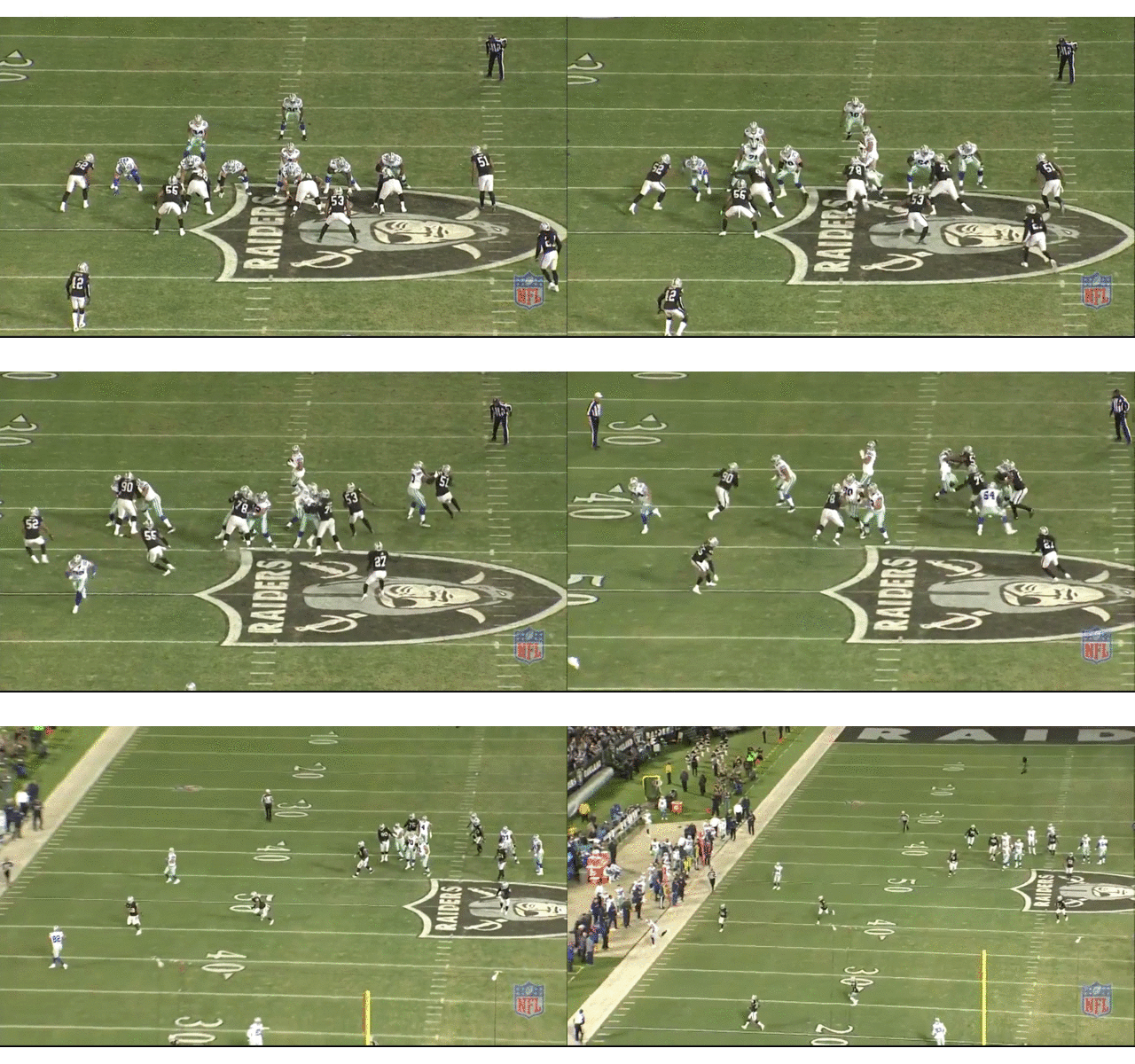
And, finally, a chance to win the game on this throw. If you don't like the Cowboys in "Empty," you won't like this play. But if you do like crucial 40-yard gains to set up the winning score, maybe you will make an exception. Good throw, and, of course, a chance for Bryant to show you what he is great at -- winning battles for the ball in the air down the sideline or in the end zone when the corner has no help.
Sunday night was a very fine road win with plenty of talking points.
A long time ago, I became interested in the inner-workings of the Cowboys game strategies. From there, I started studying more and more the Xs and Os of the game. That led to attempting to understand what the Cowboys do and why they do it. Sometimes, it enlightens a situation involving this team and sometimes it only leads to more complex questions.
But, in the end, it is now a passion of mine to attempt to decipher what the Cowboys are doing from a strategic standpoint, and then attempting to pass it on to readers who want to join on this journey.
It is not for everyone. In fact, in this day and age of fantasy football and the red zone channel, it may not be for most. But, to those who enjoy diving deep on just one team and knowing as much as humanly possible about the Dallas Cowboys, you might just enjoy this trip.
Every Tuesday, I write a blog entry called "Decoding Linehan". This, of course, is the next in a long line of "Decoding Garrett" from 2008-2012 and "Decoding Callahan" in 2013. On there, we track all sorts of offensive items that aren't generally found in the box score.
We elaborate on what worked, what didn't, and what this may tell us about their next battles. In a sense, we attempt to review and predict what their game-plans will be, and then review them carefully as the coaching staff itself does on a weekly basis.
That said, our level of detail can't get so deep that only football nerds understand it. So, it is my goal every year to track things that are easily consumed for the passionate, and not too intimidating for the newcomers to join in.
Feedback is very helpful, so that I can make sure to elaborate on points that need it from a reader's standpoint, so feel free to drop me a message at any point.
=====
To begin, let's discuss how we got here. Below, please examine the NFL run/pass splits compared to the Dallas Cowboys run/pass splits over the last 8 seasons. As you can see, the NFL is not even close to 50/50 anymore. In fact 45% run/55% pass is rather dated. We are now basically arriving at a spot where the NFL is evolving into a 40% running league. Who know where it ends up, but the fact that he red line below continues to head south tells us that NFL teams believe in running less and less.
Now, look at the blue-line of the Cowboys. The extremes of 2012-2015, in particular, demonstrate why Cowboys' enthusiasts hold up the 2014 season as a sort of holy grail. It was the year that it appeared the Cowboys nearly broke the NFL by going back to the mid-1990s, when 50/50 was normal. The rest of the league zigged, and the Cowboys zagged. Now, in 2016, they think they can do it again.
The league has told us that this is a QB league and that you don't invest in Running Backs because their roles are less than they have ever been and that perhaps they are merely complimentary pieces now. But, what if you desire to get to 50/50 or beyond? 50/50 based on a hypothetical 1,000-play season means you are running 500 run plays. If you are, then you might want the best RB you can acquire and then sign him up for 300 of them (Ezekiel Elliott). Then, you might want someone else's starter to be your backup (Alfred Morris), and even a nice rookie to take on a little of the leftovers (Darius Jackson).
Again, the Cowboys seem to be trying to pull off something - at least in their heads - that the league simply isn't doing anymore. But, because of the Cowboys DNA - a coach and front office that are still trying to go back to 2014 and the early 1990s dynasty - they have built this throwback offense and are trying to insert modern ideas with an old-school, physical style.
Next, here is a look at the % of plays in shotgun. Now, it is important for us to be clear here, as any observer or teacher should be willing to update their information. I have used this space here since 2008 to harp on my feelings about shotgun. As the Cowboys used it for years with Tony Romo, it became their solution to every problem. Poor pass protection, poor running game, poor game-plan? Well, the solution was to run the 2-minute offense all of the time. And what happens in the 2-minute offense? For the Tony Romo offense, that means 85% of the plays or more are going to be pass plays.
Now, here is where we need to update our materials. In about 2012, the NFL started learning with dual threat QBs, the best way to run the zone read with Robert Griffin, Cam Newton, Russell Wilson, Colin Kaepernick, Ryan Tannehill, etc was to run it out of shotgun. This means that we should not fear the formation anymore that it will make us a finesse team (team that has no chance to win in January). Rather, power football is played from shotgun now. And with Dak Prescott, this RB, and this offensive line, we better get on board. Under-center has always been the spot for play-action and physical football, but football has evolved and the Cowboys actually have the pieces now (and the injured passing QB) that this might be the plan for Week 1.
That doesn't mean that this Cowboys' historical data was used for that purpose. This is all with 85% passing in mind. In other words, from 2012-2015 (with that glorious 2014 outlier), the Cowboys were doing this because they were out of other ideas and unable to bully opponents and the clock for entire games.
As you can see in 2015, they had 4 different ineffective QBs (yes, even Tony Romo was poor when he was on the field last year), running shotgun as the team was always behind and always needing to score quickly.
Next, we need to know what personnel grouping the Cowboys run the majority of the time. The chart below can seem confusing (because it kind of is), but just know that you can see the Personnel Groupings on the right with a corresponding color. The numbers around the pie chart are the percentages each grouping is used. Yellow is "S11" or "Shotgun 11" Personnel which was run 41.7% of the time out of about 960 plays in 2015. Purple is "12" and was used 15.5% of the time. "S12" was used 7%, with normal "11" used 11% of the time.
Those were the 4 most used personnel groupings in 2015, which is a departure from yesteryear where "21" and "22" personnel were used. The Cowboys really don't run much with fullbacks, having replaced those one-dimensional lead blockers with TEs who may not take on LBs in the hole as well, but they also provide far more defensive stress for the chance they may be a receiver who just starts in the backfield.
PERSONNEL GROUPINGS - THE KEY TO FIGURING OUT GAME THEORY
If there is one thing we need to look at to better understand how a game of football in the NFL works, it is knowing why personnel groupings matter more than formations or even the plays themselves.
Offensive Groupings are how the defense decides who to put on the field. After every play, the defensive coaches watch the offense change players and then quickly respond. If the Cowboys bring on another WR, the Redskins are watching and quickly yell for another corner to run out and replace a LB. But, if Dallas does the opposite and takes off a WR and puts on a Fullback, then the opposition needs to take a corner off and put a bigger LB out there because they are now feeling a power run coming on.
Formations matter, but a defense has to then adjust with the 11 players already on the field. When formations are being changed by the offense, the defense cannot swap players, they simply have to match up their 11 as best they can before the snap. That is why if you can only study personnel or formations, any coach will tell you to concentrate on who is on the field.
Once you do this for a while, you will be able to count in your head as you see the screen and note what the offense is in. You might even be able to look at the defense and see how the defense has decided to match up. It is an amazing chess game that goes on before every snap.
Now, understand that the offenses around this league now love to take advantage of the defenses by having a group that can run or pass. If they can get you "stuck", then they want to play up-tempo so that you can not change your guys for the entire possession. Once again, I believe Dallas has decided that this will be one of their plans. They will use their "11" personnel - from shotgun or under center, with Elliott, Jason Witten, Dez Bryant, Cole Beasley, and Terrance Williams as their best group that can spread you out and pass, or bunch you up and decide to use runs and play action. If you go big to stop them, they will pass and expose your coverage. If you go small to cover the pass, they will pack it in and let that OL take over. The design of the Cowboys offense is in a very advantageous position as we enter the season.
Let's show you the Cowboys' favorite 6 groupings. For the most part, the entire NFL world will roll with these 6:
11 Personnel - 1 RB, 1 TE, 3 WR - Under center - The Cowboys almost never used this grouping from 2008-2012, but in 2013 they started using it more and more and in 2015 it was up over 100 snaps. The Broncos almost never run anything besides "11", but most of it is Shotgun 11. If you look around the league, the modern NFL seems to believe in "11" as they would rather have a 3rd WR in the game than a FB or another TE.
12 Personnel - 1 RB, 2 TE, 2 WR - Under Center - This is what you have heard so much about. The Patriots, the 49ers, the Packers, the Saints, and the Cowboys have all tried to make this their diet. It is the ultimate balanced package both from personnel (the defense has to make a choice between DBs and LBs and the offense then picks the opposite strength) and from formation - if each side of the offense has a TE there is no weak side!
21 Personnel - 2 RB, 1 TE, 2 WR - Under Center - Below is the standard personnel grouping that you grew up watching. This is also called "regular" as it has always been the default grouping. Of course, we know that the fullback is a dying breed and there is almost no 2-half backs (Tony Dorsett and Ron Springs!) lined up next to each other anymore. So, while this is the grandfather of them all in the Super Bowl era, it is now just a change-up. Most teams want a 2nd TE now over a FB.
22 Personnel - 2 RB, 2 TE, 1 WR - Under Center - This is the new ground and pound grouping that the Cowboys were so good at during the Martellus Bennett/Marion Barber run in 2009 that ended up in the playoffs when they ran this grouping over 200 times in one season. This declares run to the defense, they bring in extra "bigs" and we have a street fight. You have power, but they have 9 in the box to stop you. My favorite idea here is play action over the top to Dez Bryant running in a wide open secondary because everyone is up for the run. To be honest, the Cowboys are moving away from this, but in that visit to Seattle in 2014, this was how they closed the game.
S11 Personnel - 1 RB, 1 TE, 3 WR - Shotgun - This is the most run personnel package in the entire NFL now days at it isn't even close. The Cowboys love it, but their efficiency is not great. It is the 2-minute offense and the 3rd Down offense, and also the most favored of them all in any situation. It spreads out a secondary and makes the DBs prove they can cover without a ton of safety help. The bad side is it reduces your protection options and really encourages blitzing (especially if you aren't great at stopping them). This is actually also a great running option because the defense is set up for the pass and has few "bigs" in the game. Especially delayed runs when the DBs all vacate on routes.
S12 Personnel - 1 RB, 2 TE, 2 WR - Shotgun - And this is what Jimmy Graham, Rob Gronkowski, Julius Thomas, and other hybrid TE/WR types love. This is 12 out of the shotgun and may actually make defenses decide to go dime (6 DBs) so that they can cover everyone with a corner and still have 2 safeties. But, if they do, they are undersized. The Cowboys don't use this much anymore, mostly because they have decided that Cole Beasley is a much better weapon than Gavin Escobar. As a reminder, Beasley was an undrafted free agent, and Escobar was taken in the 2nd round. Oh, well.
Ok, so once you can identify the groups, you are in good shape to understand what the offense is good at and what they are not so good at. It is far more advanced than saying, "we are a good passing team". We need to know in what situations are the Cowboys good? How are defenses adjusting? Who is winning the match-up game of chess?
Those are the questions we want to answer here every Tuesday. See if you can learn to look for RBs and TEs on each play and you will have it down. Each personnel group is named by the total of each. 2 RBs and 1 TE? 21 Personnel. 1 RB and 2 TEs? 12 Personnel. Easy.
=====
Here are the rankings for the last 5 years on what the Cowboys did most. We are listing the 4 groups from each of the last 5 seasons that they ran the most often ranked from 1st to 4th. Then, we list how many times they ran the group for total yardage and then the yards per play (ypp).
Every season has a different number of plays, but 1,000 is about normal. Also, yards per play are context free, so expect more yards per play from a shotgun situation than from a "Run 1st" situation. It is nearly impossible to get 7 yards an attempt on the ground, but 7 yards an attempt in the passing game is considered mediocre.
2011
2012
2013
2014
2015
1. S11 Personnel
1. S11 Personnel
1. S11 Personnel
1. S11 Personnel
1. S11 Personnel
303 - 1733 yds
479 - 3141 yds
345 - 1911 yds
331 - 2238 yds
401 - 2362 yds
5.71 yds per play
6.55 ypp
5.53 ypp
6.76 ypp
5.89 ypp
2. 12 Personnel
2. 12 Personnel
2. 12 Personnel
2. 12 Personnel
2. 12 Personnel
224 - 1475 yds
143 - 767 yds
190 - 1063 yds
233 - 1333 yds
149 - 886 yds
6.58 ypp
5.36 ypp
5.59 ypp
5.72 ypp
5.94 ypp
3. 22 Personnel
3. 21 Personnel
3. S12 Personnel
3. 11 Personnel
3. 11 Personnel
124 - 693 yds
121 - 820 yds
105 - 735 yds
78 - 418 yds
110 - 515 yds
5.59 ypp
6.77 ypp
7.00 ypp
5.36 ypp
4.68 ypp
4. S12 Personnel
4. 22 Personnel
4. 11 Personnel
4. 21 Personnel
4. S12 Personnel
93 - 703 yds
73 - 272 yds
95 - 451 yds
75 - 483 yds
69 - 422 yds
7.55 ypp
3.72 ypp
4.74 ypp
6.44 ypp
6.12 ypp
Dallas YPP: 5.91
Dallas YPP: 5.71
Dallas YPP: 5.70
Dallas YPP: 6.05
Dallas YPP: 5.57
NFL YPP: 5.45
NFL YPP: 5.41
NFL YPP: 5.36
NFL YPP: 5.44
NFL YPP: 5.48
The final 2 lines of the graphic above are the overall "Yards Per Play" for Dallas (overall for all plays) and then the overall NFL YPP to provide some comparison numbers. You will notice that 2014 was the high point (again).
And yes, you read that correctly - the average play in the NFL is about 5.4-5.5 yards. That seemed high to me, but it is true.
That is a ton of info, but that is how we roll here. I hope you can handle it - but as I said at the top, this may not be for every football fan.
Now, we wait to see the Scott Linehan offense on Sunday with a rookie QB and a rookie RB and then begin to figure out what the changes will be. It should be fun to see how he plays with these new (and very young) toys.