Monday, June 22, 2015

Cowboys Health Check - 2014


Trainers attend to Dallas Cowboys quarterback Tony Romo (9) after he was sacked by Washington Redskins inside linebacker Keenan Robinson in the third quarter during the Washington Redskins vs. the Dallas Cowboys NFL football game at AT&T Stadium on Monday, October 27, 2014.  (Louis DeLuca/The Dallas Morning News)
Trainers attend to Dallas Cowboys quarterback Tony Romo (9) after he was sacked by Washington Redskins inside linebacker Keenan Robinson in the third quarter during the Washington Redskins vs. the Dallas Cowboys NFL football game at AT&T Stadium on Monday, October 27, 2014. (Louis DeLuca/The Dallas Morning News)
I think most of us agree that luck plays a major role in football.  We want to quantify everything in this great sport, but there is no way to know about luck's role in things, so we hold our breath and hope for the best.
Luck has many machinations and forms, of course.  The bounce of a football after a fumble would often have to fall in this category - and you may recall that occurred a few different times in the playoff game in Green Bay.  A replay review getting called correctly could also fall under the umbrella of luck.  A referee seeing something correctly could as well.
But, today, let's simply visit the "luck" component of staying healthy.  In a salary cap era where you put more eggs in fewer baskets - because those eggs cost so much of your cap - it is beyond vital that we keep those precious eggs on the field and not on the injured reserve.  These days more than ever, there is no depth that can replace or replicate your All-Pro performers if they should happen to be hurt.  This is why the preseason games often turn into consumer shams, since no team wants to lose a precious egg in a game with no real importance.  The fans are ripped off by being forced to buy tickets as part of the season ticket offering, but even they understand and almost seldom complain about this dance.
So, as we look at health, I thought we should consider the fine work of last week's study released by FootballPerspective.com on the Cowboys leading the NFL in health in 2014.  Their methodology is interesting and debatable, but by their findings, the Cowboys boasted an average of 14.5 starts per starter or 318 starts overall.  This was determined by taking the top 22 most common starters and adding them up.
Offensively, with the exception of Tony Romo and Ron Leary both missing the Arizona game, and Doug Free missing seven of the 18 games (NYG, Wash, Arizona, Indy, Wash, and both playoff games - Det, GB), the Cowboys offense was healthy the entire year.  That is pretty difficult to fathom, but it happened.  Basically, while they did have some guys play with bumps and bruises, nobody considered a starter missed extended time but Doug Free.  That is beyond remarkable, and frankly, one of those items that seems impossible to duplicate.
We spend a lot of time talking about the training staff methods and strength coaches with regards to injuries, but this is football.  I am always leery of a new trainer keeping a team from ever losing games to injuries.  Sometimes with football, I would argue that avoiding injuries is nothing more complex than playing Texas Hold Em and hoping you get the cards you need and avoid the ones that kill you.  However, it is worth discussion that the physical, forward bull-dozing style of the Cowboys offensive line from 2014 would seem to inflict more pain than it would sustain, but that is highly subjective and difficult to prove to any real degree.
Now, the defense is a different story and that is where the methodology of this study comes into question.  Here is from their findings:
Things were only slightly hairier on defense. In the secondary, safeties Barry Church and J.J. Wilcox started every game, while cornerback Brandon Carr also played the full slate. Orlando Scandrick started the final 14 games of the year at corner after being suspended for the first two games of the year.

On the defensive line, Jeremy Mincey and Nick Hayden started 16 games, Tyrone Crawford started 15, and George Selvie started 13 games (but played in all 16). The most serious injuries came at linebacker: Rolando McClain started 12 games, Anthony Hitchens started 11, and Bruce Carter started 8 games. Of course, Sean Lee also missed the entire season after tearing his ACL in May.

Now, as you can see, their methodology doesn't really consider Sean Lee's entire missed year (they acknowledge it, but it isn't in their numbers at all), DeMarcus Lawrence's missed 10 weeks or so, and Morris Claiborne not playing a snap after September.  We can debate the relative merits of all 3 players, but they were certainly all heavy enough investments that we must consider them major heath blows.  But, in this study (and I realize there is no way to account for this perfectly), the only defensive injuries that are considered in the math are McClain, Carter, and Durant (due to Hitchens' playing time).
By the perspective of this study, the Cowboys had nearly a flawless health year in 2014 - and it is highly possible that many will find this unsustainable and dubious to their fortunes for 2015.  But, as I see it, when you properly weight for Lee and Lawrence, in particular, you can see that having both back in 2015 is part of the reason that you can believe the Cowboys should be one of the heavyweights in the NFC this fall.
I wanted to broaden this out a bit and while using the methodology of FP.com, I wanted to see if there is any correlation between a healthy year and a playoff year.  It sounds obvious, but the reason it isn't is because not all rosters are created equal.  Some years, even a fully healthy roster would not compete for much because of talent.  Other years, we would argue that it certainly isn't based on how many games are missed due to injury, but who the players are who are missing them.  Also, because their methodology is only adding up the starts of common starters, we are also considering guys losing their jobs for ineffective play and not just health.  This seems dubious, as well.
But, what if I took the last 10 seasons of Cowboys football, added up the total starts of the 22 most common starters and see if there is any connection?  Well, here you go:
Cowboys Health
Isn't that interesting.  For all of the flaws in logic, we see that in the last 10 seasons, the Cowboys have made the playoffs 4 times and those are #1, #2, #3, and Tied for #4 seasons in health of the Top 22.
It seems obvious to conclude that the healthy Cowboys teams make the playoffs.  And the Cowboys were, by this definition, the #1 healthiest team in the league.  It doesn't account for Lee, Lawrence, or Claiborne, but there does seem to be a connection to success.  They could depend on the idea that the guy next to them each week would be there the following game.  I think we all remember 2012 was quite the opposite, and that graphic confirms that as well.  The only year they did not make the playoffs, but did stay healthy was 2010, when that single injury was to Tony Romo.  Surely QB1 should be weighted differently, as most teams will drop off the map if they lose THAT guy.
Anyway, it is an interesting study that you should check out over at FootballPerspective.com.

Thursday, June 18, 2015

2014 Pass Protection Register - Weeks 13-16


For the last 4 weeks, I have taken a day each week to review the pass protection of the Cowboys offensive line from 2014.  This all goes back to a discussion about the overall quality of the Cowboys offensive line and the distinction of whether they are the best line in the NFL or whether they are a promising OL that still has significant room for improvement.  By the way, that is not an insult, rather, it should be incredibly exciting that a 12-4 team has tremendous upside to improve.
The Cowboys OL is very good.  But, to be great, they will need to pass protect better than they did in 2014.  Because for all of the great things they accomplished, Tony Romo was sacked 40 times in 18 games, including 10 times in the 2 playoff contests.  For a team that did not throw near the league average, that is too many.  And for a team that had a QB who elusively escaped many more sacks, that is way too many if we are going to discuss the best OL in the league.
They allowed 30 regular season sacks.  20 teams allowed more sacks, and a few teams – Jacksonville (71) and Washington (58) allowed way, way more.  But, 30 teams attempted more passes than the Cowboys.  Only Seattle threw fewer passes.  Therefore, we look at sack rate.  What percentage of passes are sacks?  5.9% in Dallas.  The league average was right there at 6.3%, where the Cowboys finished 16th.  11 teams had a sack percentage of lower than 5%, so you could easily argue that the Cowboys would need to drop 5-10 sacks off their tally to be considered a top team in pass protection.
That isn’t to say they are lousy.  But, it is to say they are average.
They are 21st in most sacks allowed.  They are 31st in most pass attempts.  They are 16th in sack percentage.  They allow a sack once every 16.9 pass attempts.  Peyton Manning, that magician in Denver, gets sacked once every 36.7 pass attempts and Joe Flacco is once every 30 attempts.
This may not be the most air-tight way to evaluate your offensive line, but given the nature of football, there isn’t a perfect way, short of sitting down with each sack and trying to figure out what the issues are.
So, I did.  I appreciate the fact that ProFootballFocus.com has their own scoring system for charging sacks.  In case you are not a subscriber, their final standings were different than mine.  They apparently only offered blame for 21 of the 30 sacks.  I am not sure their methodology, but as a customer, I really appreciate their contribution to football research and am very happy they exist.
That said, I am uncomfortable with so many NFL media types citing their stats without doing the work themselves when it comes to the teams we cover.  I am not going to check the math on all 32 teams, but I am going to do my own study for the team I am employed to cover.  With the resources we all have in the media, it seems a bit sloppy to allow PFF to replace our own elbow grease.  It should only enhance it, or serve as a reference point to cross-examine findings.  But, I personally think we should be doing our own grading on the team we follow.
Below, I will have a chart that lists the differences between PFF and my summary, if you care to see it.
=====
Now, on to the final regular season chapter.  Games 13-16; at Chicago, at Philadelphia, Indianapolis, and at Washington.
First a disclaimer:  The analysis below is not meant to be exhaustive for each play.  There is context that could require massive write-ups on each sack, but in the interest of time, let’s do this short and sweet.  I will try to identify the bust on each sack, but sometimes, it will be a guess as we do not know specific assignments.  We are trying to get this right, but invariably, some of you will see the same play and reach a different conclusion.  Cool? 
Sack #26
SackOppQ/TimeD/D/YdRushSackFault
#26CHI1/11:233/2/36497 - Young29 - Murray
First drive of the night game in Chicago and the Cowboys face a 3rd and 2 right on the edge of field goal range against the Bears.  They want to find something big here on a Play-action look, but that will depend on DeMarco Murray holding up Willie Young on the edge for more than a second.  For this to work, Murray needs to at least chop Young's legs, but Young is too athletic for that feeble attempt.  On the other side, Tyron and Ron Leary really make a meal of their double team effort and Leary should probably get some blame here, but if I had to choose the bust on this drive-killing sack, it goes to Murray and maybe whoever thought Murray on Young was a good idea.  Young is best known for Tyron Smith's most humiliating snap back in 2011 that we talked about back here in December and is probably too much for any Running Back.
Sack #27
SackOppQ/TimeD/D/YdRushSackFault
#27PHIL2/5:553/1/47598 - Barwin84 - Hanna
Again, just like the play in Chicago, this is a 3rd and short where the Cowboys know the box is loaded, so a run play may be tough-sledding.  Instead, they want a play-action fake and hopefully some biting safeties.  Unfortunately, the coverage is pretty sound and Romo wants to buy time.  That proves to be a decision that allows Conner Barwin to get home against James Hanna who is part of a slide-left pass protection look.  Barwin does what aggressive defenders do on play-action - they keep coming.  You often see linebackers stop in their tracks and even retreat when the QB keeps the ball in a moment that surely has them yelling an expletive, but Barwin doesn't care if it is run or pass, he is still charging  forward and Hanna can't deal with him.  Then Romo tries to duck under the move but stumbles to the ground.  2 more examples of 3rd and short, play-action ideas that certainly did not turn out too well.
Sack #28
SackOppQ/TimeD/D/YdRushSackFault
#28PHIL3/12:332/11/42472 - Thornton70 - Martin, 77 - Smith
OK, this one might be subjective.  And, I admit this angle is a bit deceiving.  If you watch the TV copy, the play starts going very badly as Zach Martin is beaten almost immediately by 91-Fletcher Cox.  Romo sees that and tries to take evasive action.  Trouble is, Tyron Smith is being pushed back by 58-Trent Cole right into the path of Romo.  Because of those two players losing, Ron Leary's guy, 72-Cedric Thornton actually picks up the sack as a bit of a freebie.  So, despite Leary being the usual suspect in pass protection, on this play, he is not guilty of doing anything wrong.  He has his guy perfect and only once Romo falls does Thornton do anything and gets credit for a sack that 91 and 58 produced.  So, I am going to split the blame between 70 and 77 on this one, despite neither of their men actually getting the credit.  In the film room, I believe they did get the blame.
Sack #29
SackOppQ/TimeD/D/YdRushSackFault
#29PHIL3/6:593/19/18375 - Curry9 - Romo
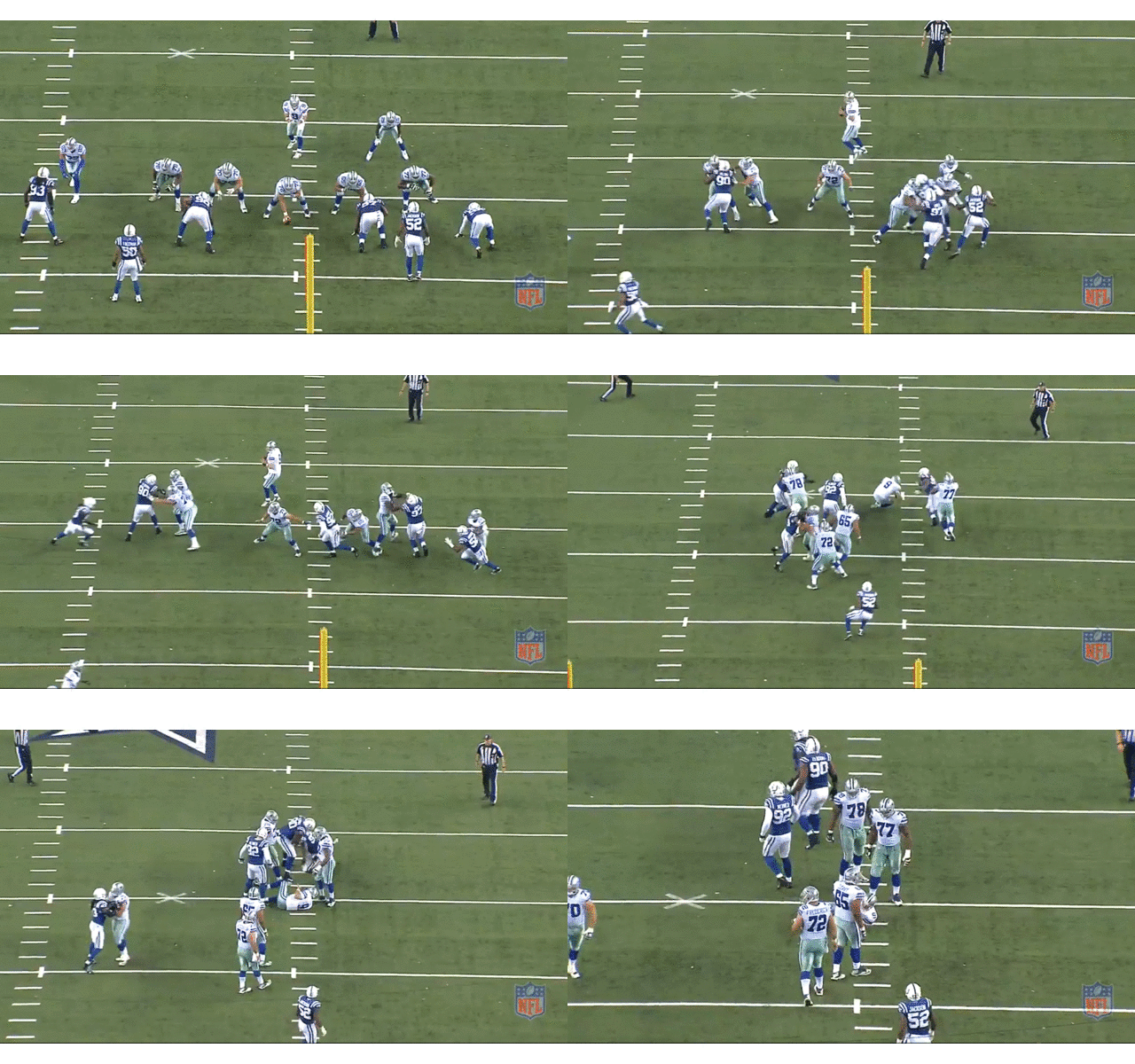
Do you know how close this play was to ruining the entire 2014 season?  This play was a 3rd and 19 from the Dallas 18.  The Eagles had been down 21-0, but had closed it to 21-17 and this play turned into a fumble that the gave the Eagles a 24-21 lead.  Romo redeemed himself wonderfully after this moment, but had the team not saved themselves, this play would have lived in infamy as another December catastrophe.  What we have here is a 3-man Eagles rush on 3rd and 19.  3rd and 19 should generally be a draw play and punt.  If you are going to try to throw on 3rd and 19, you cannot hold the ball for 8 seconds - because even a 3-man rush will eventually get home.  The OL has no idea where you are dancing around and what crazy Brett Favre idea you have in your head.  Not only was Romo sacked here, but the ball came loose.  This goes on the QB for a decision he will readily admit he shouldn't have made.  Sometimes you just have to throw it away.
Sack #30
SackOppQ/TimeD/D/YdRushSackFault
#30IND3/13:403/14/23597 - Jones65 - Leary/9 - Romo
Here is another 3rd and long and another moment where at this point of the game - with a 28-0 lead over the Colts, I would not advise this idea of Romo risking life and limb to try to move the chains when you are already in Field Goal range.  You can ask why he didn't dump it to Lance Dunbar and just take 10 yards once 25 releases into the flat where he was wide open, but the timing was off.  What did happen here is that the Colts hit the left side with a Tackle/End stunt with Ron Leary and Tyron Smith both ending up looking guilty.    You can see Leary trip Smith a bit, but I think splitting the blame here might be too harsh on Tyron.  92-Bjoern Werner's spin move on Leary collapses everything and then Romo spins right into 97-Arthur Jones.  So, half of the blame to Leary and half to Romo is my ruling, but again, this one has plenty of grey area.
=====
Here they all are in living color:
SackOppQ/TimeD/D/YdRushSackFault
#1SF1/8:152/1/2494 - J Smith77 - T Smith/Romo
#2SF3/6:452/10/28494 - J Smith68 - Free/70-Martin
#3SF3/3:142/12/39455 - Brooks77 - T Smith
#4TENN1/11:433/14/50499 - Casey68 - Free
#5TENN1/6:511/10/42592 - Pitoitua68 - Free
#6TENN1/2:182/11/12699 - Casey65 - Leary
#7TENN3/10:153/7/23431 - Pollard29 - Murray
#8NO4/8:563/6/24532 - Vacarro68 - Free
#9HOU1/7:192/5/28456 - Cushing29 - Murray/9-Romo
#10SEA3/11:292/6/43594 - J Smith84 - Hanna
#11NYG1/14:282/5/25590 - J Pierre Paul9  - Romo
#12NYG2/1:211/10/27490 - J Pierre Paul77 - Smith
#13WAS1/13:123/5/41531 - Meriweather9 - Romo/77-Smith
#14WAS1/6:093/8/42756 - Riley25 - Dunbar
#15WAS2/0:233/3/44591 - Kerrigan70 - Martin
#16WAS3/7:593/11/36852 - RobinsonCoaches
#17WAS4/1:252/1/12531 - Meriweather29 - Murray
#18ARZ2/1:412/10/16392 - Rucker72 - Frederick
#19JAC4/8:463/10/11499 - Marks65 - Leary
#20NYG2/7:132/8/22498 - Moore68 - Free
#21NYG2/0:183/3/44494 - Kiwanuka68 - Free
#22PHIL2/6:143/2/24455 - Graham72 - Frederick
#23PHIL3/10:243/2/23650 - Matthews9 - Romo, 77-Smith
#24PHIL3/7:131/10/35455 - Graham65 - Leary
#25PHIL3/4:382/2/42491 - Cox65 - Leary
#26CHI1/11:233/2/36497 - Young29 - Murray
#27PHIL2/5:553/1/47598 - Barwin84 - Hanna
#28PHIL3/12:332/11/42472 - Thornton70 - Martin, 77-Smith
#29PHIL3/6:593/19/18375 - Curry9 - Romo
#30IND3/13:403/14/23597 - Jones65 - Leary/9-Romo
So, here are the team totals from both my findings and ProFootballFocus.  If you wish to check my math, all 30 sacks have a video breakdown in this series.  Like I said, I don't fully understand why they only have blame on 21 of the 30 sacks, but perhaps they will have thoughts if they ever read this.  I would be happy to reprint their explanation.  As I have said, I think they are great for all of us.
PlayerMy TotalsPFF Total
RT Doug Free5.53
LG Ron Leary4.53
QB Tony Romo4.56
LT Tyron Smith42
RB DeMarco Murray3.53
TE James Hanna22
C Travis Frederick21
RG Zack Martin20
RB Lance Dunbar11
Coaching10
Totals3021
There are certainly quite a few discrepancies there for sure.  But, I suppose that demonstrates the subjectivity of film study.
Next week, we will finish this series with the playoffs.  That will keep us busy.