Showing posts with label 11 for 2011. Show all posts

Wednesday, August 29, 2012

11 for '11 - #11: Newman's Last Night


The Following is the 11th and final entry in an 11-part weekly series throughout the summer that will focus on the eleven plays that shaped 2011 for the Dallas Cowboys. Every game, about 130 actual plays happen and over the course of a season that number can exceed 2,000. But, we have selected 11 and will pick one each week and break it down from standpoint of "X's and O's" and see what we can learn looking back. The plays are not ranked, simply presented as the season unfolded. We hope you enjoy.

When the season comes down to one night, you wish there was just one play that stuck in your mind 9 months later. Unfortunately, this scenario has unfolded a few times in the last several years - Week 17 match-ups involving a divisional opponent on the road for all of the marbles - and neither of them turned out particularly well. This 2011 finale was not nearly as bad a trouncing as the 2008 affair in Philadelphia, but in a match-up where it is win or go home, well, the Cowboys went home on both occasions.

Unlike the play in the home match-up against the Giants that jumped off the page, this game was a series of frustrations. And unfortunately, to many fans of the Dallas Cowboys, this will be the game that will summarize the end of the Terence Newman tenure in Dallas.

Newman, the 5th pick of the 2003 NFL Draft, was a reasonably solid cornerback for the Cowboys for most of his years in town. Trouble is, he was always paid as the best corners in the NFL with a 6 year/$18m entry contract and then a 6/$50m extension signed in 2008. He did not see the final 3 years and $21m on that 2nd deal, but still made nearly $50 million as a Cowboy.

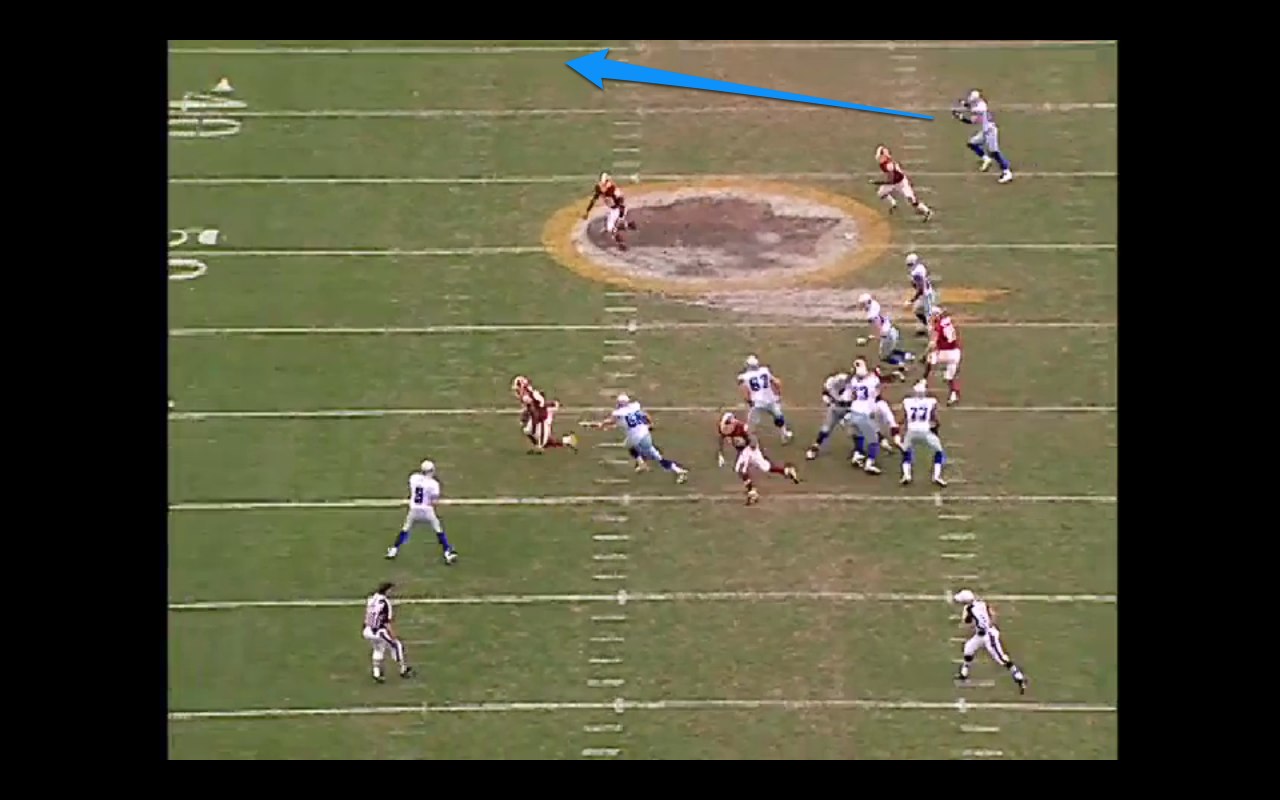
And as a player who was older than most when he was drafted (he was 25 years old when he played his 1st game in the NFL) and his speed started to diminish causing the horrible cycle of one's demise. First the wheels go, then the confidence goes to compensate for the wheels. From there, it is all "off and soft" coverage. And when the confidence goes in the NFL, it is all but over - especially on a squad that doesn't have safeties who can bail you out or offer much support nor a pass rush that can prop you up. And the Cowboys of 2010 and 2011 were not getting much safety play to say the least and too little pressure without a blitz.

So, here is one game to win the division. December has fallen apart, but with a key gut-check win in New York, all will be forgiven and the Cowboys will host a playoff game in 1 week's time.

From the moment the game began, it was pretty clear that the offensive line of the Cowboys was overmatched. Not that injuries were the only reason, but Montrae Holland did not play forcing Derrick Dockery into duty and then Kyle Kosier left with injury pushing Kevin Kowalski into the game, too. It was condition critical from the opening kick for the OL to hold off a Giants DL that got 6 sacks, but looked likely to get 6 more.

If the team was going to be able to compete, the defense would have to win the game. And they were not only beaten, they were demoralized. And Newman was on top of the list of Cowboys' suspects all night long.

Moments before the most memorable play, the Cowboys had the Giants pinned in deep at their own 5 yard-line facing a 3rd Down and 9 yards to go. The Giants were willing to concede a punt and were simply dumping a ball to Bear Pascoe in the flat to get a few more yards for the punter. Instead, with Newman meeting Pascoe 5 yards in front of the marker, Newman bailed out and went low for the legs of the plodding tight end. Pascoe, to the delight of the crowd hurdled Newman and ran easily for the 1st Down. Later in the half, fullback Henry Hynoski would also want a 1st Down more than Newman would want to stop him. Was Newman hurt? Most likely. It seemed that Newman was always dealing with some injury and it often hurt his play.

But, for whatever reason, the Giants 2 least athletic skill position players on their offense took turns beating Newman on a crucial play on their first 3 Touchdown scoring drives of a game they led 21-0. But, the play in the middle of those two demoralizing moments was the one that many of you can see in your sleep. It is Newman getting beat for 75 yards by Victor Cruz for a rather easy Touchdown that opened the floodgates.

The Play: 3-1-N26 (5:11) (Shotgun) E.Manning pass short left to V.Cruz for 74 yards, TOUCHDOWN.

Personnel: It is worth noting that on 3rd and 1, the Giants remain in "12" personnel (1RB, 2TE, 2WR) rather than switching to the normal 3rd down personnel package for most teams which is "11" (1RB, 1TE, 3WR). THe explanation is because it is 3rd and short, but the result keeps the Cowboys in a base personnel package rather than switching to nickel by replacing a LB with an extra corner.

So, the Giants put on "12" personnel, the Cowboys leave just 4 DBs on the field, preparing for a 3rd and short run. Then the Giants do what is constantly done in this chess game of the NFL - they spread you out by deploying a TE, Travis Beckum wide right against the Cowboys safety Abram Elam. Then, they put both WRs to the left, making both Cowboys' corners man-up with Hakeem Nicks (Mike Jenkins) and Victor Cruz (Terence Newman). This means Newman is left to play the slot - Something that makes him extremely uncomfortable against a player like Cruz who feeds off the slot game. Just to be clear, if the Giants moved to customary "11" personnel in this spot, they know that the Cowboys would have Scandrick on Cruz. The Giants didn't want that. So that is why they used formation and not personnel to get the match-up they wanted.

Let's look at the routes the Giants have on for this 3rd Down. It is pretty clear that their objective is simply to move the chains, not look for a big play. But, this might be one of the many cases where people (including high-ranking people inside Valley Ranch) accuse Rob Ryan of getting too cute. If a exotic defensive idea works and Eli throws an easy interception, it is a brilliant call. But, if it leads to a play that starts an avalanche, then your DC got too cute.

The Giants want Beckum to run a slant, Cruz in the slot to run a short out to the chains, and Nicks wide left to run a 10 yard stop. Very basic stuff.

Picture #1 - CLICK ON ANY PICTURE FOR ENLARGEMENT


Here is the Cowboys pre-snap plan. They are showing a single-high safety in a Cover 1 posture. But, their plan is to show that and then do something completely different. The Cowboys plan is to have Sean Lee jump Beckum's slant and for Sensabaugh to charge up the field and blow up a slant to Cruz. They want Newman to play outside leverage (line up over the receiver's outside shoulder, forcing him to want to run inside) which will force Cruz to option to an inside route (likely the slant). When this happens, the Cowboys will have 2 men on each quick route that Eli is likely to throw and the Cowboys should be in a position to blow either up.

Picture #2


At the snap in Picture #3, we already see that Newman lost leverage. Newman doesn't get lined up quick enough and Cruz crosses his face on the route with ease to the outside, and now Sensabaugh's gamble leaves him up the field with nobody to defend. Meanwhile, if any pass is completed, the Cowboys have no safeties deep. They are essentially playing a Cover 0, which means that the slightest completion can go for a Touchdown if the first tackle is broken.

Picture #3


Picture #4 shows us how badly Newman lost leverage, as now Cruz has a step on him to the sideline. Eli sees this develop and makes a quick read to Cruz past the 1st Down marker. The Giants left both a RB and a TE in to block, so there is no pressure whatsoever with 7-man protection.

Picture #4


Here is the presnap from the endzone in Picture #5. You see the Cowboys have the 3-4 base defensive look, but they are dropping Lee into Beckum's slant and Ware is not really rushing, but rather playing off the edge receiver and if he stays in to protect, Ware rushes, but if he releases, #94 must go with him. But, also look at Sensabaugh. If this is an ambush, he sprung it too early. His depth of 10 yards indicates to Eli and Cruz that something is up. He must be blitzing, because his normal depth is much deeper than that. In a world where Cruz has option routes all day (where his route is determined by his read of the coverage), it would be easy for the QB and WR to be on the same page and know how to counter this defensive look. From there, if Newman is not cheating to the sideline with outside leverage, then the Giants have a distinct advantage.

Picture #5


Picture #6 shows us the precise moment where Eli is throwing the ball. Look how out of position this play has left Sensabaugh. There is nobody behind him and he is in full sprint to try to catch the play. But, if Cruz has a 5 yard advantage on Sensabaugh and a 2 yard advantage on Newman, neither of those players are going to catch him.

Picture #6


Now the difference between a 4 yard gain and a 74 yard Touchdown is the roll of Hakeem Nicks. Nicks has Jenkins on the outside and once the 1st Down is gained, if Cruz can stay in bounds and turn it up field, Nicks might be able to spring him. He has a choice to either put a "ear-hole" shot on Newman or simply stay with Jenkins as sort of a basketball pick. He chooses to stay with Jenkins and box him out and Cruz is so fast that he just continues north and nobody came close to catching him.

Picture #7


Simply too easy the rest of the way.

Picture #8


Video of the Play


The summary is this: The Cowboys schemed themselves into a bad spot here. They perhaps were frustrated because a few snaps earlier, they had the Giants pinned in deep and Newman was abused by Pascoe. Then, Ryan rolled the dice with a very risky decision to basically go Cover 0 on 3rd and 1. Was that impatience and frustration talking? If Scandrick is on Cruz, does the same thing happen?

Clearly, this game demonstrated why Newman was overdue to be replaced. He was making premium dollars and was a liability in coverage in the biggest game of the season. Brandon Carr and Morris Claiborne were major investments and the genesis of those expenditures can be traced back to games like this one.

The team ended the year with a 8-8 record and a trail of tears that were both frustrating and inspired an offseason of moves to try to get the mix correct.

In 7 days, we will see how that has worked.

To review any of the 11 for '11 series, click on the links below:

1. The Revis Interception
2. The Home Run to Holley
3. 3rd And 21 to Dez
4. Megatron's Dominating TD
5. DeMarco Murray's 91 yard Run
6. Eagles Zone Counter Trap
7. Romo's Improv Bomb To Witten
8. Romo's Throw of the Year
9. The Hyphen Screen
10. Lost in the Lights

Wednesday, August 08, 2012

11 for '11 - #10: Lost in the Lights


The Following is the 10th in an 11-part weekly series throughout the summer that will focus on the eleven plays that shaped 2011 for the Dallas Cowboys. Every game, about 130 actual plays happen and over the course of a season that number can exceed 2,000. But, we have selected 11 and will pick one each week and break it down from standpoint of "X's and O's" and see what we can learn looking back. The plays are not ranked, simply presented as the season unfolded. We hope you enjoy.

All plays are certainly not created equal.

They are not the same and should not be treated as such. And, if you were to rank every play of the 2011 Dallas Cowboys season based on their level of importance to the outcome of the year, I would submit to you that the #1 play of the year is the one we are about to breakdown.

It is a play that has been discussed since it happened. In doing so, both the quarterback and the wide receiver have been blamed and accepted blame. They both know they could have done better not this particular play, but nothing that can be said can bring the moment back.

The fact is, on this 3rd down and 5 opportunity in Week 14 of the 2011 season, the entire league was altered by one throw that fell to the turf at Cowboys Stadium in Arlington. The butterfly effect of this play going differently - a pass thrown a bit shorter or a receiver that spots the pass a moment sooner - then the entire 2012 NFL season has a different champion and a different NFC East representative in the playoffs.

So, despite the fact that this play has been studied in depth quite a few different times since December 12, 2011, let's look at it again from a purely Xs and Os perspective and see what we can see.

As you will recall, this was a back and forth battle between two teams playing a desperate game. Neither defense seemed particularly up for the challenge of stopping the other's offense, but in particular, Eli Manning was having his way with the Cowboys secondary all day long. This was a game where Eli Manning dropped back to pass nearly 50 times and was hardly touched all night long. It was a frustrating exercise in trying to bring pressure, but the more you brought, the more you exposed your undermanned secondary that was surely not up to the task of staying with their men.

However, as the game went to the 4th Quarter, the Cowboys started taking over. Tony Romo hit Miles Austin for a touchdown to give them a 27-22 lead. Then, Sean Lee intercepted a pass DeMarcus Ware deflected and within a few moments, Romo hit Dez Bryant for what appeared to be the dagger touchdown with 5 minutes to play, 34-22.

From that point on, the only way the Giants would be able to win is if they had 4 scenarios ALL go in their favor. They would need to score touchdowns on both possessions and the Cowboys would have to get nothing on both of their possessions. Through a series of events, that is exactly what happened, including the best player on the field, Jason Pierre-Paul capping off a night that will be long remembered by blocking a Dan Bailey 47-yard field goal attempt that made it two straight weeks where Dallas had a field goal that could have won the game end up not being converted.

The Giants scored on their first possession to cut the score to 34-29. So, with 3:14 left to play in the game, this was a perfect example of why teams practice what is known in the football community as the "4 minute drill". The 4 minute drill is nothing like the 2 minute drill in which you are trying to run a "hurry up" offense to score as quick as you can. The 4 minute drill is quite the opposite. It supposes that you have a lead and are simply trying to kill the clock. In most situations, the thought that 2 first downs will win the game is there, assuming the opposition has a full compliment of timeouts. Basically, you must run the ball when the opponent knows you are running, and you move the chains and win the game. Every team needs this ability to run a 4 minute drill a few times a year.

Here, the Giants had 2 timeouts. 3:14 to go. On 1st Down, Felix Jones found 5 yards. Clock runs down to 2:30, when on 2nd Down, the Cowboys try a zone running play to the right, but Felix attempts the backside cut to find more space. Trouble is, the backside is where Pierre-Paul awaits and only Tony Fiammetta to deal with him. That did not go very well, as Pierre-Paul tossed the fullback to the side at the same time Chris Canty overpowered Montrae Holland and the play went for no gain. The Giants called their 2nd timeout, leading us to this particular moment.

The Play: 3rd and 5, 2:25 to go. Ball is at the Cowboys 25 yard line. Dallas has "11 personnel" (1 RB, 1 TE, 3 WRs) and are in the Shotgun. This is their basic 3rd Down look in almost all situations that are not 3rd and short. The Cowboys are lined up 3x1 with 3 targets to Romo's right with Witten next to RT, Austin in the slot, and Robinson out wide. Bryant is wide on the left by himself. Felix Jones is to Romo's left, which would indicate he is ready to help on JPP if necessary.

In Picture #1, we see the routes the Cowboys have called. Double slants to both outside receivers which is rather standard on 3rd and 5. These can often be easy conversions if run properly. The tight end Witten will drag across the field in another high percentage opportunity to move the chains and get the game down to its end. The lowest percentage route is basically a "go" to Austin, but it is also the pass with the largest reward because Aaron Ross has no help over the top which we will cover in a moment.

Picture #1 - CLICK ON ANY PICTURE FOR ENLARGEMENT


Also, if you look up at Picture #1, you will notice the Giants pre snap posture. They are not being mysterious about their intentions. They don't buy the premise that the Cowboys will go deep on them. They know the score and the situation and realize that conservative football 101 calls for a draw play or a very high percentage pass. They want to make that more uncomfortable and Perry Fewell calls a play that will attempt to blow that idea up. The Giants are bringing the house. This will kill any running play and if they do try a quick pass, they are going to press cover everyone and make sure the windows are very tight for Romo to attempt to find.

Below, in Picture #2, you can see that when the Giants bring both safeties, there is no way for the Cowboys to block everyone. A simple truth of football is that the defense can always bring more than you can block if they so choose. And the Giants did so choose. Circled is the unblocked man, safety 26-Antrel Rolle. He will get to Romo in very short order, so the QB knows that he is facing press man and must get the ball out quickly. He has very little time altogether. Also, when looking at this picture, it is tough not to notice that both slants look like they have inside leverage and might be inviting targets at the moment Romo is looking at Austin. But, it happens so fast that Romo quite likely made his mind up before the ball was snapped.

Picture #2


This picture clearly verifies what Romo saw. He saw Austin beat Aaron Ross with amazing ease and is on his way against a "Cover 0" blitz. Cover 0 simply means there is no safety in the deep center of the field and any completion could go all the way unless the cover man is in a position to make the tackle and Ross clearly isn't. Austin is about 3 yards behind his man and you can imagine everyone up in the Cowboys coaching booth believes they just won the game and likely the division. A good throw is a touchdown. An under thrown ball is a sure pass interference as Ross has no idea where the ball is. The only thing that can't happen is an over throw.

Picture #3


Let's go back and look at the protection scheme and see that the Giants are bring everyone. That doesn't necessarily mean they are bringing 8, because the Giants don't know the intentions of Witten and Felix. But, they will bring 8 if they both stay in, 7 if one goes out, and 6 if both release into routes. Basically, their plan is to bring more than you can block.

Picture #4


In Picture #5, you can see the protection is to slide right for everyone on the OL but Free. Free stays with JPP and then Felix Jones is responsible for the inside blitz man. This is a bit counter to what is normally taught as you don't want a free man coming from the inside, but I am quite sure the Cowboys told Free to stay with #90 after the chaos he had been causing. You certainly don't want Felix to try to deal with Pierre Paul. So, Jones gets the inside, but the Giants ran 2 guys at that B-gap, and Felix tries to get the closer threat, 57-Williams. That leaves Rolle unaccounted for and Romo has to know that and adjust accordingly. This frame also shows us that Witten appears to have leverage on his man as well. Perhaps difficult to see and a huge gamble throw for Romo because if Rolle is only bluffing a blitz, then he would be sitting on Witten's route for an easy pick (like he did in Week 17 in New York on a similar play).

Picture #5


I believe Picture #6 is the indigestion shot. You see how far behind Ross that Austin is. You see how this should be one of the easiest passes to make under normal circumstances. Of course, there is nothing normal about knowing you are about to get hit by a blitz that is unblocked on a 3rd down late in a great game with all of the marbles on the line. But, that is what the job is for Tony Romo and that is why I am sure this play has stuck with him all year. We will consider Austin's poor path in a moment, but clearly, it would be extreme homerism to not suggest this ball could have been thrown with a better distance on it. He simply put too much on the throw and missed the proverbial short putt.

Picture #6


Picture #7 is just a fraction of a second after Picture #6, but it does show the odd path Austin takes. He is fading to the sideline when there is no reason to do so. Normally, the flight of the ball would determine his path, but the ball will clearly hit next to the numbers on the field while Austin is floating laterally on this play as if the ball will lead him outside. Speculation and interviews have indicated that the ball was lost in the lights and he was guessing the ball was taking an outside path, but for reasons that are unclear and fuzzy, the precision of Austin's path the ball leaves you wanting as well. The ball lands near his feet and there was really no play on the ball in terms of diving or even outstretching. The look on Romo's face and on Austin's face after the play seems to indicate that the ball was delivered in a reasonably catchable spot. Not perfect as it was overthrown, but if Austin sees it, the game is likely over.
Picture #7


And then, the moment captured on TV, where Austin, as he is running off the field, studies the roof of the $1.2 billion dollar stadium that had betrayed him.

Picture #8


It is a play that will go down in the history books as one that got away. The Giants gambled big and were burned badly. But, the Cowboys best players let them off the hook with a poorly timed misfire. You can see the entire play by clicking here and make up your own mind on the blame game. But, no matter what you come up with, it will not make you feel any better. The Giants have a Super Bowl trophy because the Cowboys let them off the hook on this single play. The Giants have other plays in the "play of the year" category as they tell the story differently, but any Cowboys fan knows that it all should have been different.

11 for '11 series Previous Plays :

1. The Revis Interception
2. The Home Run to Holley
3. 3rd And 21 to Dez
4. Megatron's Dominating TD
5. DeMarco Murray's 91 yard Run
6. Eagles Zone Counter Trap
7. Romo's Improv Bomb To Witten
8. Romo's Throw of the Year
9. The Hyphen Screen

Tuesday, July 31, 2012

11 for '11: #9 - The Hyphen Screen


The Following is the 9th in an 11-part weekly series throughout the summer that will focus on the eleven plays that shaped 2011 for the Dallas Cowboys. Every game, about 130 actual plays happen and over the course of a season that number can exceed 2,000. But, we have selected 11 and will pick one each week and break it down from standpoint of "X's and O's" and see what we can learn looking back. The plays are not ranked, simply presented as the season unfolded. We hope you enjoy.

Parts of this post first appeared on December 8, 2011.

Blitzing, and more specifically, fire zone blitzing is a staple of the Rob Ryan defense. We have discussed this at some length in past entries, but usually it is when it works to perfection - such as the study we did when he had Buffalo all confused back in November.

But, of course, sometimes when you blitz, the other team has figured you out from their film study or they just lucked into a perfect call at a perfect moment. Regardless of how the Cardinals walked the Cowboys right into a trap on the final play of Sunday's game, the truth is on the film for all to see.

Larod Stephens-Howling is known as the "hyphen" in Arizona, and surely is one of those water-bug types that if they can get into the open field, the opponent is going to have a hard time containing him and bringing him down. Another note worth considering is that the Cardinals have a notoriously difficult time executing screen plays. Perhaps that is why the Cowboys felt that this was not going to be a major issue entering the action on Sunday.

The Cardinals are on the 1st Drive of OT, and are facing a 1st and 15 after a penalty. The Cowboys scheme for fire zones vary, but just know that it means the Cowboys are overloading their blitz to one side of the field, while the weakside edge LB will drop into a zone instead of rushing. In this case, that LB is DeMarcus Ware, and the normal genius of such a concept is that the opponent has 2 guys assigned to block #94. So, the premise is simple: Blitz more guys from one side than can be blocked, and rush almost nobody from the other-side which leaves the LT and sometimes LG just standing there with nobody to block.

From the Cardinals standpoint, if they can somehow have a play on that attacks the blitz side, it can go for miles (which it did). If they call the screen to the opposite side, Ware will be standing there and ready to devour the play as he will be unblocked.

Look at the diagram of how the Cowboys defense is to deploy in this situation on a fire zone to DeMarcus Ware's side:


And here is how it looked in presnap from the same view from the coaches film (click on any and all pictures for enlargements):

Picture #1


The Cowboys are trying to drop 2 LBs (94 and 56) into the shallow zones on either side. Of course, Bradie James is highlighted in green on the diagram (and is standing on the Cardinals logo on the film) because it is rather clear that he busts on this play and gets "caught up in the wash" as he tries to get out wide to the side that the play is about to go. With Sensabaugh and Newman in man coverage, they will have their backs to the play for most of the play, so this is Bradie's play or likely nobody. Notice Sensabaugh - highlighted below - asked to man up against Fitzgerald on this play in the slot. This is why pressure is going to be key, because the Cowboys know that asking Sensabaugh to run with Fitzgerald if Kolb gets time is a very bad idea.

Also, let's note that the defense must be aware of who is on the field at each position. A specialty player like Stephens-Howling is a wrinkle that might burn the defense if they are not prepared for it. Keep in mind, in 59 snaps before this play, Beanie Wells was the RB on 40 of them, Chester Taylor had 6 plays, and Stephens-Howling just 7. What are the keys for the linebackers when he sneaks out there? Is he a decoy? Or is he a legitimate target in a key spot? The Cowboys are about to find out.

Picture #2


Picture #3 goes along with the diagram above. Notice the drop responsibilities for Ware and James. James has a longer way to go and if the hyphen gets to the edge, there is big trouble. So, if they have the screen to his side called, there is going to be a footrace between the Cardinals fastest player and the Cowboys slowest linebacker.

Picture #3


The Cardinals do not even attempt to block Anthony Spencer which is either a horrible decision if Spencer can grab Kevin Kolb or a brilliant one if Kolb can slip past 93 long enough to dump the ball off to hyphen in space. It works like a charm. This demonstrates why mobility for a QB has almost nothing to do with "straight-line" speed and more to do with understanding how a side step can buy you another few tenths of a second.

Now, the moment that causes the issues is shown in Picture #4. Let's credit #70-Rex Hadnot, the Cardinals right guard, for getting a very impressive hold on James that keeps Bradie from getting to where he is supposed to go on this play. Holding for a split second on a screen play is often done and seldom called. But, if you can throw James off of his route to the flank by disrupting him for a moment, the damage is done. Also, we should perhaps blame Bradie for attempting to get too cute as he tries to give the impression that he is blitzing. It is a good bluff in some scenarios, but in this one it cost the game. The concept is for Bradie to occupy a blocker with his first step or two, but he has to bail before anyone can get their mitts on him because he has that entire half of the field on the defensive left. It is going to be a long run with no contact, but once Hadnot touches him, this play is doomed.

Picture #4


We can certainly question the Cowboys thinking their slowest LB could beat the "hyphen" to the edge, but they tried it and the picture below will attest to the fact that the result was ugly:

Picture #5


At the moment Picture #5 is taken, here is Picture #6 from the long angle. Look at what Stephens-Howling is seeing. He knows he will not be caught from behind and ahead he has 2 blockers for 3 Cowboys defenders. And, unless Newman can defeat his man, the only other threat is Abe Elam who is 30 yards down field. Surely, Stephens-Howling knew that this was a touchdown the second he looked downfield.

Picture #6


Sean Lee is a very fast inside LB, but at 4.6, he is no match for a 4.35 guy like Stephens-Howling. Lee diagnoses the play and peels off as fast as he can (and is actually quicker to get there than James), but he will not be able to run him down from behind. James just cannot get there in time, and as you can see, Sensabaugh has his hands full worried about Larry Fitzgerald and is running with his back to the play.


From the time of the catch, the play is doomed. The Cowboys only real hope is that Terence Newman can get around Andre Roberts to bring down Stephens-Howling near the 45. Once Newman is dealt with quite easily, it becomes a comedy of missed tackles and less-than-inspired efforts to bring him down inside the 20 which speaks to the knowledge that the game is already lost once the play goes deep inside FG range.

You can see full video of this play here.

Is it a horrible call from Rob Ryan? This is the nature of all of football. Call a blitz on 1st Down when few would expect it is a great idea when it works (a sack is a drive ender if the Cardinals are looking at a 2nd and 22)- and a horrible plan when it fails. Asking Bradie James to get to the flank in time against Stephens-Howling sounds like a very poor plan, unless you are playing the odds that the Cardinals hadn't used him hardly all day long. One does wonder how a speedy inside LB like Bruce Carter would do in the same situation, and we will get to find out in 2012.

So, perfect call against your blitz or reckless play call from Rob Ryan? It is a results-based business, so in this case, Ryan was caught with his hand in the cookie jar and his players were unable to bail him out.

This is why blitzing is a fine art. If you call it right, you cause a big play. But, one false move and you concede a game that will potentially keep you out of the playoffs. At 1st and 15, the Cowboys might force a punt from midfield and have another chance to win the game. But, in this case, it was a fitting end to a day where coaches and players alike seemed a step behind.

Next Week: The season is lost in the lights.

11 for '11 series Previous Plays :

1. The Revis Interception
2. The Home Run to Holley
3. 3rd And 21 to Dez
4. Megatron's Dominating TD
5. DeMarco Murray's 91 yard Run
6. Eagles Zone Counter Trap
7. Romo's Improv Bomb To Witten
8. Romo's Throw of the Year

Monday, July 23, 2012

11 for '11: #8 - Romo Finds Laurent Robinson


The Following is the 8th in an 11-part weekly series throughout the summer that will focus on the eleven plays that shaped 2011 for the Dallas Cowboys. Every game, about 130 actual plays happen and over the course of a season that number can exceed 2,000. But, we have selected 11 and will pick one each week and break it down from standpoint of "X's and O's" and see what we can learn looking back. The plays are not ranked, simply presented as the season unfolded. We hope you enjoy.

One of these days, we need to find the short list of Tony Romo's top throws of all-time. There is no question that what we are about to look at is his best throw of 2011, but I need to reserve judgement on his entire career before I get too carried away. But, when you talk about improvisation, vision, arm strength, and execution, this particular Thanksgiving throw has it all.

This drive put the Cowboys in a spot where they took over a football game that until that spot early in the 4th Quarter was proving to be extremely difficult. To see the entire drive broken down, I recommend you read the piece from last November that looked at the drive as a whole. It might have been the high-water mark for the offense for the entire year. It demonstrated their QB, who had a collapsed lung and broken ribs earlier in the campaign, taking a beating behind an offensive line that was susceptible to the pass rush and the blitz on a regular basis.

It also demonstrates some strategy points that go back to last week as we discussed the performance level and chemistry between Romo and his elite tight end, Jason Witten. As fans, we obsess and focus on statistical findings about a given player and how those numbers match up with his contemporaries around the sport. Surely, 90 catches is always better than 80, and so on. But, I think this play can show us an important example of what Witten does to coverages which, in turn, affects the opportunities all over the field for his mates. And this, is where Jason Garrett has a design advantage that he is crazy not to use as often as he can when looking at route combinations all game long.

This Miami win also gave Cowboys fans a result that has seemed somewhat rare in the last few seasons; one in which the team as a whole and the veteran leaders in specific had just refused to lose. Many things went very poorly in this game and mistakes were made in multitudes. But, in the end, the game was not going to be conceded. They were going to scratch and claw and get that 7th win of the season. As this game ended, with the Cowboys 7-4 after once being 3-4, it seemed relatively certain that this team was determined to fall into its same old familiar December pattern. But, we all know that it turned out that way yet again. More on that in weeks to follow.

The Play: 1-10-MIA 18 - (14:37) (Shotgun) T.Romo pass deep left to L.Robinson for 18 yards, TOUCHDOWN. Pass complete on roll P15 left by Romo; ball caught back of the end zone.

Click Here to see the play on NFL.com - And please remember to click on any of the pictures below to see them enlarged.

It is S11 Personnel, which is Shotgun, with 1 RB, 1 TE, and 3 WR on the field. They have a 3 x 1 setup to the right, meaning that they have overloaded the right side of the formation with 2 WR and a TE. The only thing threat on the opposite side of the formation at the time of the snap is Dez Bryant.

On this first picture, I wanted to overlay the routes for the play at the snap so you have an idea of what the plan is before the bullets start flying for real. They are pretty self-explanatory, but I did want to add something to Witten's description. He is really just running a basic 10 yard hook that he converts into a crossing pattern when he sees Romo break contain in the pocket. Much like last week, much of what Witten does on his routes are determined by glancing back in the pocket and knowing what his QB needs. So, know that his initial assignment is to run 10 yards and sit in an open area on a basic route he runs 10-20 times a game.

Picture #1


Miami has a coverage that appears to be man to man on the edges with a zoning of Witten in the middle of the field and a single-high safety to decide where he is needed. Yeremiah Bell is that high safety, and in Picture #2, you can see what he must read. He is not concerned with Bryant who is on a crossing pattern or Ogletree who is on the sideline. He has 2 reads which the arrows indicate: 1) Witten who is in front of him or Laurent Robinson who is headed for the post. From a Cowboys perspective, you can see the spacing here really stresses a safety. Witten is at the 5 yard line and Robinson is headed for the back of the end zone. Otherwise, they are headed in the same direction which likely is why when Romo bails out of the pocket, he wants to bail to his left which keeps those two in his throwing range.

Picture #2


Much like last week, Romo is not very confident in his protection again. There is no reason to blame him, because he has taken a tremendous beating all season long, but the clock in his head does appear to be deceiving him a bit when he feels the pass rush before it actually seems to be arriving. Kendall Langford is pushing Doug Free back into Romo somewhat, but I cannot imagine that it was enough to force Romo out of the pocket unless he was looking for an excuse to bail. By the way, again, as you look at the similarities between this week and last week's throw in Washington, it is interesting to see left tackle being the spot where Romo looks most nervous. I wonder if Tyron Smith at left tackle will settle this down in 2012.

Picture #3 shows what Romo is looking at when he does break the pocket and sets his feet going to his left. There are only 2 reads that he is considering - the same two that Yeremiah Bell is looking at. Bell, the replay will show appears to have been paralyzed by the choice and ended up covering neither. But, as Romo looks, he sees two players on Witten shallow and two more players on Robinson deep. Remember, it is 1st and 10. This might have been where he considers DeMarco Murray at the sideline or even a scramble, but clearly, he had other ideas.

Picture #3


Now, it is time to throw the ball. In picture #4, you see the throw he has to make. This is where Witten controls the coverage and allows others opportunities by his mere presence. If you are a Dolphins defensive back, where do you think Romo is going with the ball when he breaks contain? Remember, the Dolphins have been looking at the throw in Washington to Witten all week during their film study. It just happened 4 days prior. Robinson has a step on his man, but Romo has to lead him perfectly or risk an interception that would demoralize the stadium after a drive this long. What is interesting is that his throw to Robinson in the back of the end zone will have to basically go right over the head of Jason Witten and his defenders to get there. Witten might even think it is an overthrow initially, but Romo knew where he was going. When we discuss the "NFL Arm", this is what we are discussing. A 30-yard frozen rope to the sideline that must arrive on time. This, is a throw of great beauty.

Picture #4


In Picture #5, I have placed 2 blue arrows. One is to show where Robinson is when the ball leaves Romo's hands and the other is to show where the ball will be caught. The throw is such that if thrown correctly, the only person with a chance to catch it will be the Cowboys' man. And it was executed to great perfection. The only argument on this throw would be whether it should have been attempted (which only gets asked if something bad happens). From this angle, you can argue that a throw to Witten is available that would have given a 1st and Goal if it was caught. But, keep in mind, Romo doesn't have time to study each frame and analyze this all over the course of an hour. He had 5.1 seconds from snap to throw.

Picture #5


And, finally, the catch, which should not be oversold either. Robinson, for having such a short time in Dallas which included no preseason, had a wonderful knack of understanding how to assist his QB when the play breaks down. Some receivers have this knack and others don't.

Picture #6


As I was pondering this play this morning, it reminded me of a play from a few games earlier against Seattle that utilized many of the same concepts. It is a different personnel grouping, but again, the idea is to stress the safeties with a high/low cross concept that uses Witten to attract coverage and slips Robinson behind him in the back of the end zone.

Coincidentally, both of these plays from the two different games are the 2nd snap in the 4th Quarter and both end up as touchdowns to Robinson in the back of the end zone. The other players are trying to take defenders out of the middle of the field and leave Witten and Robinson for Romo to decide.

Picture #7


Now, click here to see this touchdown against Seattle from NFL.com and see if the two plays remind you of each other.

How the team seemed to be on such a good run in November but then collapsed some in December is what we must now focus on for our remaining 3 entires in this series. They had the schedule right where they wanted it until the calendar turned.

Next week, the gutting ending in Arizona...

11 for '11 series Previous Plays :

1. The Revis Interception
2. The Home Run to Holley
3. 3rd And 21 to Dez
4. Megatron's Dominating TD
5. DeMarco Murray's 91 yard Run
6. Eagles Zone Counter Trap
7. Romo's Improv Bomb To Witten

Sunday, July 15, 2012

11 for '11: #7 - Improv To Witten In Washington

The Following is the 7th in an 11-part weekly series throughout the summer that will focus on the eleven plays that shaped 2011 for the Dallas Cowboys. Every game, about 130 actual plays happen and over the course of a season that number can exceed 2,000. But, we have selected 11 and will pick one each week and break it down from standpoint of "X's and O's" and see what we can learn looking back. The plays are not ranked, simply presented as the season unfolded. We hope you enjoy.

The final 5 editions of this 11-part series take us down the stretch drive. The next 2 will be of the positive variety, and unfortunately, like the season itself, the final 3 will not turn out so well for the home team.

This week, we need to spend some time on one of the elite players of this team. Jason Witten has been so elite for so long, that the level of appreciation for his week-in, week-out play almost gets lost in all of the noise of a Cowboys season. In fact, Terrell Owens, in his most disgruntled form, tried to use his chemistry and unspoken language with Tony Romo as proof of a clique in the Cowboys locker room that keeps the Cowboys from moving forward. Most informed people had a great laugh at that nonsense, but for the most part, Witten hasn't missed a beat as his Hall of Fame career marches on.

At some point, his elite performance level will diminish as he has now passed his 30th birthday, but there seems very few signs of that right now. He has not missed a single game since his rookie year, when on October 12th, 2003, the Cowboys played the Eagles without Witten. Since then, he has played 143 straight games and has made an impact on plenty of them.

As his career has been recognized, his numbers have continued to grow. In the 5 years since Jason Garrett has run the Cowboys offense, Witten has been featured over and over again. In fact, there are 10 names in the entire NFL that have more receiving yards than he does over those 80 games: Larry Fitzgerald, Roddy White, Reggie Wayne, Wes Welker, Brandon Marshall, Calvin Johnson, Andre Johnson, Greg Jennings, Steve Smith, and Marques Colston. You will notice that there are no tight ends in that list at all. Yes, other tight ends have had bigger seasons than Jason Witten. But, over the long 5 year sample, Witten's 5,071 yards and 444 catches are enough to put him atop all tight ends. During that span, Tony Gonzalez has 4,628 and Antonio Gates has 4,405. Witten doesn't get the same praise as those two, but he does get the results.

This game, from Week 11, featured the 5-4 Cowboys trying to get their win streak to 3 consecutive wins in a division battle at Washington. The Redskins felt that they were robbed during the Week 3 battle in Arlington and now wanted to even the score back at their place. You might recall that Washington lost that game because Jim Haslett went off the coaching reservation a bit with 3 consecutive Cover 0 blitzes that finally got burned late on a Romo improv play to Dez Bryant. Why, on 3rd and 21, the Redskins blitzed everyone plus the kitchen sink makes coaches wake up in a cold sweat. But, he did, and he paid. And surely, he would attempt to right that wrong on this Sunday if things materialized.

The Redskins started 2011 with a 3-1 record (the only loss to the Cowboys), but by this day in November, the Redskins would be 3-6 and eventually end the season at 5-11 for another sub standard year of football in the nation's capital. They had many talented defensive players and a unit that can cause many issues for their opponent, but the very poor QB play has been an issue for a long stretch in Washington.

I am taking some license here at the writer to suggest that this Touchdown to Witten is the pivotal play of the game. Fans will recall that there were more than a handful of plays in this contest, including another long 3rd Down conversion to Dez Bryant in overtime (against who else? DeAngelo Hall) that put this game in the win column. But, given that this play was one of the longest touchdowns of the year and given that it features one of the central figures of this decade of Cowboys football, I elected it for this week's breakdown.

The Play: Cowboys 17, Redskins 17 - 4Q - 9:01 - 3rd Down, 8 to go. Ball at Dallas 41 - Shotgun 12 Personnel - T.Romo pass deep middle to J.Witten for 59 yards, TOUCHDOWN.

To fully appreciate what we are looking at here, one needs to understand the cat and mouse game that Haslett and Garrett have been playing in these 2 games. There are 3rd Downs and there are high leverage 3rd Downs late in games that are close and hanging in the balance. As we examine both meetings, we see that it comes down to the Cowboys being a bit better both times, but hardly due to Jason Garrett's play-calling. Closer to the truth is the improvisational skills of Tony Romo.

The other element very much at play here is the safety position of the Washington Redskins. Like their counterparts in Dallas, safety has been a bit of a revolving door over the last several seasons in Washington. Proof of that is that all 3 main players in a story from Game 10 of last season are pretty much out of the mix in Redskins-land for 2012. OJ Atogwe is now in Philadelphia, LaRon Landry is a Jet, and DeJon Gomes is buried well down the Skins roster.

But, on this day, because Landry has been hurt the week before, Gomes was being asked to cover the deep secondary as a 5th round rookie. This would be the only day where he would play an entire game all season long. And on this play, the Cowboys would attack him. Otherwise, Gomes is known for 2 things: 1) he is the guy who made the hit when Adrian Peterson blew out his ACL and 2) he is often mistaken for Robert Griffin III.

Click on all pictures to enlarge. Here in Picture #1, we can clearly identify the Cowboys S12 lineup, with Witten in the right slot, Laurent Robinson wide right and Dez Bryant wide left. In the backfield beside Romo, John Phillips is to the right and Felix Jones is to the right.

Picture #1


In the 2nd picture, we count that the Redskins are only rushing 4 and dropping 7. We will see later in the play that this is actually rushing 3 and dropping 8, because Ryan Kerrigan will peel off and chase John Phillips once Phillips releases into a route.

Picture #2


OK, inside the red circle below is the rookie safety, DeJon Gomes, filling in for the injured Landry. His responsibility is to provide over the top help to his half of the field. This will require him to read the deeper threat and either help to the inside with Witten or to assist to the outside if Robinson gets behind the corner on that side, which appears to be #34 Bryon Westrbook. Witten's curl route past the sticks (at the Dallas 49 yard line) is covered by several dropped linebackers, but as the play morphs into a sandlot play when Romo escapes the pressure in the pocket, Gomes will need to collapse down to Witten - something that he fails to read in time.

Picture #3


In the frame below, we see the moment Romo has to make his final read. He has spun to the left of the pocket because he could feel Redskins' LB and sack artist Brian Orakpo collapsing down on Doug Free. One of Romo's trademark moves as a Brett Favre cover band is to spin back against a rusher from the left tackle side. It is human instinct to try to run from a pass rush, but as a QB gains experience, he learns how difficult that can be to outrun a edge rusher who is at a full gallop as he turns the corner. Instead, you can buy more time as a QB with the risky move of spinning left when a rusher is coming from your left. The reasons this is risky are obvious - but the worst part is that you must turn your back to your receivers as you spin if you are right-handed. Now, Romo must re-find all of his targets and assess the field as Orakpo is closing down on him. He knows that it is 3rd and 8 so Romo is not considering the underneath options of Jones and Phillips who have both released when they saw the Redskins zone drop.

Picture #4


Now, let's go back to the pre snap and look at the play again from the end zone camera that the coaching staff will use to determine the roles of the pass protection group and the quarterback. The two arrows show Felix Jones and John Phillips locking on to their primary blitz pickups, or more specifically, the players that will determine their duties for this play. In the event that the nickel defense of the Redskins on 3rd and 8 turns into a blitz, Jones and Phillips will stay put. This is often called "check - release". They check those two players to see what the plan is, and then release into the flats if there is no protection required. In 2010, Chris Gronkowski was fooled on the play that Romo was injured in because he checked the LB, released, and then the LB came on a delay rush and broke Romo's collarbone. To be clear, those two inside linebackers will not necessarily be the primary responsibility of Jones and Phillips. But, rather, if those two blitz, Jones and Phillips will stay in to be a part of the protection scheme. Phillips will now chip Kerrigan - 91 who is rushing on Tyron Smith, whereas Jones will now head out the "A gap" into the middle flat.

Picture #5


Below, Picture #6 corresponds time-wise with Picture #3, above. At this point of the play, Romo has but one option that is open. That is a quick dump off to Felix Jones (blue circle). But, with the score 17-17 in the 4th Quarter, Romo is not willing to accept a punt right here if he can help it, and a dump off the Jones 5 yards short of a 1st down with 2 linebackers ready to get him to the ground. Meanwhile, we put a red arrow on Brian Orakpo, who has Doug Free backing into Romo, and he also has Romo's full attention. Whether he is in actual danger or not, Romo is now spending more time thinking about his left tackle than he is thinking about potential targets downfield.

Picture #6


OK, now Picture #7. This is a spot that there is simply no coach of a young QB that will authorize this type of evasive action. I am guessing most coaches would scold his QB for bailing out of the pocket this quickly, because fundamentally, Romo was not in so much trouble here that he had to bail out. But, he did, and because he did, this 5 yard pass from Jones turned into a 59 yard touchdown to Witten. In this picture, while Witten is using the opportunity to head for green grass that is not being watched by Gomes the safety, Romo has his chest facing the opposite end zone. But, this unconventional maneuver buys him another second, which is what the play calls needed.

Picture #7


Most right-handed QBs do not throw very well running to their left. The reason is that it is quite difficult to be able to square your body to throw to most of the field. When running or scrambling left, the only throw that is easy to pull off is to the left sideline. Otherwise, you have to square your body and that takes time and space. Romo does so in Picture #8, and this is where we discuss the rookie safety Gomes again. Picture #8 corresponds time-wise with Picture #4 and in that frame, you can see that Gomes does not make a veteran decision. This is his first game of starting in the NFL and it shows. What he should have done is realize that Laurent Robinson is no longer a threat once Romo bails to his left. That would now be classified as an impossible throw from the left flat to the deep right sideline. It either cannot be done or if it can be done, you make them prove it. Gomes had to peak up to see Romo spin left and when that happens he has to dive down on Witten quickly or this is going to be a problem. Once he doesn't, Witten knows where Romo needs him to go. This is where chemistry and unspoken knowledge of what the other is going to do comes in handy. Witten knows to convert his hook route into a deep in that is beyond the middle zone defenders. And Romo is locked on just one guy. Why? Because they know where each other will be. And that should never be described as a bad thing when a play has broken down like this.

Picture #8


In #8 and #9, you can see what else Romo is dealing with. You can see that Orakpo has now readjusted his sights on Romo and after the spin, no longer has to go through Doug Free to get to him. So, as Romo is setting his feet and squaring his shoulders, he is also seeing an unblocked Orakpo closing in at a rapid rate. The throw looks easy if you consider the blown coverage, but if you consider the fact that this throw is going to include a painful ending, it gets a little more difficult. In picture #9, the ball is gone and if Witten catches it, he will be able to run for a while.

Picture #9


Finally, in Picture #10, we see that Witten can still pick them up and put them down at a rapid rate. His foot speed, which never gets brought up enough, is still such that he can race 3 Redskins defensive backs to the end zone from the 25 yard line, and they can not catch him. Touchdown.

Picture #10


This play, which can be seen on video here is another sign that most of Romo's decisions turned out very well last season. He really played a high level, despite the fact that the network shows will repeatedly rerun those plays where he did not make sound decisions against the Jets and Lions. In fact, his last interception against the Lions in that gutting loss was a situation where he thought Witten was behind the linebackers and the safety had busted, too. But, on that play, he could not plant his feet and make a good throw so it was picked off by Stephen Tulloch.

But, when you look at Romo's best plays of the season, you see that so many of them come off plays where he makes something out of nothing. When the group of people that look forward to a new, young QB to replace Romo speak up, I wonder if they realize that the next guy likely won't have improvisational skills like this guy. I get tired of the endless discussions of his mental makeup and whether he can ever "win the big one", because so much of that is out of his control. But, in the simple talk about whether or not he can defy Xs and Os and make plays to win a game, Romo never gets enough credit for what he can do in plays like this. This was simply a QB who found a TD on a play that called for a 5 yard dump down to Felix Jones.

And it certainly helps to have a tight end who knows what to do and when to do it to offer a security blanket when things break down. Romo to Witten has been quite a combination around here for quite a while. And, no Terrell, there is nothing wrong with that at all.

Witten from Bob Arnold on Vimeo.


Next week, another Romo improv gets an amazing TD against Miami.

11 for '11 series Previous Plays :

1. The Revis Interception
2. The Home Run to Holley
3. 3rd And 21 to Dez
4. Megatron's Dominating TD
5. DeMarco Murray's 91 yard Run
6. Eagles Zone Counter Trap

Wednesday, June 27, 2012

11 For '11: #6 - The Eagles Zone Counter Trap

The Following is the 6th in an 11-part weekly series throughout the summer that will focus on the eleven plays that shaped 2011 for the Dallas Cowboys. Every game, about 130 actual plays happen and over the course of a season that number can exceed 2,000. But, we have selected 11 and will pick one each week and break it down from standpoint of "X's and O's" and see what we can learn looking back. The plays are not ranked, simply presented as the season unfolded. We hope you enjoy.

"Clearly, they are confused out there" - Cris Collinsworth

One of the biggest issues for the 2010 Dallas Cowboys was a complete inability to stop the big play. So, the plan for 2011 was to not change players on almost any level defensively, and to change out the defensive philosophy from the Wade Phillips 3-4 defense to the Rob Ryan 3-4.

The Rob Ryan 3-4 is a more complex defense that attempts to utilize all resources to cause confusion, chaos, and the ability to cause game changing plays for the defense. When run properly - with the proper personnel - it is a rather tried and true scheme that has worked well across the NFL. Of course, the Cowboys tried to take 10 starters off the worst defense in the history of the Dallas Cowboys and simply change the scheme and hoped for much better results. They learned the hard way and spent the spring of 2012 trying to find what amounts to as many as 5 new starters for this upcoming season.

In 2011, Ryan tried to install his defense without the benefit of the offseason program. We will never know how badly that set things back, as some players and teams were affected by the lockout and others seemed to do just fine (see: Cam Newton) with the limited schedule for installation and learning. What is odd about the 2011 Cowboys defense is that it defied conventional wisdom. Most observers expected the transition to the defense of Ryan to go slowly. There would be early growing pains, but as the season went along, he would be able to install things on the fly and ultimately by Thanksgiving everyone would would grasp their responsibilities with great ease.

And yet, everything went quite the opposite. In September and October, the Cowboys defense was actually outperforming expectations. In every game, the defense had done its job to put the team in a position to win. They played well enough to win in New York, but were sabotaged by a poor QB decision. They won in SF and against Washington. They played very well against Detroit until the offense turned a 27-3 lead into a 27-17 lead on two throws. By the time the defense took another snap, they were back on their heels. Then, a very difficult test in Foxboro went very well. The defense scratched and clawed and did a great job over 60 minutes, but couldn't stop Tom Brady late. Still, they outperformed all expectations in that difficult spot. The next week, they dominated a feeble Rams side and were among the league leading teams in many defensive metrics. Including a major downturn in the number of explosive plays conceded.

In 2010, the Cowboys surrendered 69 explosives (plays of 20 yards or more). That number was high above the league average for playoff teams of 54. If they wished to get in the playoff mix, they would need to knock their per game average down by 1 explosive per game. From 4.3 per game to around 3.3. And through those first 6 games, they had done even better, surrendering just 19 explosives in 6 games (3.2 per game).

But, their 7th game of the season would be their first battle against one of the two elite teams inside their division. They would play the Eagles in Weeks 8 and 16 and the Giants in Weeks 14 and 17. Then, and only then, would the Cowboys know their true ability to deal with those teams that would stand in their way. Sadly, the findings would be quite disconcerting.

By the end of 2011, the Cowboys would have improved in the big play defense, dropping from 69 to 64. In fact, the league went the other direction, with the average number of explosives conceded by playoff teams rising from 54 to 64. This, one might note, was a direct result of the putrid defenses in New England and Green Bay that were not bad enough to keep either team from making the playoffs, but might have been the reason that both were beaten ultimately by the Giants in the playoffs. They conceded absurd numbers of big plays, but had offenses that were able to cover for them for most of the year.

Regardless, the Cowboys still gave up too many big plays. Of the 64 conceded, 57 were through the air and 7 on the ground. This might explain the offseason initiative to overhaul the secondary. One might argue the pass rush needed help, too, but nobody can debate the premise of finding two potentially elite corners in the offseason if you have given up 57 passes of 20 yards or more in 1 season.

Which leads us back to the NFC East. Perhaps the most troubling number when digging into the 2011 defensive season were the issues that the Cowboys had with the division. In 6 games against the division, the Cowboys gave up 33 explosives. In the other 10 games against everyone else, they only allowed 31. That tells us a few things. Outside of the division, the Cowboys played some rather weak offenses. But, inside the division, they were sliced and diced by the Eagles and Giants in a scary way. The Redskins put up 8 explosives, the Giants had 12, and the Eagles put up 13.

And no night was a bigger disaster than the Sunday Night in Philadelphia on October 30th. Realizing that this series is about "11 plays that shaped 2011", it would be nice to identify one play from this debacle. But, the truth is, the Eagles didn't have one play that decided the game. They had as many as they wanted.

You might recall that Rob Ryan had some pretty inflammatory things to say about the Eagles in the build-up to this game. And therefore, many of us rubbed our hands together to see what sort of Ryan family game plan he would unleash in his Dad's old city. But, what we saw was one of the worst Cowboys performances in a long time. The Eagles had a season high 7 explosives. They had 10 different plays of 18 yards or more. They knocked out the Cowboys in the 1st Quarter, and by halftime, the game was in garbage time.

And the worst part? The Eagles were doing much of their damage by running the same plays over and over again. Now, remember that their were only 7 running explosives all year against the Cowboys. And yet, 3 of them, were on this night in Philadelphia. And all 3 of them, were to LeSean McCoy who was breaking off a 30-carry night for 185 yards. And, all 3 of them were on the EXACT same play.

Let's look at it:

Play #1 - 12:57 1st Quarter - 2-7-Phi 46

The Eagles are running a zone play to the right. They will get a right slanted block from every member of their offensive line. DeMarcus Ware will be unblocked - or so he thinks - as LeSean McCoy will take the handoff from Michael Vick. The Cowboys in pre snap are seeing the Eagles set up for a strong-side run right, too. And therefore you can see a safety sneaking down to cover the tight ends. Clay Harbor - 82 is in motion on the right side and the plan will be for him to go all the way across the line and get the unblocked Ware in a trap situation. (Reminder: Click on any picture to enlarge)


The play hinges on 2 things happening for the Eagles to get anywhere. 1) - Clay Harbor has to get to Ware before Ware destroys the play. But, the premise of not blocking him is to encourage Ware to "take the cheese" and to in some ways take himself out of the play by heading too far into the backfield. Whether he realizes it or not, Ware is the only defender who is in any position to protect the cutback if McCoy doesn't follow the action of the offensive line to the right. And 2) - Jason Peters, the Eagles LT must move Marcus Spears out of the lane. If Spears can hold his ground or defeat Peters, this play won't get much. But as you begin to see in this photo below, Spears is certainly not close to standing his ground. Just looking at the hash marks, you see how easily Peters is able to truck Spears and build a wall for McCoy to see. Now, Ware is upfield and Harbor hardly touches him, but he doesn't have to, since Ware has over-pursued and taken himself out of the play. And look at all of the green grass for McCoy to navigate.


By the time of this 3rd picture below, McCoy is by himself looking at both Cowboys safeties as the only players left on the field. The rest of the defensive line was plowed out of the picture and now he will grab an easy 21 yards on a play that they would run again very soon.


Here is the exact same play, a bit later:

Play #2 - 3:37 - 1st Quarter - 1-10-Dal 36

OK. It is one possession later. The Eagles have the Cowboys on their heels and confused. And the Eagles are going to come back to that very same play to see if the Cowboys have a better plan. The only difference from a Philadelphia standpoint is that there are not double tight ends stacked to the right. Instead, Brent Celek-87 is the single TE and his motion to the right sets the trap again. Dallas, seeing a more balanced formation, does not overload to the offense's right, but instead is ready to bring Abram Elam as a blitzed to the outside of DeMarcus Ware. So, the Eagles will purposely not block Ware again - but the trap will be headed his way. Meanwhile, there is no accounting for Elam. He is unblocked and will have a chance to destroy this play. Both Ware and Elam are circled in blue. Remember, zone play to the right, with McCoy looking for a seam to cutback left. He takes one step with his offensive line, and then darts off the back shoulder of the left tackle.


So, remember the two keys for the Eagles. 1) - Celek must get a piece of Ware and have leverage so that Ware cannot get back to the inside in that split second where McCoy is arriving with the ball, and 2) - Peters vs Jason Hatcher. If Hatcher can stand his ground, the play cannot cut back. But, Hatcher is plowed out of there with no effort whatsoever, and there is enough room for the Queen Mary on this play. Elam totally takes himself out of the play by guessing it might be an outside running play. When it is a quick hitting run up the middle, the Cowboys are doomed.


In the photo below, I have circled Elam and Jason Hatcher. I just want you to see the body position of Hatcher as his back is facing the ball carrier. He is totally turned around. The middle linebackers follow the offensive line's movement to the right, but the ball carrier is not. That is a very bad combination for the Cowboys. And, once Ware is taken out by a tight end again, with Elam further outside taking himself out of the play, the Cowboys have called a run blitz that attacked the wrong spots. And McCoy is doing nothing more than taking candy from a baby.


Sensabaugh will catch him before the goal-line, but not before a 34 yard run.


So, the Cowboys have taken the bait twice. Surely, the Eagles will run this play again before the night is over. Will the Cowboys be more prepared?

Play #3 - 4:11 - 3rd Quarter - 2-18-Phil 34

Again, this is the same play, however, this time, the Eagles will flip it and zone left with the tight end kicking out to the right side to get an unblocked Anthony Spencer.


The Eagles again have double tight ends to off of their left tackle. So, the Cowboys are lined up to deal with that. In fact, if the Cowboys don't cheat to that side, there is likely a call at the line of scrimmage to run the play left. Then, if the Cowboys do shift, they come back with this cutback. We are also reminded on this play how middle linebackers get their keys on where a play is headed. They always take hints from the offensive line and most specifically, from the guards. So, you can see from watching Keith Brooking-51, how tempting it is when you see the entire OL zone blocking to the left to take a few steps in that direction, because we always anticipate that the running back is going to follow his line. But, when the Eagles show us that it is all a deception game to get the Cowboys to over-pursue, Dallas just cannot resist the urge. See Spencer, again, unblocked.


Spencer sees Clay Harbor coming to get him again and turns his body to keep contain. Jay Ratliff is easy caved in and cleared out of the way by the right guard. The right tackle goes to get Bradie James. This leaves Brooking (inside the blue circle above) as the unblocked man who must get McCoy or the Cowboys are in trouble.


Brooking is there, but with too much open space around, it doesn't take a quick player like McCoy much effort to leave a slower LB like Brooking in the dust. This, in a few frames, demonstrates the Cowboys hopes that Bruce Carter's speed can make a real difference moving forward. Look how far back Brooking is as McCoy is now 10 yards down field, and spots the 2 Cowboys safeties another 10 yards back. No wonder he had 185 yards. We just showed you 3 carries where he found 77 yards on the same play without much resistance at all.


The Cowboys did not have much trouble stopping big runs all season. Remember, these 3 plays are bad, but they are 3 of the 7 explosive runs all year long. This was a horrid night, but it did not repeat all year.


But, the bigger issue goes back to the NFC East. If you are the Cowboys, you simply must look closely at the 6 games you play each year against the division as the biggest priority. Entering 2012, you have the Giants and Eli Manning who routinely score in the mid 30's against you. You have the Eagles, who have so much speed at the skill positions that you simply must adjust and find equal speed to stop them. And now you have the Redskins, who appear to have a QB who actually has more explosive physical tools than Michael Vick. When you 3.1 explosive plays per game to teams outside the division, but 5.5 explosive plays per game against divisional foes, you can understand the initiative to change or die.

Just as we have seen time and time again, you have to survive your division if you wish to go further. The Cowboys were 2-4 in the NFC East in 2011 and were blown out in their two prime time road dates at Philadelphia and at New York. These games are huge and the organization cannot step forward without handling this business. On these plays, the Cowboys were simply out schemed and out manned. The defensive ends were caved in 3 times in a row. The LBs and DBs offered no support. And the Eagles, like a 6th grader playing Madden, just called the same play again and again.

I trust this game is talked about quite a bit inside Valley Ranch when they were making changes this spring. Let's hope they made enough of them.

11 for '11 series Previous Plays :

1. The Revis Interception
2. The Home Run to Holley
3. 3rd And 21 to Dez
4. Megatron's Dominating TD
5. DeMarco Murray's 91 yard Run