Showing posts with label 2015 Cowboys. Show all posts

Tuesday, July 12, 2016

Cowboys Defensive Film Study Summer Project - Part 4

WEEK 13 - GREEN BAY

All hands were on deck again in Green Bay, now with four games to play.  The Cowboys put up an amazingly silly offensive performance that saw 12 possessions only advance to their own 40 yard line on 2 occasions.  They got nothing done at all, which left the defense on the field all day long.  The Packers ran 81 plays for 435 yards and an mauling 230 yards on the ground, despite having their own massive offensive issues in the passing game where Dallas held up very well.  Basically, the Cowboys stayed in Cover 1 (out of a Cover 2 shell) and then the Packers responded by taking what they could on the ground and only passing as a change-up.

Green Bay (like Atlanta) employed the physical FB right at the LBs and this is a game where the Cowboys were certainly accused of being to light up front to stop a big rushing attack.  It didn't help that by December, Sean Lee and Rolando McClain looked beat up and physically worn down from the long year of ground and pound.  Meanwhile, Claiborne left he game again injured, which took Byron Jones from FS back to corner, and Wilcox or Jeff Heath played deep in the 2nd half.  Time of possession was 38-22, GB, and the Cowboys just looked beaten up by their own offense's incompetence.  It truly felt like the last game of the season with 3 pre-season games to follow.

COVERAGES - The Cowboys wisely dedicated all troops to the run (it also was rainy and cold) and forced Aaron Rodgers to try to sort through some Cover 1 Robber most of the day.  It worked pretty well, as the Cowboys were only really beaten in the air by a few well-timed screen plays to RBs.  40 pass play situations with Cover 1 - 26 times, Cover 3 - 9 times, and Cover 2 zone on 5 change-ups.  It should be noted the Cowboys used a ton of Cover 2 shell to disguise their Cover 1/3 intentions.

Season totals through 13 games - Coverages in 479 pass plays: 235 in Cover 1 (49%), 120 in Cover 3 (25.1%), 11 in 2-Man (2.2%), 112 in Cover 2 (23.3%), and once in Cover 0.

WEEK 14 - NEW YORK JETS

The Cowboys played the Jets on a Saturday Night without Mo Claiborne (Again) and without Rolando McClain who fell late in the 4th Quarter of the Green Bay game.  That means Hitchens would play the mike LB and Byron Jones would head back to cornerback, meaning Wilcox and Church would handle the safety spot again.  Terrance Mitchell ended up playing the slot corner spot and grabbed a very rare Cowboys interception.  The game was more of the familiar theme of the team getting beat in the turnover game, the offense providing very little, the defense being on the field too long, and then conceding a 4th Quarter collapse that resulted in losing the lead late and the game at the end.

They tried to key on the run (plenty of 3 LB sets with Wilber at the SAM after many games where that position hardly gets on the field) and send the extra safety (Church) down at Chris Ivory and actually did a nice job there.  Behind it, it was pretty clear they weren't trusting the team to stay in Cover 1 much, and therefore tried the safer Cover 3.  Unfortunately, Brandon Marshall and the gang knew how to kill Cover 3 all day (with outs and posts), so eventually, they played more Cover 2 which then gave up plays underneath to tight ends.  They simply did not have their first choices at pretty much every spot except Carr.  DeMarcus Lawrence continued his growth with some really impressive run stops, and Hitchens performance was uneven at the mike as I don't know that scraping is his forte and shedding is no picnic, either.  He will run with guys, but power seems to lack at point of attack.  The defense is really running on fumes now and they are getting work for many players just added to the roster in the secondary.  There was a major mix-up late in the game that cost them the win when coverages were confused and it appeared Byron Jones took the blame for the bust.

COVERAGES - Ryan Fitzpatrick passed for 299 yards and aside from his one error in judgement had a very efficient and impressive night.  44 pass plays situations - Cover 1 - 13 times, Cover 3 - 14 times, and Cover 2 zones the other 17 plays.

Season totals through 14 games - Coverages in 523 pass plays: 248 in Cover 1 (47.4%), 134 in Cover 3 (25.6%), 11 in 2-Man (2.1%), 129 in Cover 2 (24.6%), and once in Cover 0.

WEEK 15 - AT BUFFALO

The Cowboys went to play Buffalo with no Mo Claiborne (who had now been shut down for the year) and no Jeremy Mincey.  No Claiborne combined with the fact after Byron Jones had a major bust late against the Jets meant that they were going to stick him in his now permanent home at Free Safety once and for all.  Of course, that meant that they were going to have to play 29 Deji Olatoye and 21 Terrence Mitchell full time for the remainder of the year because they had no Claiborne, and had already released Tyler Patmon and Corey White into the wild.  Perhaps because of this, the Cowboys broke from their season-long tendencies of using Cover 1 as their primary coverage (or the fact that they were dealing with a Buffalo team that loves to run the ball and features a QB who is a dual-threat.  Cover 1 is not great for stopping the run, so on this day there was a full compliment of zones (Cover 2, Cover 3) behind the fronts.

This game also featured the Cowboys playing with 3 LBs for most of the time on early downs which would also break tendencies where the Cowboys were in nickel almost 70% of snaps all season long. This would also be in the mix for the best game of Sean Lee's 2015.  He had several - all seemed to be on the road - and returned to the top of the Cowboys defender rankings.  He was simply superb in scraping and blowing up run play after run play.  The team also grabbed multiple takeaways for only the third time of the year (at Philadelphia, at Tampa Bay).  But, the story of the game for the defense would have to be collapse late in the 4th Quarter where because of no offensive support, they had to deal with a long drive where Buffalo pretty much just ran it right down the field for the win.

COVERAGES -  with 28 pass situations: Cover 1 - just 3 times the whole game, Cover 3 was 12 times, and Cover 2 was the other 13 (although 2 of those 13 were 3rd and long prevents that looked more like 4-4 zones.  They butchered one of these badly, allowing a pass to the sticks on 3rd and 19 or so - it looked like Olatoye.

Season totals through 15 games - Coverages in 551 pass plays: 251 in Cover 1 (45.5%), 146 in Cover 3 (26.5%), 11 in 2-Man (1.9%), 142 in Cover 2 (25.8%), and once in Cover 0.

WEEK 16 - WASHINGTON

The final week of a disastrous year is not a great place to get a feel for a defense.  This had all the trimmings of a "let's just get this over with" performance from the entire roster.  But, in the interest of properly cataloging all 16 games, here are the notes.

First, Barry Church, Sean Lee, and David Irving joined Mo Claiborne in street clothes.  This kept the 2 backup corners on the field at all times and Kyle Wilber got a lot more play at the SAM with Hitchens playing the Will for Sean Lee.  The defense looked positively lost throughout and were sliced up by Kirk Cousins and Colt McCoy.  Combined they had about a perfect performance with a passer rating of 151 and a ridiculous yards per attempt of 10.8 per play.  All told, the defense gave up some season highs in many categories and they looked absolutely lifeless.  The Redskins scored touchdowns on drives of 2 plays, 3 plays, 8 plays, and 3 plays.  In other words, there were big plays on blown coverages all day long.  Tackling was poor and this team looked like it already left for vacation.

COVERAGES -  In 26 passes, they returned to the trend of Cover 1 the majority of the time (18), Cover 3 on 4 occasions, and Cover 2 on 4 others.

Season totals through 16 games - Coverages in 577 pass plays: 269 in Cover 1 (46.7%), 150 in Cover 3 (25.9%), 11 in 2-Man (1.9%), 146 in Cover 2 (25.3%), and once in Cover 0.

Sunday, July 03, 2016

Cowboys Defensive Film Study Summer Project - Part 3

WEEK 9 - TAMPA BAY
No Sean Lee in this game due to his concussion at the start of the 2H vs Philadelphia.  Scratches were 23 White and 99 Russell.  This game was another frustrating trip through an inept offense putting a beat-up defense on the field repeatedly with no offensive scoring support.  The Cowboys allowed an unreal 5 drives of 8 plays or more to a rather weak offense which demonstrated an inability to get off the field.  There were a few takeaways and a few sacks, but Tampa was able to get 327 yards by pretty much just finding Mike Evans and throwing him the ball.  Otherwise, there was virtually no real threat on the ground and Jameis Winston was inaccurate for much of the day.  The Cowboys also lost Morris Claiborne at halftime who was being victimized by Evans - especially out of Cover 3 - and left due to a hamstring that would keep him out for a month.  Jeff Heath played more than usual and was good.

COVERAGES - The Cowboys really mixed up coverages after a majority of Cover 1 vs Philadelphia.  Tampa played more run groupings and the Cowboys faced 44 pass plays with the coverages divided between Cover 1 (15), Cover 3 (13), and a real uptick in Cover 2-Zones (16).  When in dime in the 2nd half, there were 4 safeties and 2 corners, which might have been showing how they really had no other extra corners besides Byron Jones.  Jones played in every spot in the secondary and was really solid at all of them.  The Cowboys also had 3 other chances at takeaways in the 2Q, 3Q, and 4Q and perhaps could have won had they gotten any of them.

Season totals through 9 games - Coverages in 336 pass plays: 162 in Cover 1 (48.2%), 86 in Cover 3 (25.6%), 11 in 2-Man (3.2%), and 77 in Cover 2 (22.9%).

WEEK 10 - MIAMI

No Morris Claiborne who was lost in the Tampa game at halftime.  Sean Lee returned.  Scratches were 49 Nzeochoa and 99 Russell.  This game was the return of Romo and everyone had a skip in their step.  It also helped that Miami appeared nearly helpless in the passing game throughout.  Dallas opened in a ton of Cover 1 and the Dolphins tried to run against nickel with 6 bigs but eventually had to throw and when they did they did not beat Cover 1 early.  Eventually, Tannehill hit Jarvis Landry and Ken Stills deep both over Byron Jones at corner (for Claiborne) and the Cowboys decided to move more to Cover 2 options in the 2nd half when they had a lead.  Also, there was at least one sweep against Cover 1 where the Cowboys got outflanked with the corner (Carr) turned his back.

The defense was dominant versus 3rd Down (1-10) and dominant in yards against (210).  They also went and got the ball with a Pick 6 and also found 3 sacks.  There was reason to believe the season was turning in this game.  Rolando McClain was very good.  Byron Jones demonstrated the first signs that he might be a better FS than a corner.  David Irving showed signs at DE.

COVERAGES - The team faced 30 passing plays and were in Cover 1 14 times, Cover 3 just 3 times, and Cover 2 variations for 13 times including 11 out of 16 situations in the 2nd half when they had a lead.

Season totals through 10 games - Coverages in 366 pass plays: 176 in Cover 1 (48.1%), 89 in Cover 3 (24.3%), 11 in 2-Man (3%), and 90 in Cover 2 (24.6%).

WEEK 11 - CAROLINA

No Morris Claiborne again.  The Cowboys were playing a red-hot Panthers team that did not need help from a generous turnover-prone Dallas offense, but they received it.  Many interceptions were thrown and 2 for touchdowns put this game in the loss column without any assistance from the defense.  However, it should be said that the defense was very, very poor on this day and perhaps best exposed to be a bit too light up front to deal with a physical rushing attack.  When the Cowboys went nickel, the Panthers were determined to run into a light box and Dallas was never able to slow it down.  They tried to play a nickel with 3 safeties with Heath joining Church and Wilcox, but the Panthers barely had a single short drive.  Every drive was either 8 plays or a scoring drive or both.

The Cowboys moved to a ton of Cover 3 early to make sure that they were not in man with their backs turned to Cam Newton on passing plays.  This is a departure from the normal zone-read offenses, but Newton is a far bigger threat than Bradford or Tannehill to run.  The Cowboys did not get very positive performances from many.  They faced nearly 40 runs and just could not get off the field on 3rd down.

COVERAGES - 33 pass plays (most in the 1st half before the score got way out of hand.  The Coverages normalized as the game went on, but was heavy Cover 3 early.  Cover 1 - 14, Cover 3 - 11, and Cover 2 zones - 8.  Newton didn't throw much, but hit 4 different passes for 24 yards or more that were all quite deflating.

Season totals through 11 games - Coverages in 399 pass plays: 190 in Cover 1 (47.6%), 100 in Cover 3 (25.1%), 11 in 2-Man (2.7%), and 98 in Cover 2 (24.6%).

WEEK 12 - AT WASHINGTON

All Hands were on deck for this Monday Night matchup in Washington. The Cowboys were going to continue life without Tony Romo again and that led to the shoulder slumping Matt Cassel return. But, the defense was up to the task for the most part and dominated early with a very high number of blitzes and a streak of 5 consecutive punts from the Redskins to open the game. The most interesting attributes in this game were the constant blitzes of Barry Church and trying to get him more proactive in the game. He sometimes appears a decoration on the defense with no perceivable impact in some weeks, but when they deploy him to attack, he seems better for it. He blitzed about 6 times and came up with some splash plays on three occasions. This was also a great look at Byron Jones at Free Safety on a more regular basis and it sure appears between this game and the Seattle game that this is his best fit. Greg Hardy was a load - especially against the run, and it should be noted that the center turns to his side quite often, making us wonder how much more attention Crawford and Lawrence will receive in his absence in 2016.

On the negative side, this was a very poor return by Mo Claiborne. He was very poor against Tampa, left with an injury, missed Miami and Carolina, and now returns against Washington. If he was still hurt, then we will cut him some slack. But, really, his great start has been cancelled out with Jameis Winston and Kirk Cousins both picking on him. Zone or man, it doesn't matter. He is being targeted. I recall his verbal jabs about too much zone and not enough man early in his career, but there are just too many times where he is asked to run with a player and he gets lost. His confidence looks low and he is attacked, including an ill-advised sequence late where he was in cover 1 against DeSean Jackson and a simple Go route was the game-tying touchdown.

COVERAGES - The Cowboys faced 40 passing sequences in this game and went Cover 1 on 19, Cover 3 on 11, Cover 2 zone on 9, and Cover 0 for what I believe was the first and only time of the season at 11:23 in the 1st Quarter.

Season totals through 12 games - Coverages in 439 pass plays: 209 in Cover 1 (47.6%), 111 in Cover 3 (25.2%), 11 in 2-Man (2.5%), 107 in Cover 2 (24.3%), and once in Cover 0.

Tuesday, June 28, 2016

Cowboys Defensive Film Study Summer Project - Part 2

WEEK 5 - NEW ENGLAND 

No Gregory - Otherwise this is the full defense as planned in training camp.  Greg Hardy and Rolando McClain play their first action of the year and are used liberally to start.  The game featured the Cowboys taking off a linemen to allow most of the game in the dime defense to feature a 3-2 in front of it with Hardy, Crawford, and Lawrence as the front with Lee and McClain behind it.  The Cowboys rushed all 5 at times with this alignment and actually were quite impressive with 5 first half sacks.  Hardy was very effective off the RDE spot.  In the 2nd half, the Cover 1 spread out attack ran into repeated pick plays and rub routes which put the Cowboys in space.  In particular, 24 Claiborne was attacked repeatedly down the field and 42 Church underneath trying to deal with Dion Lewis.  Also, Claiborne and the secondary were exposed with the edge contain on multiple run plays leading to issues.  As the game went on and the offense proved hopeless, the Patriots started to figure out the Cowboys defense and put on a clinic starting with about 5 minutes left in the 2nd Quarter.  It ended up being a bloodbath.  Byron Jones was locked on Gronkowski all day and did a fine job against a much bigger opponent.  JJ Wilcox was again late on many plays and is now so deep that there is no chance he is going to jump a play in front of him.  Is he being coached this way?

COVERAGES - The Cowboys were in 32 pass situations against Tom Brady and basically ran Cover 1 all day with actually man coverage across the board, and then as many as 3 shallow robbers underneath trying to take away Brady's initial quick pass offense.  20 times in Cover 1, 6 instances of Cover 3 (all in 1st half), and 6 of Cover 2.

Through 5 Games – Coverages in 193 pass plays: 90 in Cover 1, 39 in Cover 3, 11 in 2-Man, and 53 in Cover 2.

WEEK 6 - AT NEW YORK

Gregory is back so pretty much all hands on deck for this 2nd meeting with the Giants.  They did scratch Tyler Patmon for Corey White as they try to figure out how to live without Orlando Scandrick on the fly.  This game was one of the best defensive performances from the Cowboys all season, but it might be partially because the Giants were never too aggressive on offense.  The Giants ran the ball, they completed a few big plays at big moments, but for the most part were nothing to write home about at all.

The issues started to creep up though that would be the theme of the season - no takeaways, although they had a chance or two again (Byron Jones INT), and the offense sabotaging them to no end (and a KO return for a touchdown to Dwayne Harris).  It was remarkable how badly the offense and Matt Cassel played in the 2nd half and that means the defense would get more and more frustrated as they felt the game slipping away.  They did great on total yardage (less than 300), great on 3rd downs, and yet there was very little to show for it.  Jack Crawford did well, Byron Jones was great.  Rolando McClain started to look very poor.  And the safety position had all sorts of mixing and matching with 27/42 broken up for Byron Jones high and than a small amount of Jeff Heath.

COVERAGES - The Cowboys were in 28 pass situations against Eli Manning and it was almost completely Single-high safety to try to get that extra man down against the run and to flood the intermediate zones.  14 times in Cover 1, 11 times in Cover 3, and 3 times in Cover 2 zone.

Through 6 Games - Coverages in 221 pass plays - 104 in Cover 1, 50 in Cover 3, 11 in 2-Man, and 56 in Cover 2.

WEEK 7 - SEATTLE 

All hands are available in this one.  This is a pivotal home game in which the Cowboys are going to be an substantial underdog.  Unfortunately, they did not play that way and their conservative offensive style and lack of any sort of playmaking made this a very frustrating day for the defense.  They really battled their rear ends off and got really big performances from many.  Greg Hardy might have played his best game for the Cowboys - he was great and also grabbed an interception on an exceptional play.  Byron Jones was good again.  DeMarcus Lawrence was very good.  They did a wonderful job against the Seattle running game limiting them to 3.6 yards per carry all day.  And Seattle's passing game was nothing special for the most part.  The Cowboys defense played about as hard and as well as they possibly could.  They even blocked a FG in the 4th Quarter to fight their tails off to the end when Seattle finally broke through.

It did appear that the Cowboys wanted to run a ton of single-high Cover 1 and Cover 3 on this day.  Seattle started sniffing out the Cover 3 and were attacking it as you would expect Seattle would given that this is basically a coverage that they have created and perfected.  The 2nd Quarter TD drive - their only one of the day - was a clinic on this with a lot of the attack centered on Claiborne and a little on Church underneath.  Rolando McClain was horrendous and looked like he should be replaced throughout the day.  Maybe hurt, but just substandard play all afternoon.

COVERAGES - The Cowboys faced 30 pass situations against Russell Wilson and the Seahawks and were in a Cover 1 or Cover 3 on 29 of those 30.  They had one Cover 2 late in the 1st half.  Otherwise, Cover 1 - 15, Cover 3 - 14.  So, it was a very vanilla day where the 2nd safety was up to stop Marshawn Lynch.  It worked pretty well, too.

Season totals through 7 games - Coverages in 251 pass plays:  119 in Cover 1 (47.4%), 64 in Cover 3 (25.4%), 11 in 2-Man (4.3%), and 57 in Cover 2 (22.7%).

WEEK 8 - PHILADELPHIA 

A rematch of the week 2 battle where the Cowboys looked like world beaters on defense.  They absolutely dominated the first game and then started this game with all sorts of effectiveness.  This game was more of the same early, but for numbers reasons, the Cowboys pretty much stayed in Cover 1 for the majority of the game.  When you play Cover 1 (usually with a LB as a robber), you make things pretty easy for an offense to work against.  They know what you are doing and they have also watched the Saints and Patriots (Giants and Seahawks, too) just run rub routes over and over until someone gets free on a high percentage shallow cross.  It happened a lot on this particular occasion and the Cowboys did not find success as the game wore on.  Sam Bradford looked about as good as he ever has against the Cowboys in this game.

The Cowboys did great against 3rd downs, but no takeaways and no real stops as the Eagles racked up 459 yards and 8 explosives (plays of 20 yards or more) which probably was the most the Cowboys gave up all season long.

Sean Lee was lost early in the 3rd Quarter with a concussion and the game went down hill from there.  Andrew Gachkar and Anthony Hitchens were repeatedly attacked.  Gachkar also looked to struggle with run fits on a few occasions.  Wilcox with another poor angle on the winning touchdown.  No real pass rush to speak of.

COVERAGES - The Cowboys were in pass coverage on 41 occasions.  It was mostly Cover 1 (28), with some Cover 3 mixed in on 3rd down (especially) - 9, and Cover 2 - 4.

Season totals through 8 games - Coverages in 292 pass plays:  147 in Cover 1 (50.3%), 73 in Cover 3 (25%), 11 in 2-Man (3.7%), and 61 in Cover 2 (20.9%).

Wednesday, June 01, 2016

The 2015 Cowboys Defense - Splash Play Final Results

http://sportsday.dallasnews.com/dallas-cowboys/cowboys/2016/06/01/bob-sturm-2015-cowboys-defense-splash-play-final-results

About 5 years ago, I was talking with some defensive-minded football sorts about the issues with statistics when it comes to that side of the ball.  The sport is based on numbers, but the exercise of any defensive player is to be 1 of 11.  Everyone do your job.  And often times, that job is a thankless effort where you take on someone so that your team-mate can make the actual play.
There is no way to change the fiber of how defense is played.  The beauty of football is that the guy with all of the big plays had plenty of help.
However, sometimes a play on defense causes a stop and it is less glamorous than a sack that the whole world notices.  So, back in 2011, because of that inspiration, I started collecting splash plays for the Cowboys defense.  
What is a splash play?  Here is a quote about Navarro Bowman from NFL Films that I enjoyed:
"He's really starting to make a lot of splash plays. We don't like those on offense. But, a splash play is when you have a big hit. Big hit on a running back. Big hit on a wide receiver. Big hit on a quarterback. Or just making a tackle for a loss. Just making that impact play is what they call a splash play. He makes a lot of those." - Davin Joseph on Navarro Bowman
So, because of that, I started asking defensive players and coaches to help identify what a splash play would be to them.  Here is what we came up with 5 years back.  What is a splash play?  
A sack, a pressure that forces a bad throw, and big hit on the QB, and a batted ball that may lead to an interception opportunity. Again, you can see how this leads to subjectivity, but a subjective breakdown is better than no breakdown at all, I have decided. In addition, a splash play will include tackles for loss, a big hit for a short gain, or a stop which is an open field tackle where a player is pulled down on 3rd down short of the marker because of an exceptional effort from a defender. An interception is clearly a splash play, but so is a defended pass that required a great effort. A major hit in the secondary could be a splash play, but I believe that the outcome of the play will determine that. Sorry, defensive backs, but standing over a guy who just caught a 15 yard pass because you think you hit him hard will not generally pass the test on this blog. So, stop doing it.
I am trying to be careful about handing out too many splash plays per game. I am trying to be picky, but not too extreme in either direction. When I log a splash play, I always put time of the game on the chart so that if you want to review the same game and challenge my ruling, you are welcome to do so. Also, if multiple players deserve recognition on a single play, we will try to see that as well. 
Basically, we are trying to assign a value to making plays on the defense. We don't want to just see sacks and interceptions. We want to see broader definitions of splash plays to assign credit to those who help the Cowboys get off the field in important situations. These rankings will not deduct for negative plays at this point. There are simply too many occasions where we are guessing, and for now, I want to avoid that for this particular idea. 
A splash play is a play that makes a positive and major difference in the game. And by keeping it all season long, we will see which defenders are play makers and which are simply warm bodies. And now, we have 5 years of Data to consider.  Since we started, the Cowboys have logged 1,186 splash plays over 80 regular season games.  The average game gives us about 14.8 splash plays.  The team results are as follows for each of the last 5 years:
TEAM TOTALS - SPLASH PLAYS BY SEASON

Now, below, we will see the annual leader for the team for each of these 5 seasons.  You can see that in 2011 and 2012, the Cowboys had amazing years from DeMarcus Ware and Anthony Spencer and since have not had anyone with what we would describe as "amazing".  We are still trying to find context on what is a great season and what is a good season, but clearly, anything that averages 2 splashes a game for 16 games is a rare feat we have only seen a few times.
SPLASH PLAY - SEASON LEADERS


By the way, Ware had 30 more in 2012 and Spencer had 29 more in 2011.  So, back then, the 2nd best player would have won any year since.  They were really impressive together (despite the public perception of their performances at the end).  
The chart below will take all of the Cowboys who were still active in 2015 and show the 5 year trend.  Again, the first thing that jumps out during the project is that no player has even 1 splash in all 5 seasons.  Sean Lee and Orlando Scandrick would have, but they both were lost for an entire year.  Most everyone else demonstrates that the Cowboys have had plenty of turnover and that longevity is a rare trait in the present day NFL.
Also, the chart below shows that Sean Lee is the all-time splash leader and will surely be the first player to 100 splashes this season (he sits on 92).  Amazingly consistent production from Lee as the chart shows.  
5-YEAR SPLASH TOTALS

Ok, now below, let's focus on 2015-only.
Here are the final standings for 2015 for the Cowboys season - 
2015 SPLASH STANDINGS


Lawrence wins the title, by barely edging out Sean Lee (who did not play in the final game).  Greg Hardy finished with a disappointing 19.5 (hoping for much more for that trouble and cash) and then Byron Jones with a very fine rookie season.  The Cowboys definitely could have used 2014 Tyrone Crawford.  

Now, raw splash numbers are problematic because if one guy is playing 1,053 snaps like Brandon Carr while another guy is playing 307 snaps like Tyler Patmon, we cannot just look at the splash numbers to settle all debates.  That is why we thought we should find out how many snaps it takes each player to get a splash.  Here we see DeMarcus Lawrence leading the way again with a splash play every 28 snaps.  Very impressive and on pace for a 30 splash season (if he can avoid suspensions).  Meanwhile, JJ Wilcox required an absurd 182 snaps per splash.  Apples and oranges for a deep safety to be compared to a DE, but I am not sure anyone would debate against the idea that the Cowboys need more big plays from their safeties.  That is why Byron Jones is so exciting.  
SNAPS PER SPLASH - 2015
I
f you are wondering what to compare these numbers to for context, here is the same chart from that magical 2014 season - Check JJ Wilcox in 2014.  Also, Tyrone Crawford from year to year shows his value, as well as Scandrick the play-maker.
SNAPS PER SPLASH - 2014

I realize it is a lot of data, but I wanted people to have this to see the production moving forward.  Here is one last chart that is difficult to make readable, but I want to post it anyway.  It will hopefully answer the questions about "what kind of splash plays is each player getting".  You can also see the categories for the entire study here:


So, there you have it.  Leave comments below if you would like further clarifications.  Also, if you are the type to want more details about the math or where each splash occurred, you can go through each games archives on my blog and I list time and spot for every single splash in this study here.


Thursday, May 05, 2016

The Final 2015 Running Game Numbers - Man Vs Zone

http://sportsday.dallasnews.com/dallas-cowboys/cowboys/2016/05/05/sturm-final-2015-cowboys-running-game-data-man-vs-zone


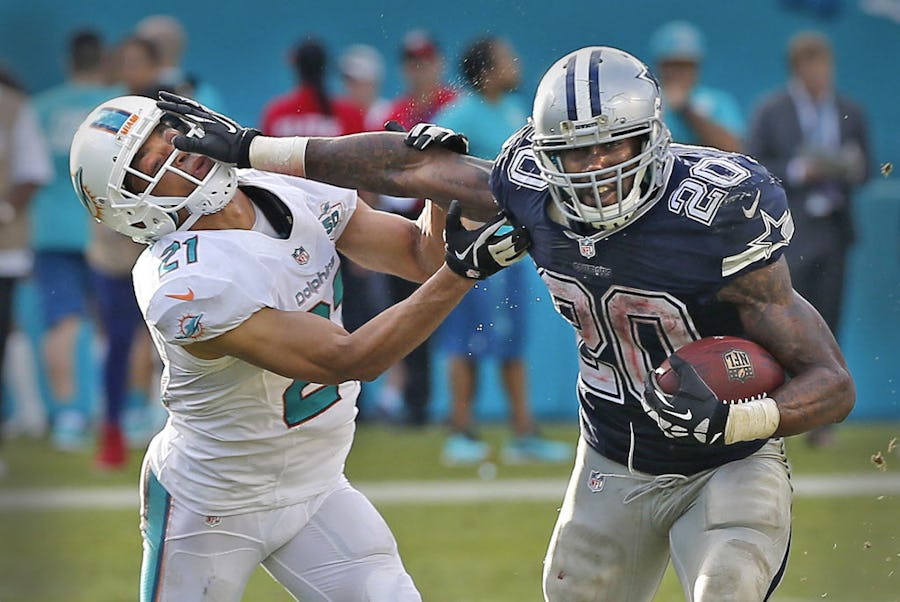
Miami Dolphins' Brent Grimes gets stiff-armed by Dallas Cowboys running back Darren McFadden during the fourth quarter on Sunday, Nov. 22, 2015, at Sun Life Stadium in Miami. (Charles Trainor Jr./Miami Herald/TNS)
CHARLES TRAINOR JR/TNS
Miami Dolphins' Brent Grimes gets stiff-armed by Dallas Cowboys running back Darren McFadden during the fourth quarter on Sunday, Nov. 22, 2015, at Sun Life Stadium in Miami. (Charles Trainor Jr./Miami Herald/TNS)

 
Now that the draft is over, I have a chance to tie up a few loose ends from the 2015 season that I see I overlooked as I hurried to get through as many draft prospects as possible.  Please feel free to request a topic you would like me to elaborate on between here and training camp.  I cannot promise I will do them all, but you can certainly inspire a day's work or two if you try.
For instance, I was reminded last night that I had never finished the 2015 running game analysis that I was publicly tracking throughout the season.  The data was collected, but I never posted it for you to enjoy.  So, here is the tweet that inspired this entry:
He couldn't find it because I forgot to post it.  
Granted, with the selection of Ezekiel Elliott, not to mention the signing of Alfred Morris, it is pretty clear that the Cowboys wanted to address this position for some of the items in our statistics.  They were productive last season and actually ran the ball very well for a team without much of a passing threat last season, but when you look at these numbers, you might detect an issue or two below:
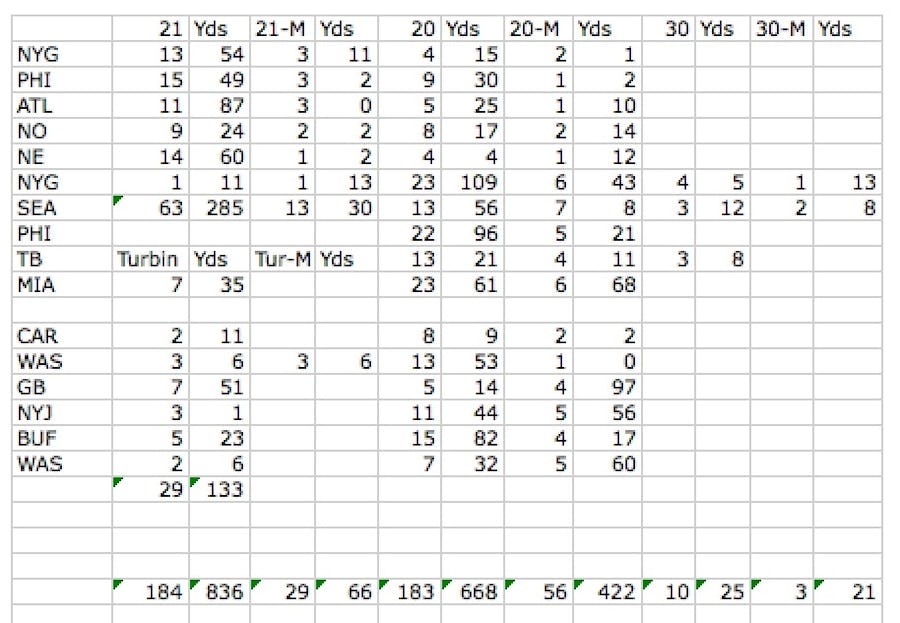
As you can see from my primitive spreadsheet, here is an attempt to catalog each and every run that the Cowboys attempted in 2015.  I tried to organize it by runner and by separating it into two categories - zone runs (inside or outside zone) and man/gap blocking runs.  Most are easily identifiable when looking at the All-22's, but I do not claim 100% accuracy as I certainly did not double check my work on this many plays.  One pass through the games and I did the best I could.
Now, you can read the above chart in the following fashion.  "21" is Joseph Randle, "20" is Darren McFadden, and "30" is the departed Christine Michael (for some reason the Turbin column is just Turbin even though he wore "23", I believe).  The "21" column is zone runs, the "21-M" would be man runs.  And, then the next column in each case is the yardage.
So, Joseph Randle averaged 4.1 yards a carry if you take his 76 runs as a whole.  But, divided into the man vs zone question, you can take his 63 zone runs at 4.5 a carry and then 13 man runs which totaled 2.3 per carry.
Christine Michael and Robert Turbin were both brought in to help supplement the zone running scheme after Randle was gone (or on the way out) and while neither ever really was given a heavy workload, but when they did get the ball, it was almost all on zone plays.  And the samples are so small we can't learn much.
But, the McFadden information is interesting.  Last summer, I did a big study on McFadden's years in Oakland and discovered that one of the main story lines there for the Raiders was whether the zone running scheme was something that was hurting McFadden.  As we pointed out then, not all zone offensive lines are created equal, so the hope was that the better players in Dallas might push McFadden to new heights.
And it seemed to work!  Despite only being the #1 RB from November 1 on, McFadden and this offensive line combined to put him into the top 4 runners in the entire NFL.  Without a QB!  In a little over half the season!  If you look at it from this perspective, it really boggles the mind how well they ran the ball down the stretch.
But, it gets even crazier when you look at McFadden's numbers by type of run.  He ran the ball 239 times for 1,089 yards for 4.6 a carry.  There is nothing wrong with those numbers at all.  76.6% of those runs were of the zone running variety.  But, just 61% of the yards were on zone plays.  In other words, on zone running plays that require a slightly different skill set (patience and then decisive decisions) from where he is most comfortable, he was only able to get 3.65 yards per carry.
Meanwhile, his man/gap runs, which were only 23.4% of his total runs, racked up 39% of his yardage, at an incredible 7.5 yards per carry.  What we heard in Oakland became true here.  He specializes in the type of runs that the Cowboys only use as their change-up.  The Cowboys have built a line with massive resources that specializes in the fine art of zone blocking.  Then, when they have you set up, they throw an occasional change-up with a pulling guard or a man scheme to catch you off balance.  It has worked very well since they completely bought in with the drafting of Zack Martin in 2014.  
Now, many of you have asked - if McFadden is so good at a certain type of run and so poor at another, why don't we change the scheme to fit him?  I realize that seems like a simple solution, but if an organization is built on running a certain scheme, it seems foolish to make large-scale changes to accommodate one guy who you signed for almost no money.  Instead, the objective for 2016 was to find someone who could run their scheme.  That was Alfred Morris for a few weeks (who ran almost nothing but zone in Washington) and then Ezekiel Elliott in the 1st round (who seems to be able to do anything you want him to do).  What becomes of McFadden?  That remains to be seen in training camp, but the Cowboys do not have very many special teams contributors from their backup RBs if those backups are McFadden and Morris.  And with small game-day rosters, that might be a consideration when filling out the final roster.  We shall see.  
So there you have it.  To the best of my knowledge, the book on the 2015 running game.  And the promise that the Cowboys in 2016 are going to get back to the recipe from 2014:  Zone right, zone left, inside zone, and even more zone running down the field with only the occasional moment with a pulling La'el Collins into space to catch the defense guessing.
Hope that answers your questions on that topic.

Friday, January 08, 2016

How the 2015 Cowboys Were Built

YEARDRAFT PICKSFREE AGENTS/TRADESUNDRAFTED COLLEGE FAs
2015
(17)
Byron Jones, Randy Gregory, Chaz Green (PUP), Damien Wilson, Ryan Russell,  Geoff SwaimGreg Hardy, Darren McFadden, Corey White, Andrew Gachkar, Danny McCray, Keith Smith, Charles Brown, Brice Butler, Christine MichaelLa'el Collins, Lucky Whitehead
2014 (13)Zack Martin, DeMarcus Lawrence, Anthony Hitchens, Devin Street, Ken BishopTerrell McClain, Jeremy Mincey, Rolando McClain, Brandon Weeden,  Jack CrawfordDavin Coleman,  Tyler Patmon
2013 (8)Travis Frederick, Gavin Escobar, Terrance Williams, JJ Wilcox, Joseph RandleNick Hayden, Tyler CluttsJeff Heath
2012 (9)Morris Claiborne, Tyrone Crawford, Kyle Wilber, James HannaMackenzy Bernardeau, Brandon CarrCole Beasley, Ron Leary, Lance Dunbar
2011 (3)Tyron Smith
Chris Jones, Dan Bailey
2010 (3)Dez Bryant, Sean LeeBarry Church
2009

2008 (1)Orlando Scandrick (IR)
2007 (1)Doug Free
2006

2005 (1)
LP Ladocuer
2004

2003 (2)Jason WittenTony Romo
53261912

Thursday, January 07, 2016

2015 - The Year of The Close Losses

http://sportsday.dallasnews.com/dallas-cowboys/cowboys/2016/01/07/sturm-close-games-got-away-end

This week, 12 teams prepare for their playoffs that will occur either this weekend or the next one, while the other 20 teams discuss what went wrong and how they intend to do better next year.
Any Cowboys' enthusiast knows which end of that stick the local team falls on, and it is interesting to see the fallout (or lack thereof) locally.  It appears that there will not be any sort of penalty distributed from on high for the massive disappointment, as the circumstances revolving around 2015 are mostly understandable and, frankly, unavoidable.
Because of poor QB play for most of the year, the Cowboys had a lost season.  This starts with Tony Romo's collarbone and its ability to sustain major impacts, but then leaks into the idea that the team had nobody ready to confidently run the offense and capable of doing so.
The result was 4-12.  That is a heavy price to pay.  But, it is interesting how we justify the season, even to ourselves.  I write about this team on a daily basis for hours at a time and even though I study the franchise closely, I find that my memory and initial thoughts about where the blame lies is not always accurate.
For instance, one of the real issues in my head is that the defense constantly collapsed and gave out in the 4th quarter.  But, a close examination of the facts are that the Cowboys defense allowed nearly exactly the same point totals it allowed in 2014.  In fact, we wrote about this somewhat back on Monday: 
Interestingly enough, with a better showing yesterday (don't get me started about that 1st Quarter), the Cowboys 2015 defense could have actually been at about the same exact points allowed number as they were in 2014. This, of course, is an odd number that requires context (such as the opponent often was not compelled to try to score more points when they are in a winning position), but the 2015 defense conceded 374 (23.4 per game) and in 2014 were at 352 (22 per game). This defense hung around in games, however, collapsed in the 4th Quarter repeatedly and if they had given up 8 more points in the final quarter all season, they could have overtaken the Saints and the Giants for the league's very worst 4th Quarter scoring defense. Next year.  
I wrote that 3 days ago.  They "collapsed in the 4th Quarter repeatedly."  I believe it to be true.  So in researching today's writeup about those collapses, I was shocked to see that the 2014 defense gave up roughly the same damage.  Did you know in 2015, the Cowboys defense that was collapsing so much allowed 132 4th Quarter points?  They did.  That ranked 28th in the NFL and just 8 points from the bottom of the league.  Here are the teams below them in this ranking:  The Lions, Raiders, Saints, and Giants.  Not a playoff team to be found amongst them.  Horrible, right?
What if I told you the 2014 defense ranked 27th in this same category, allowing 123 points?  I couldn't believe it, but yes, in 2014 they were equally awful.  Now, again, all points require context (such as in 2014 you could argue a large amount of those points were in garbage time as the opponent scored against a Cowboys team that was protecting a big lead), but nobody would believe the 4th Quarter defense was almost just as bad in 2014 as it was in 2015.
No, once again, as we look for answers in 2015, all signs point to an inept offense.  The defense was nearly the same as it ever was in just about all the categories.  But, like in everything else (did you know they scored 56 touchdowns in 2014 and 26 in 2015???  Staggering), the offense's 4th Quarter production is your real target.  After ranking 5th in the NFL in 2014, they fell to 25th with just 94 points.  That caused a point differential in the 4th Quarter of "-38", which will lose a ton of games for you.  There were 4 teams in the NFL with a worse 4th Quarter point differential than Dallas:  The Raiders, Titans, Rams, and Browns.  Again, find the playoff team amongst them.  You can't.
The Giants recently decided it had enough of the Tom Coughlin era, and if you point to one thing that made them quickly forget 2 Lombardi trophies, it would be their frustrations in close games.  The NFL defines close games as "games decided by 7 points or less."  I find this definition a bit frustrating because it includes games that weren't close until garbage time and excludes games that were close until garbage time, but I realize they have to try to keep it simple.  
Regardless, the Giants were very poor in close games in 2015 (3-8) and frankly, very poor since the last Super Bowl to end 2011 (9-18).   The Cowboys, meanwhile, over that stretch have been near the top of the division until this Romo-less season.  The division rankings since 2012 in close games by the NFL definition go like this:  Philadelphia 15-11, Dallas 18-17, Washington 14-16, and New York 9-18.  That will also tell you that Dallas has played in easily the most close games during that stretch and before this year, were 16-11 from 2012-2014.
But, this year, the Cowboys were 2-6 in "close games".  I broaden the definition because, like I said, I don't think the NFL's definition is airtight.  I came up with this: 
 https://twitter.com/SportsSturm/status/684879732421201921?ref_src=twsrc%5Etfw
2-8 - Even worse than the Giants snake-bit season!  I think that is a remarkably futile run and we should focus on that.  
By my count, the Cowboys had 2 clear wins - At Philadelphia and At Miami and 3 clear losses - New England, Carolina, and Washington (all home games).  
Then, they won 2 close games - home against the Giants in Week 1 (which they should have lost) and at Washington in Week 12.
So, lets look at those other 9 lost games briefly to see how 2015 might have been different with just a play here or there:
WEEK 3 - ATLANTA - Cowboys lead 28-25 entering the 4th Q
This game was pretty famous for the way Joseph Randle and the Cowboys could not be stopped early.  Randle had 3 touchdowns and McFadden ran for a 4th as the Cowboys took a 28-17 halftime lead.  Then the Falcons went in a decided that they should focus on the run and make Brandon Weeden try to beat them.  Great idea, because the Cowboys never scored again and despite leading entering the 4th Quarter, lost by double digits 39-28.  Dallas had just 52 yards, 3 first downs, and 0 points in the 2nd half.
WEEK 4 - NEW ORLEANS - Cowboys tied game at 20-20 with 1:52 left 
This was the game that got the 4th Quarter defensive collapse theory working.  Because after Weeden hit Terrance Williams for a touchdown, the Cowboys never touched the ball again at the end of regulation (when the Saints missed a FG) or in overtime (when the Cowboys did not cover the RB).   The defense conceded basically 2 80-yard drives to end the game and sink the ship.  And the Cowboys had lost 2 in a row.  
WEEK 6 - At NEW YORK - Cowboys tied game at 20-20 with 7:14 to go
This was Matt Cassel's debut and the offense looked much better - aside from the interceptions.  Somehow, they got the game tied when Cassel hit Devin Street on a 25 yard touchdown pass (he has made a play in Dallas!).  But, that was short lived as the ensuing kickoff was returned for a touchdown by old friend Dwayne Harris to give the Giants back the 7-point lead within 13 seconds.  From there, an odd decision to throw it to James Hanna on 4th and long and a Cole Beasley muffed fumble ended the chances.  Not much can be placed on the defense for this game.  
WEEK 7 - SEATTLE - Cowboys led Seahawks 12-10 with less than 2 minutes to go.
The Seattle game was incredibly odd in that the Cowboys technically led the game until very late, but the Seahawks had all of the possession in the 4th Quarter and it really did feel like a matter of time.  David Irving blocked a field goal in the 4th Quarter and tried to save the game for the Cowboys, but they were terrified to try any risky plays and therefore punted it right back to Seattle who marched down the field and hit a chippy with about 1 minute to play.  The last-gasp drive from Cassel and the boys was sadly comical and the team went to 2-5.  
WEEK 8 - PHILADELPHIA - Game Tied at 27-27 at end of Regulation
Yet another occasion where the play-calling for the Cowboys was ultra conservative (even though it called for just the opposite given the odds) and the team played for field goals in the 4th Quarter which ended up costing them.  Dan Bailey did his part, but if on any of those drives against the Eagles in the 4th Quarter, Linehan and Garrett showed ambition, they might have been able to steal this one (and Seattle).  Instead, they played it close to the vest and locked the game up at 27-27 - only to have the defense give up a touchdown on the opening drive of Overtime to send the team to 2-6 as they lost another close game.
WEEK 9 - At TAMPA BAY - Cowboys led the game 6-3 with 1:00 to Play
Of course, it sounds silly to feel you should have won a 6-3 game, but Dallas was in a perfect spot to win this one in Tampa Bay with the slightest bit of anything in the 4th Quarter.  Instead, Dez Bryant drops an easy 3rd down conversion and then, of course, his odd attempt at trying to track down a Hail Mary on the final drive leads everyone to believe he hurt himself on the circus catch in the end zone the week before against the Eagles.  Winston scores with 0:59 to play, and the record is now 2-7.  
WEEK 13 - At GREEN BAY - Cowboys trailed just 14-7 with 5 minutes to play
This one doesn't really apply to the close game stat, but they were down just 7 with 55 minutes played and had thrown an interception in the end zone.  As bad as the Packers have played, it should be remembered how competitive the Cowboys were, even with a very hapless offense all day long.  The signs were there that Green Bay wasn't very good and the Cowboys couldn't do anything about it.  They caved in for 2 late running TDs to make the final score 28-7.
WEEK 14 - NEW YORK JETS - Game Tied 16-16 Late Inside 2 minutes to Go
Once again, it seemed all year that Garrett was pretty sure settling for the field goal to tie games was the play, when in reality, he had to know by now that unless you are taking the lead, you are in big trouble.  Bailey tied the game at 16-16 inside 2 minutes, but the defense conceded the big pass down the right sideline to set up the Jets almost immediately thereafter and they had their own chippy to put the home record to 1-6 and the overall record to 4-10.  
WEEK 15 - AT BUFFALO - Bills Led 9-6 with under 3 minutes to play
This game is not counted by the league as a close game, but it felt close late until the Cowboys caved in an allowed a long touchdown run that the Bills weren't even really trying to get.  That was capped off by Lucky Whitehead fumbling the kickoff right back and the Cowboys not even touching the ball again.  Special teams clearly played a role in a few of these disasters, no doubt.
So, I realize the Green Bay game shouldn't technically being included, so let's leave it out.  
Still, 2-8 in close games and one of the two was mighty fortunate.  Perhaps the year would have been easier to swallow if there were more blowout losses.  You could then surmise they were just awful.  But, this team spent most every week right in every game for 95% of the day.  
But then, even though it was a different part of the team each time - offense one week, defense the next, special teams, and I think coaching, too - this team found new and creative ways to lose.
That is what I will always remember about 2015.  They were just very poor with the game asking to be won.