Showing posts with label Aaron Rodgers. Show all posts

Monday, October 09, 2017

The Morning After - Green Bay 35, Dallas 31 - (2-3)

https://sportsday.dallasnews.com/dallas-cowboys/cowboys/2017/10/09/sturms-morning-cowboys-defense-stop-rodgers-late


Green Bay Packers quarterback Aaron Rodgers (12) shakes Dallas Cowboys defensive tackle David Irving (95)  as he rushes for 18 yards for a first down on a third down play in the last minute of play in the fourth quarter at AT&T Stadium in Arlington on Sunday, October 8, 2017. Green Bay Packers defeated the Dallas Cowboys 35-31. (Vernon Bryant/The Dallas Morning News)
Vernon Bryant/Staff Photographer
Green Bay Packers quarterback Aaron Rodgers (12) shakes Dallas Cowboys defensive tackle David Irving (95) as he rushes for 18 yards for a first down on a third down play in the last minute of play in the fourth quarter at AT&T Stadium in Arlington on Sunday, October 8, 2017. Green Bay Packers defeated the Dallas Cowboys 35-31. (Vernon Bryant/The Dallas Morning News)

The Morning After

If you believe "the best defense is a great offense," then the result of Sunday's game falls to the group that had the ball in its hands down on the other end of the field. If you believe Aaron Rodgers is nearly unstoppable -- especially in AT&T Stadium against the Cowboys' defense -- then you have to roll the tape back to where there is still 1:24 to play in the game.

 
That is where my attention goes.
Ezekiel Elliott just reeled off a zone-read give for eight yards. The Cowboys are rolling. They have the Packers on the run and the game in their sights. Yes, they trail 28-24, but because of two consecutive challenges -- one from each head coach -- we had a Cowboys first down, challenged back short of the sticks, then a Cowboys fourth-down stop, challenged barely ahead of the sticks, all within moments. SkyCam saved the day with a view of Elliott reaching the ball past the hash mark at the 19-yard line.  
Then, Elliott eats up eight more yards. The Cowboys have the Packers down to one timeout and there is a very real possibility now -- with 1:24 to go -- that if the Cowboys play this right, they can take the clock almost all the way down, burn the Packers' last timeout, and then drive over the goal line with no time remaining. Perhaps even a replay of Bart Starr crashing in behind Jerry Kramer, but here it's Dak Prescott following Zack Martin to pay dirt.
But that requires some perfect decision-making to complement the rough execution of driving the dagger into the heart of their current nemesis.
And this is where the decision-making went bad. You see, the play before it (the Elliott eight-yard run) and this play and the play after (the Prescott touchdown) were all basically the same play call off the RPO (run-pass option) we talk so much about. They all gave Prescott the authority to diagnose the situation and defense's alignment, and all the coaches can do once they give him complete control of the steering wheel is to hope he makes the correct decision.
Now, they do that because he makes the correct decision almost every time. And, just like the loss to this same opponent 266 days ago in the exact same location, Prescott played a brilliant game that should have been more than enough for the Cowboys to leave with a win. Unless, of course, the other guy plays a game even closer to perfection.
So, here is second and 2 with 1:24 to go. Prescott's biggest decision blunder is to look at the Packers in pre-snap and diagnose what he sees as a call that is an automatic in the Dallas offense. You see a corner on his own -- this time, Davon House (a man released by the Jacksonville Jaguars in March and re-signed by his original Green Bay team shortly thereafter) -- trying to handle Dez Bryant in the red zone. This is a read the quarterback sees only on occasion since most opponents don't try it anymore, but when you do see it, the alarms go off. Tony Romo saw this at Lambeau Field when Sam Shields was trying to do the same thing back in January 2015, and now Prescott saw House on Bryant all by himself.
You always go to this throw. It is 100 percent the correct read, in a vacuum. But that decision was incorrect here.
If you go to that read, Bryant on House, you have a number of potential outcomes. The best one is a touchdown, which is great to give the Cowboys the lead, but then you give the Packers way too much time to answer to a three-point deficit based on lessons learned in January. Another not-so-great outcome is an incomplete pass, which gives Green Bay a timeout it didn't have to spare.
Prescott almost always makes the right decision. But here, you have to ignore your meetings and instincts and you have to play the game in front of you. In other words, this decision is automatic -- unless you are playing against the clock. On second and 2, you run the ball and keep the clock moving. You cannot allow the Packers to keep their timeout with the remaining time. The quarterback did not know his situation well enough at this early stage of his career.
The clock stops at 1:18 and sets up a third and 2. The Cowboys call yet another RPO. If there are three different adventures for RPOs, we see them all here. Give to Elliott on the dive, keep and throw to the open man (which worked for the second Cole Beasley touchdown in the first half) and, finally, keep the ball and run to the opposite corner after Elliott draws all the attention from the backside edge defender.
On this third down, Ahmad Brooks crashed in on Elliott and had both arms around No. 21. Problem is, he didn't have the ball, and now Prescott runs to the space Brooks just vacated and turns the corner. From here, Mike Daniels is not facing the run, and no other Packers defender is close. Jason Witten has Ha Ha Clinton-Dix on a block and the safety had no chance, either. By the time anyone touches Prescott, he had already crossed the goal line to score an 11-yard touchdown with 1:13 to play. He was untouched.
It made you wonder if the Packers were playing a game in their own heads. Surely they weren't, but watching Clinton-Dix not really give effort to get around Witten suggested that they knew if they couldn't stop Elliott on that fourth down, maybe their best chance to win was giving Rodgers the ball back as soon as they possibly could. In other words, if you can't stop them, let them score quickly. Twenty years ago, they did that in Super Bowl 32 with different players and coaches, and anyone who follows Green Bay was thinking that very thing yesterday.
Should Prescott have considered getting to the 1-yard line and purposely falling short of the goal line to eliminate any chance Green Bay had at a response? Let's be clear: I am not sure any team in the history of the sport has tried this while trailing. Brian Westbrook did it at Texas Stadium in 2007, but that was with his team leading 10-6. Was it crazy to consider it? Could Green Bay have stopped the Cowboys four times from the 1-yard line? And if you don't get the ball into the end zone, does Jason Garrett get fired for his quarterback's decision?
Prescott scored to give the Cowboys a 31-28 lead -- as any football player surely would have there -- but, we will always wonder if the only way to win this game would have been to "pull a Westbrook" and understand that not only did you have to score, but you also had to leave no chance for a response. He went in virtually untouched, and then it fell to the defense to save the game as Dallas kicked the ball back to Green Bay with 1:13 to play.
In January, Rodgers had two timeouts and 35 seconds to play in a game that was tied 31-31. This time, he gets 1:13 and one timeout against a defense that doesn't have Sean Lee -- and a point that has been made exceedingly clear through all of this is that Lee is, without question, the most indispensable member of the Dallas defense.
In that game in January, there was a moment when Jeff Heath had Rodgers for a blind-side sack and a chance to get the ball. He does not. Rodgers escapes disaster and eventually makes the play to win the game.
In this game, there will also be that moment when Dallas was right on top of him and he somehow pulled another escape act to snatch victory from the jaws of defeat. But first, on the initial four snaps of the drive, the Packers find 14 yards to Davante Adams on the left sideline, 14 yards to Martellus Bennett back to the right and 15 yards on a handoff to their third running back, Aaron Jones, who was anonymous until Sunday afternoon.
Those 43 yards in four plays carried them all the way to the Dallas 32-yard line with 39 seconds to play. They were already in field goal range, if you assumed Mason Crosby was in any shape to kick one (one thing that really had changed from Jan. 15).
But, after an incompletion and a short run, Green Bay faced a third-and-8 at the 30-yard line. This is the play that will stick in your memories for a bit.
The Cowboys are going to roll out the "Deacon" package, where they are in 2-deep, man under with three rushers and a linebacker playing quarterback spy. The two linebackers who are on the field are Anthony Hitchens and Justin Durant. One of them is to pick up Jones and the other is to keep Rodgers from breaking contain. The three pass rushers are the best the Cowboys have -- DeMarcus Lawrence, David Irving and Benson Mayowa from left to right.
The Packers will double-team Lawrence -- which requires the right tackle and right guard -- leaving Irving in a one-on-one with center Corey Linsley and Mayowa against Lane Taylor (who is their left guard playing left tackle for just the second time in his career). The left guard is responsible for a blitzing linebacker who appears to be Hitchens, but when Jones slides out of the pocket into a route, Hitchens goes with him. The problem with that is Durant is doing the same thing. The Cowboys have two linebackers who play both positions regularly, and on this occasion it appears both seem to be thinking they have the same responsibility. Both are on the running back, and neither is spying the guy with the ball and reputation -- Rodgers.
As the play develops, Mayowa is beating Taylor, and as Rodgers steps up in the pocket, Mayowa gets both hands on the quarterback at the 38-yard line. But Rodgers is able to power through that and head to the left sideline. Irving, who has tremendous mobility for a man his size, is now on top of Rodgers' path and dives from close proximity to get his legs at the 33-yard line. Somehow, Rodgers eludes him, too. Since there are no linebackers nearby and the secondary is in man coverage, he has a lot of space down the sideline and finally stops the clock and play at the 12-yard line with 21 seconds to play. It is a fresh set of downs, and that might have been the last chance to stop him, as the ending from here felt a bit inevitable.
The Packers then run consecutive back-shoulder fades to Adams against promising rookie Jourdan Lewis. As solid as the young Lewis is, he is still 5-foot-10, and the Packers knew to isolate him for a rather unstoppable concept if properly executed. The first attempt was not a great throw. The second one was perfect, and Adams caught it in a spot where Lewis could do almost nothing. The only way to stop that situation is generally to halt them further up the field. Green Bay is the gold standard in the red zone and ball placement from its quarterback is the top reason why.
Green Bay wins again, 35-31. The Packers won in the playoffs, 34-31. The Rams won last week, 35-30. If you are wondering if the Cowboys' offense can protect its defense, the answers here are pretty clear. In fact, thanks to football writer Scott Kacsmar, we have this ominous statistic to chew on: Since 2010, the Cowboys are just 15-10 in home games in which they score at least 30 points. Ten losses is double that of any other team in the NFL over that span. The league wins 89 percent of the time over that span. New England is 40-2, Green Bay is 28-1, Denver is 24-2 and Seattle is 21-2. Basically, nobody ever loses home games when scoring 30 points besides Jason Garrett's Dallas Cowboys. They have lost 10 times in 25 chances.
We certainly blamed Tony Romo for that and, on this Monday, I have blamed Prescott's decision-making a bit for this loss. Neither were perfect and unfortunately, because the franchise has had such a hard time building championship defense, they have had to be just that to win regularly as the Cowboys' QB1.
This is just the latest example of the opponent being one score better.

Wednesday, January 18, 2017

Marinelli Report - Playoffs - Green Bay

http://sportsday.dallasnews.com/dallas-cowboys/cowboys/2017/01/18/sturms-marinelli-report-cowboys-defense-comes-short-classic


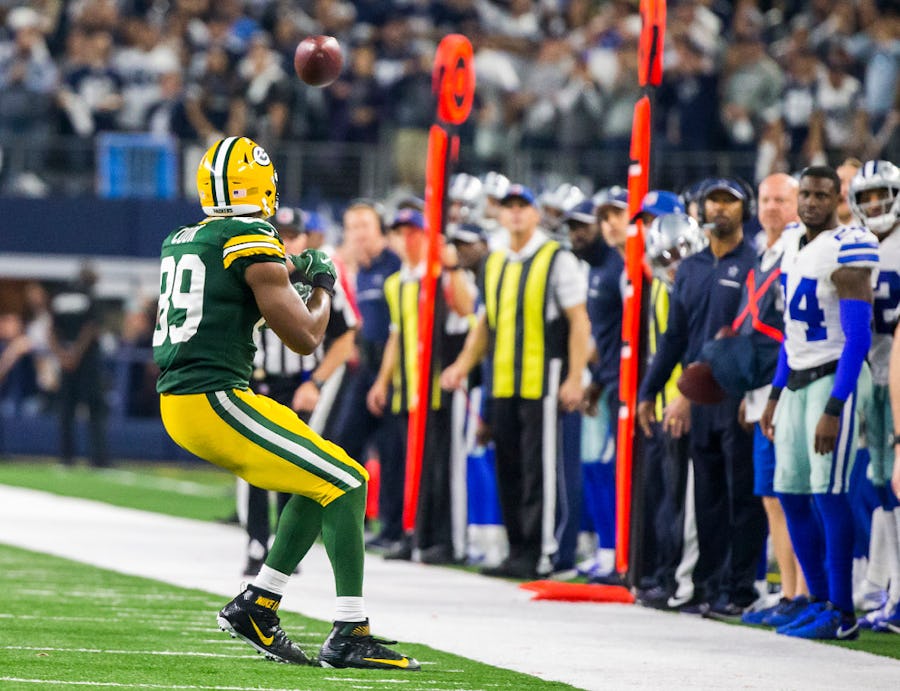
Green Bay Packers tight end Jared Cook (89) catches a 36-yard pass pass from quarterback Aaron Rodgers that set up a game-winning field goal in the final moments of an NFC divisional round playoff game at AT&T Stadium on Sunday, Jan. 15, 2017, in Arlington. (Smiley N. Pool/The Dallas Morning News)during the second half of an NFC divisional round playoff game at AT&T Stadium on Sunday, Jan. 15, 2017, in Arlington. (Smiley N. Pool/The Dallas Morning News)
Staff Photographer
Green Bay Packers tight end Jared Cook (89) catches a 36-yard pass pass from quarterback Aaron Rodgers that set up a game-winning field goal in the final moments of an NFC divisional round playoff game at AT&T Stadium on Sunday, Jan. 15, 2017, in Arlington. (Smiley N. Pool/The Dallas Morning News)during the second half of an NFC divisional round playoff game at AT&T Stadium on Sunday, Jan. 15, 2017, in Arlington. (Smiley N. Pool/The Dallas Morning News)

Marinelli Report

There are very few times when you know, while watching a football game, that what you just witnessed will be replayed for the rest of your life. But when it comes to a rivalry that was born 50 years ago, and then reborn for this generation, the moments of January 2015 in Green Bay and January 2017 in Arlington easily pass the test of historical relevance.

 
Both games came down to a late play that tested the limits of what constitutes a catch, and how the officials see things with their naked eye in real time. Both went against the Dallas Cowboys. And given the way the latest one went, I assume many are too sick to even look at what we want to discuss and dissect today.
But for those brave souls who want to look at the details of what happened (or to those of you who are reading this for the first time in April as the wounds are starting to heal), let's take one last look at how the defense performed in a game in what was as unforgettable 2016 season.
For the entire summer, the defense would be blamed for ruining most of 2016's prospects to help this stunning offense reach its goals. Then, for most of the season, the defense performed better than expected. For the entirety of 2016, many of the defensive numbers were flattering. In fact, the Cowboys finished with a top-five ranking in points allowed, which should maybe be considered the most important stat of all, and spent most of the time after Thanksgiving looking like they were peaking at just the right time.
Then the playoffs began, and the Cowboys drew a meeting with the hottest quarterback in the game right now. We annoyed many by making last week all about Aaron Rodgers and the impossible challenges he presents. Many responded by claiming we were making "too big a deal about one guy and that the Cowboys will shut him down like they did at Lambeau in October."
And now we examine how it appears that one guy was the primary reason why the Cowboys are looking ahead to the 2017 season.
This is the issue, sometimes, with regular season numbers. The NFL is about earning your spot in the regular season, but the postseason -- where legacies are made -- is about a three-hour test. And within those three hours, there may be 10 plays that decide the game. And among those 10 plays, one quarterback may be asked to make five of them. And if he makes all five, he can undo all of the hard work an entire organization put forth from July to January. There are no best-of-seven series, in which you are allowed a few bad days. In the NFL, you are hardly afforded bad plays in the postseason. That is why it is so hard to get your hands on that trophy.
In this game, the Cowboys' defense had some options. It appears they tried them all. They tried to mix up coverages and pressures. They blitzed almost as much as they had at any point of the season, but also tried to bring just three at other times to frustrate Rodgers with a populated secondary. They even brought a number of four-man pressures with zone-blitz elements, when one of the four might have been a cornerback with a defensive end dropping to a zone. It worked a few times. But over the course of the day, Rodgers remained a step ahead of Rod Marinelli.
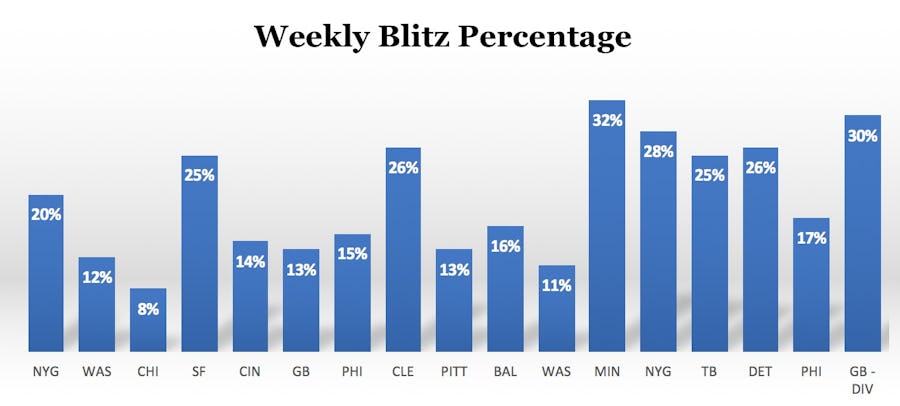
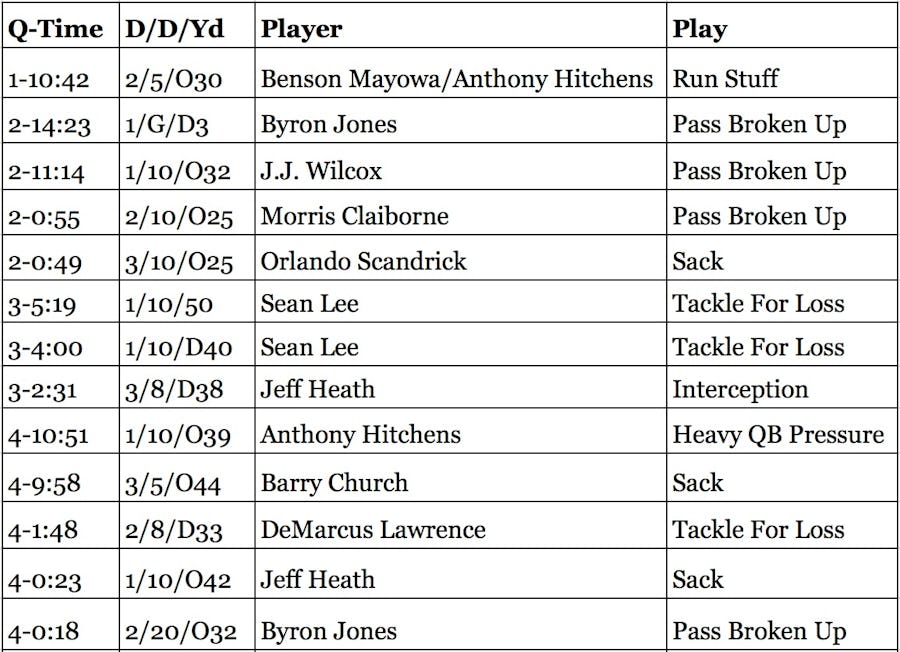
Below, please find the weekly blitz percentages. After the Redskins exposed the Cowboys' secondary on Thanksgiving Day, you definitely see an uptick in pressure plans. They wanted to rattle quarterbacks and were having success when the quarterbacks were Sam Bradford, Eli Manning, Jameis Winston or Matthew Stafford.
The issues came about when Rodgers started carving them up early. He then put the Cowboys on their heels with the inability to substitute sub-packages. Then he started ear-marking matchups he wanted to exploit. First, Mo Claiborne, then Sean Lee, then Byron Jones. By the time it was over, Rodgers was able to lead his team to its eighth straight victory. The Cowboys were actually able to give him as much trouble as basically anyone had during that streak (it was his second-lowest passer rating during the stretch, but in Chicago, Davante Adams dropped two easy touchdown passes) and picked him off for his first interception since Nov. 13.

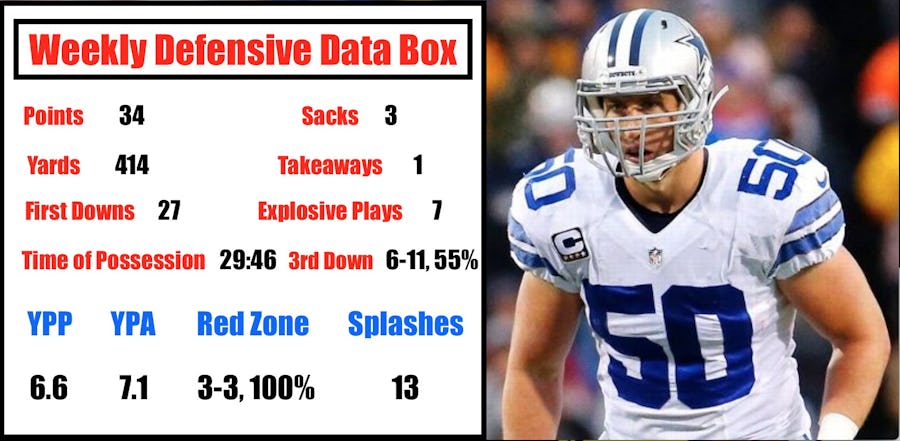
WEEKLY DATA - GREEN BAY

The numbers above give you the details. The three sacks and a takeaway are nice. The third downs, explosive plays, red-zone percentage and, of course, 34 points and 414 yards allowed are usually the types of numbers that will get you beaten. You cannot allow a team to score seven every time it gets down in the red zone, and you cannot let them beat you for 20-yard plays seven different times.
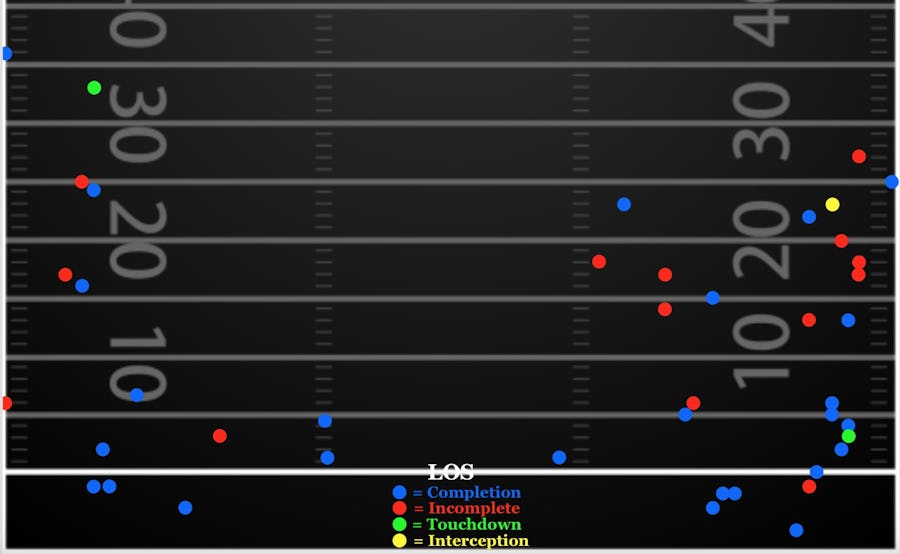
Here is the damage done through the air Sunday:

AARON RODGERS THROW CHART

Twenty times he threw the ball more than 10 yards down the field. He actually only hit on nine of those 20 passes, but oh, the damage that was done. On top of that, there were penalties, free plays and a number of occasions that asked guys to defend their men for 5-8 seconds. It is really difficult to deal with that offense right now, despite the facts that they had no Jordy Nelson and are very limited in the run game (that they seldom care to use).
Additionally, the Cowboys had one of their lowest "splash play" totals of the year, with 13. When you are on the field for 63 snaps, you would like to have a positive ending on more than 13 plays. But from the first drive of the game on, Cowboys defenders were mostly trying to keep up with the challenges they faced.

SPLASH PLAYS

Let's look at some tape:
I think this is a real key part of the game. Right after the Brice Butler penalty, the Cowboys punt. They pin the Packers deep (at the 10). Now, it is third-and-7 from the 13. Get off the field, the game is still in great shape and you likely start again near midfield. Instead, Rodgers makes a throw under pressure to Jared Cook (with Byron Jones in his pocket) and he hits a target that is extremely small, where you might even say he threw Cook open. Jones is right there. But that is a real difficult third-down conversion.
Later in that drive. Another third down from midfield. They go after Jones again, who is on Adams this time. Cowboys are in a Cover 1-Rat, where they have a safety high and another player in the hole. Rodgers sees his corner route and actually makes a weird throw that Adams adjusts to before Wilcox gets there to clobber him. Another conversion.
Near the end of the half, the Cowboys pull back into the game with a few important third-down stops. Adams wanted a hold on Claiborne on this one, but the refs were letting them play. Forced a nice stop and punt.
And then this one is another slot blitz from Claiborne that gets home right before the half. If the Cowboys hadn't had to waste all of their timeouts, this would have allowed another nice chance for the offense to get points with 40 seconds to go.  
So, they are trying everything and are starting to give him problems. On to the second half. And the first throw shows that Rodgers is still going to make silly throws. And by silly, I mean this:
It all looks so harmless on the first play of the second half. The zone releases Randall Cobb to the safety. And yet, from this other view, it seems like a ridiculous throw.
He is on the run. He is being chased. He has a defender charging at him. He is throwing the ball 35 yards. He is trying to throw it where only his guy can catch it on the boundary. And he made it look kind of easy. I really don't know how to defend this throw. And yet nobody will call it his best pass of the day.
Later that drive, the Packers hit Cook again as Rodgers stares down a slot blitz and runs a pump-and-go over the top. They beat the safety to the spot, and the fourth touchdown is a moment later. Remember that play, because the Cowboys are going to learn from this one.
This is the next drive. The key here is twofold. One is it's on the near hash, not the far hash. The other key is that it's Barry Church the first time, and the surprising Jeff Heath in center field on the other. I have to admit, although I have not written much about it, the more I watch this team, the more I think Heath is their best free safety (at least, the best one not named Byron Jones). Something is weird here about Adams -- he appears to lose the ball in the lights, or something. The throw is also too inside, but Heath makes a great play (the kind of play we don't see much from a Dallas centerfielder) and turns the game on its ear.
Rodgers is not short on confidence, but I think the Cook play made him think he could do this again and got lazy on his location. Also, look at Adams. He seems to have no idea. Great play, and it also looks like the Cowboys had a chance at a really big return if he beats one more guy.
Fourth quarter now. Another big third down and another time a Marinelli blitz gets to Rodgers. All the third downs were massive plays for both sides, it seems. One thing about all of these sacks is consistent: The Cowboys' pass rushers never once beat their men. All of these sacks look like scheme sacks, where Rod gets a free run at Rodgers. To win, you will need some pass rushers who can win in games like this.
Two minutes to go, 28-28. Packers at midfield. Here is a penalty I have heard many be mad about, because Heath ends up with another interception. If it sticks, it likely is the game and the Cowboys seem in full control.
Packers go empty and motion out running back/wide receiver Ty Montgomery. They did this in the first half and had Montgomery open behind Sean Lee on a sluggo (slant-and-go). They will do it again here, but the Cowboys are prepared with a corner -- Anthony Brown. Same concept, same move, and this time, Brown gets handsy. Rodgers is looking here the whole time and likely still annoyed he missed the chance in the first half  (2:38 in the first quarter). He is under pressure but knows where he wants to go, and knows that either Montgomery will have a step, or it will draw the call. He gets the flag.
I assume people want to see that call allowed to go, but it also seemed pretty cut and dried that any tugging in the open field with the intended target was likely going to attract the attention. Perhaps a five-yard defensive hold, but they charged 10 yards for pass interference. Both come with an automatic first down.
This play above might have been the game-saver. It appeared to knock the Packers out of field goal range. They lost five yards here moving, a 51-yarder to 56 when DeMarcus Lawrence makes a huge play. But, as history will tell, Mason Crosby was able to handle that. It's 31-28.
So the Cowboys tie the game and leave a little time. This last part might leave a mark.
Heath had the game of his life. But he was so close to two more plays that might have made him a Cowboys hero. This is the other one (not the disallowed interception), where he gets a clean run and a blindside hit on Rodgers. Rodgers has the ball in one hand. Orlando Scandrick is right there to pick up a fumble. Nobody knows how Rodgers doesn't lose the ball. Inches away.
... Which sets up third-and-19.
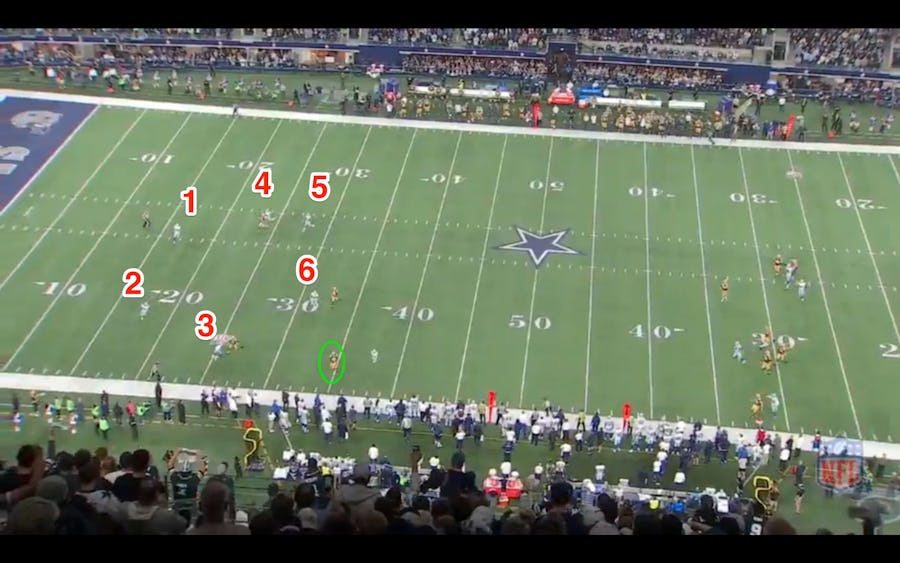
We have talked quite a bit about my theory that the Cowboys were worried Rodgers was going to the end zone. I said this because all they heard about all week was the Hail Mary. They were asked repeatedly in the room and I am sure they game-planned. I might be wrong, but the lasting memory will always be the above picture, which shows six defenders deeper than the field goal target of the 35-yard line. Nobody but Byron Jones is close to Cook.
Now, I have heard knowledgeable people identify Brandon Carr as a bust. He was supposed to stay in his area and help Jones "bracket" Cook. I will assume they know the call, and it makes some sense as long as Rodgers doesn't then try to hit Adams before the safety gets there. J.J. Wilcox is still 15 yards off Adams, so it is difficult to be too critical of Carr.
Additionally, would Carr have made a difference? A well-timed hit of Cook? Perhaps.
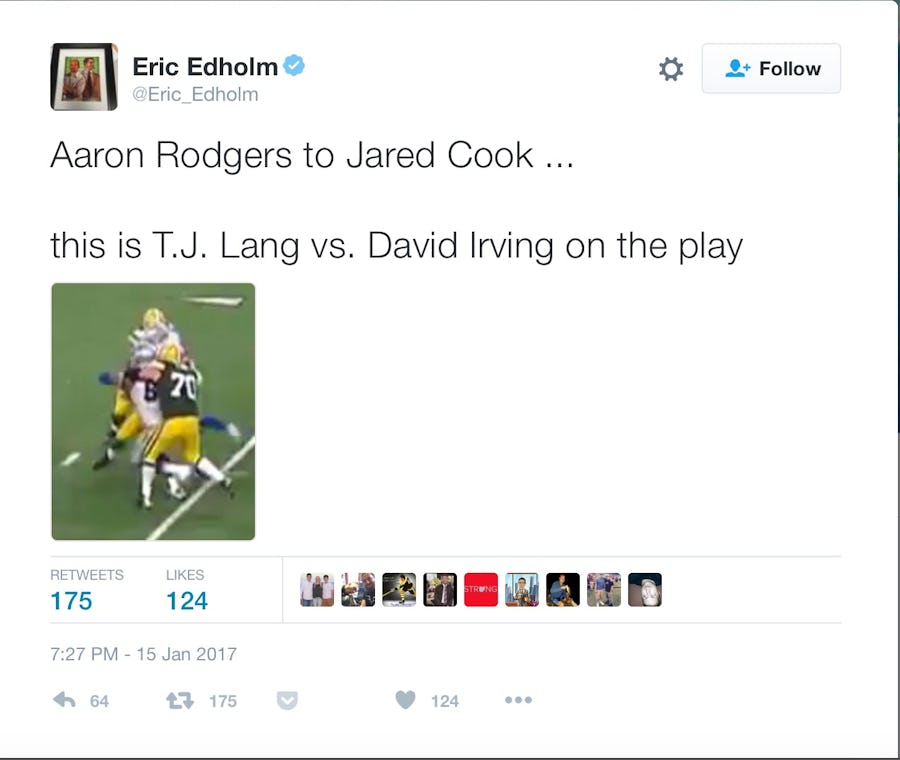
This view will reveal some things. Most notably, another ridiculous throw that is hard to imagine Rodgers doing again if you gave him 10 more tries. (But who knows?) Also, Cook's effort and ability to secure the ball and get his feet in. And the controversial hold on David Irving.
I am sure you have seen this:
The video above shows that Lang certainly did something that could have been called, but definitely stopped short of tackling him, or jumping on for a horse-back ride like the picture indicates.
The center is blocking Irving and that is why Lang releases him, but the picture sure makes it look like a blown call -- and something we will talk about, along with the play itself, for decades. It is one more layer of the onion of this instant classic, when one side was elated and the other gutted at the end.

SUMMARY AND CONCLUSIONS

This one really will hurt for a while because so much seemed set up for a Super Bowl run. And in the moment of one play, it is all gone. I have talked to countless fans who swear if the game goes to overtime, the Cowboys surely win. We will never know.
I think the Cowboys made a calculated gamble on draft day to not really do too much to address the defense in 2016 and bolster an already loaded offense. They still feel happy about it, and we will really change the mood the moment Jaylon Smith takes the field. But on Sunday, they certainly looked outclassed when the Packers had the ball. And that will no doubt be the focus this offseason. If they meet again, you need a few more difference-makers who can win and sack that quarterback before he can make those throws.