Always the horses, seldom the jockey...
Daily Commentary on the Dallas Sports Scene - By Bob Sturm - Sportsradio 1310, The Ticket - The Athletic Dallas - The Athletic - Bob Sturm
There is no question that theDallas Cowboysand their many machinations of defense over the last decade-plus have had a takeaway problem. Every coach has told us that in order to understand the secrets of football, we must simply understand the importance of winning the turnover battle. Then, for years and years, we have seen the Cowboys almost never end up too strong in that department, mostly because the defense cannot make a single play.
Dallas Cowboys defensive coordinator Rod Marinelli communicates to his players during the second half of play at AT&T Stadium in Arlington on Sunday, October 8, 2017. Green Bay Packers defeated the Dallas Cowboys 35-31. (Vernon Bryant/The Dallas Morning News)
Sturm's observations
During the bye week, I wanted to offer some observations to prepare us for the stretch run with 11 games to go. Sitting at 2-3 is not a great place to be, and the schedule ahead looks a little daunting. On the other hand, there is nothing in this sport like an off weekend to look around and see you aren't the only franchise dealing with issues and challenges that were unforeseen in the offseason. Everyone has a plan until you get punched in the mouth, right? Well, the NFL season is all about taking those punches and charging forward to strike back.
The Cowboys remain in a fine position to strike back. Not because of their win total or their great accomplishments this year. Not at all. But again -- just like in 2016 -- it seems like they're just about the healthiest team in the sport. On offense, they have had perfect attendance across the board from pretty much every single member. That is not common right now in this league. Everyone is dealing with injuries and nearly everyone has lost someone for a few months or the year. Not the Cowboys. Look at that offensive roster -- where they have planted their resources and salary cap -- and you will see that they just keep marching on with the exact lineup that appeared on paper when the season began. That can change on any hit that occurs, but for now, you have a healthy team and that puts you in as good a spot as pretty much anyone in the conference.
The defense has not been as fortunate, but the few injuries that have occurred have been of the "weeks" variety rather than "months." Yes, Sean Lee being out could have likely made the difference between beating the Rams and Packers and not, but he is back. Anthony Hitchens is back. David Irving is back. Damontre Moore is back. The only injuries that have really been issues are Charles Tapper (broken bone in his right foot) and Stephen Paea's, who just up and retired because of his knee.
As you look at the calendar and see that we are approaching the end of October, we know two things: 1) There is a long way to go and the injury fortune could turn on a dime as early as Sunday, and 2) if a team can navigate to the postseason relatively healthy, they have a substantial advantage against the ragtag bunches that they will compete against, where most teams have 3-5 pieces (sometimes more) that have been lost for the rest of the season by then. Aaron Rodgers getting hurt (broken collarbone) means Green Bay is just another potential foe that the Cowboys made up massive amounts of ground on from their couches this past weekend.
Health appears to be a bit of a gift from the football gods some years, but I believe it is also a function of having a young team, and the Cowboys certainly have young players all over the field these days with almost nobody over 30 besides Jason Witten and Lee.
There are some other things to talk about, though, that are more than just hoping against injuries in the most violent sport we could possibly imagine. That is why a lot of what I am thinking about during this off time in the schedule is how much pressure Rod Marinelli is up against if this team doesn't pick up the pace defensively.
The Cowboys play a conservative brand of defense. Last year, it worked out pretty well until they got into a game in the playoffs and didn't have the ability to stop an offense that was as good as Dallas could throw out there.
This year, though, the defense has some very interesting characteristics that are not quite what we feared in the offseason. Let's look at some of them from my friends at NFL Remarkable at Inside Edge:
The Cowboys defense has allowed passes of 40+ yards on just 1 of 183 attempts (0.5%) this season (2nd best in NFL; League Avg: 1.6%)
Offenses facing the Cowboys defense have thrown deep balls on just 8.2% of pass attempts (15/183) this season (5th lowest in NFL; League Avg: 11.5%)
These two numbers above tell us what we know about how the Cowboys have defended. There is really no sign of teams trying to beat the Cowboys "up top." The Cowboys have put their two safeties deep and played conservative coverages to keep everything in front of them. Wide receivers have not had big days against the Cowboys partly because the Cowboys have taken that away. Now, unfortunately, when you take something away you give up something else, but aside from Carson Palmer to Larry Fitzgerald, the Cowboys have not allowed a 300-yard passer or a 100-yard receiver this season. They have taken away the quick death.
But they also haven't been able to stop C.J. Anderson, Todd Gurley and Aaron Jones from running all over them in the losses. And they also have all caught important passes to make it even worse.
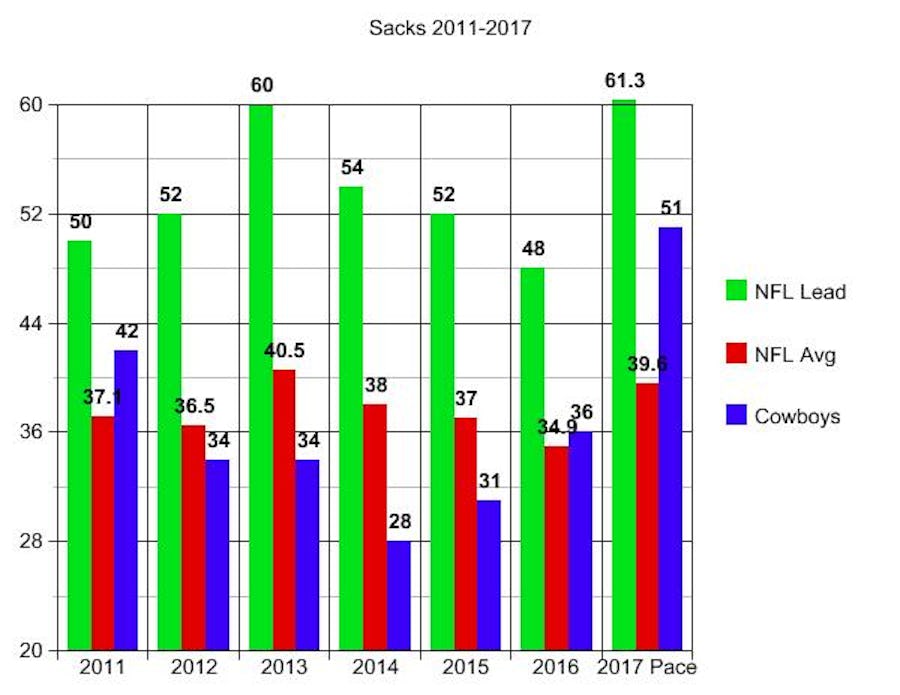
Now, the sack totals are interesting and encouraging to say the least. Look at the seven-year trend as we compare the Cowboys (blue) to the NFL leaders (green) and NFL average (red) team totals:
As you can clearly see above, the Cowboys' pass rush is as productive as anything we have seen in this era post-Wade Phillips and DeMarcus Ware. They led the NFL in sacks in 2008 and were a great pass rush for almost all of Wade's tenure, but since then, they have dropped below the league average for almost all of Rob Ryan, Monte Kiffin and part of Rod Marinelli's stay. Now, they may have assembled a group that can get home and currently sits in the top 10 in sack rate. That is most encouraging. But, back to the folks at Remarkable -- what about this? The Cowboys defense has not hurried opposing QBs on any of 59 dropbacks in close and late situations this season (worst in NFL; League Avg: 8.5%) This is subjective, and it sure looked like Rodgers was under duress on that final drive a time or two, but if it is anywhere close to accurate that they have no hurries on 59 dropbacks in "close and late," that tells us that while they have the pass rush, perhaps they don't have enough of one to get home late in games due to fatigue? Or, it tells us that the defensive play-calling gets way more conservative in these spots and the Cowboys' rush is not as determined to get home. Either way, this is a trend worth investigating.
But, the biggest issue I have remains with what every defensive coordinator is mandated to do: stop threats and create takeaways.
Look at these numbers -- none of them are terribly positive:
The Cowboys defense has allowed 5.5 touchdowns per interception (11 TDs allowed, and 2 INT) this season (6th worst in NFL; League Avg: 1.9)
The Cowboys have intercepted 2 of 183 attempts (91.5 pass attempts per int.) this season (7th worst in NFL; League Avg: 42.9)
The Cowboys defense has forced 4 fumbles this season (tied for 3rd fewest in NFL)
So, no interceptions and no fumbles forced -- not a great combination.
It is worth noting that it seems quite obvious this league is committing fewer and fewer turnovers every year. We are trying to completely eliminate risk in our offenses and in our quarterback decision-making over the years.
Last year, there were 700 turnovers in the sport. Ten years ago: 918! That is a remarkable drop-off in that span of time. The NFL average used to be around 28-30 for each team per year, and now it has dropped to 21-22 league-wide.
So, it is tougher to get takeaways, sure. But, Marinelli and his crew have just 35 in the past 37 regular-season games going back to the start of 2015. This trend is almost too big to be a trend as much as it is simply who they are. They are trying to alter that, but the first five games of 2017 have been more of the same. Deep, deep safeties, careful corners, three-man pass rushes and hope something that good happens.
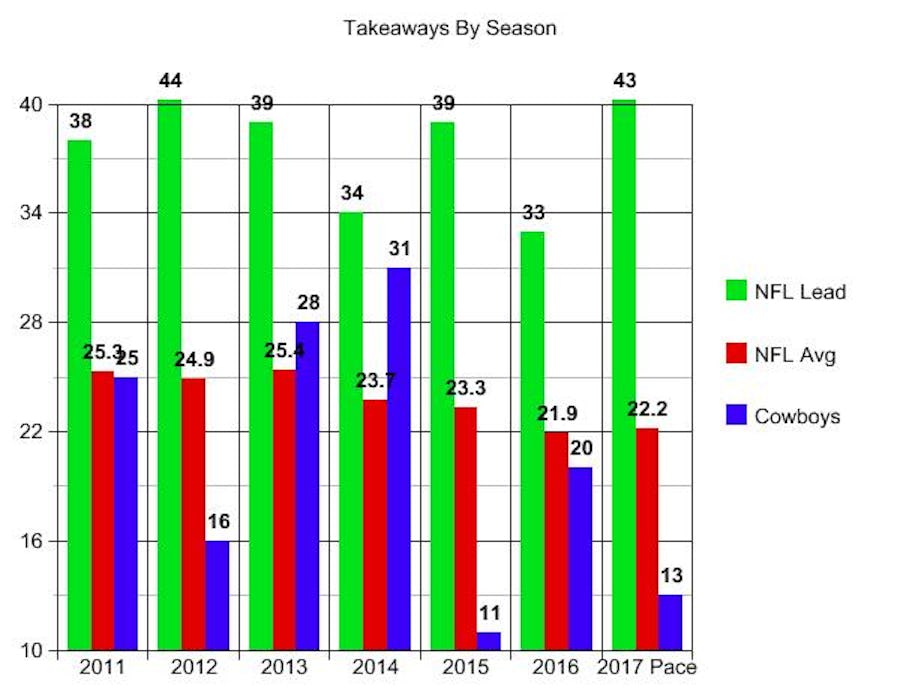
In doing this, opponents aren't even looking deep, they are just taking the easy stuff underneath that moves the chains and hardly don't risk any turnovers. I would love to know if any defensive coordinator in the history of the league has ever produced takeaways at such a low rate for three seasons and not been under threat of job security, or at least some public heat. I generally hear nothing but plaudits for Marinelli and I really admire his personality and his defensive approach in general, but to oversee three years in a row that have yielded an average of 15 takeaways, in a league where the average team is able to get about 22 (46 percent more), is a problem that is going to be difficult to overcome.
Starting Sunday, the Cowboys have to reverse this trend quickly.
Without question, the top reason the defense gave the entire organization indigestion in 2015 was a lack of taking the ball away.
We all know how closely correlated turnovers are to winning and losing, and when you have arguably the most disappointing season in franchise history (expectations to reality) and you also have the worst takeaway year in the history of the sport, the two things can often be linked together.
You may recall this paragraph summary from last year's final "Cowboys Morning After" that followed the finale against Washington:
IN THE HISTORY OF PROFESSIONAL FOOTBALL RECORD KEEPING, NO TEAM HAS EVER HAD FEWER TAKEAWAYS THAN THE 2015 DALLAS COWBOYS. In fairness, the 2013 Houston Texans had just as few (11), but now the Cowboys can imagine how many teams and how many years of football has been played to consider just what that means. Pick any team and pick any year you can think of from the time you were a baby or perhaps even when your father was a baby, and that team in that given year took the ball away more than 11 times. While it may seem impossible to fathom, it is true.
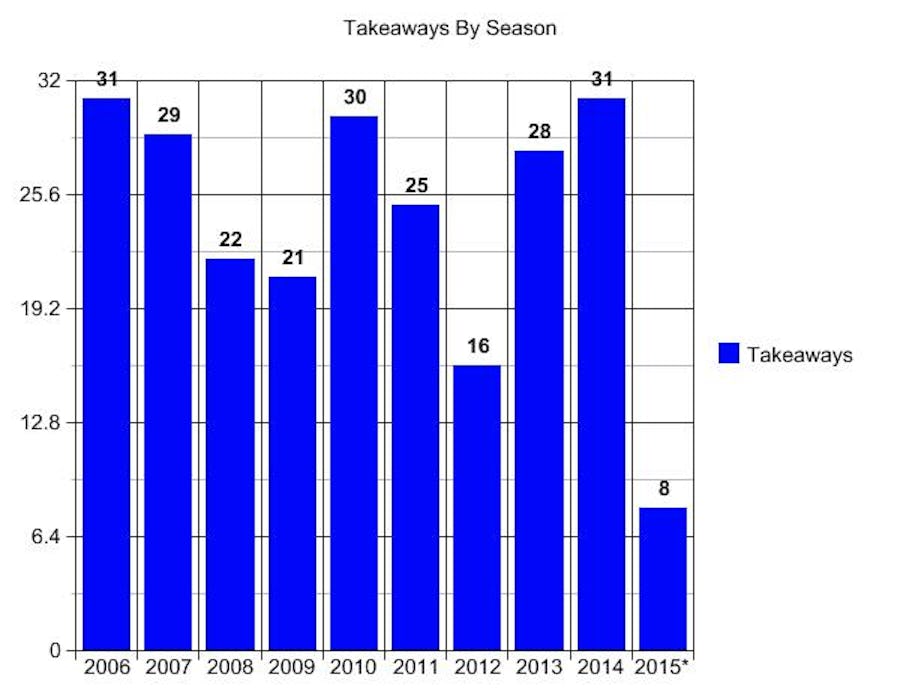
Looking back, it is still hard to believe. And yet, it doesn't really matter if one believes it. It happened. In graphic form, here are the past 10 years of takeaways from the Cowboys' defense:
You can see that of all of the mysterious issues of 2015, this is a stat -- the lack of interceptions and fumble recoveries that cannot be blamed on Tony Romo's collarbone, right?
This theory actually has been pushed forward by my radio colleague, David Newbury, who loves the sport and looks at stats and film as much as I do. It goes like this:
In 2014, the NFL had 32,784 plays (which tells you that with 32 teams, each defense faces about 1,000 snaps a season). In that total, 19,094 passes occurred which resulted in 450 interceptions and 1,211 sacks if you total up the defensive accomplishments.
But, here is where game theory comes in -- if you divide those 32,784 plays into two categories, you will see the stats begin to tell you a story. The categories are: 1) plays in which the defense is ahead by four points or more and 2) plays in which they are not. If you simply divide it into those two, you see how the game is different for a defense with a lead of more than a field goal.
So, now, look at those 32,784 plays divided into those two categories:
Stay with me. There is a lot here. But, look, the top row shows normal situations. The bottom row is what happens when you get to play defense against an offense that needs points. Look at the run/pass balance. When game is neutral, it is nearly a 50/50 run and pass split. When you fall behind, it turns to 67/33.
Now, look at the number of passes for a team that is behind. Just 8,352 passes (43 percent) in a league that threw 19,094 times. But, that 43 percent accounted for 54 percent of all interceptions (241 of the 450) and almost 50 percent of all sacks. That is incredibly disproportionate and shows a few things.
1) Offenses clearly are forcing the ball into spaces more. They need points. They have to get more aggressive.
2) Newbury has this one: "To me, it's more about the D-line being able to go get the QB without worrying about stopping the run. The offense is forced to throw more and run less. They throw 67.4 percent of the time when losing by four points or more. Look how balanced the offenses are when they are winning ... And teams abandon play action and sprint-outs when they are losing. The QB stays in the pocket more, thus the D-line knows where he's going to be before the ball's snapped. Heck, think about what Romo went through when opposing defenses knew he had to throw the ball. Defenses weren't honoring the run. They were pinning their ears back to get to Romo."
So, if the numbers prove that you need a lead to get most of the turnovers in the league, then it stands to reason that we have been looking at takeaways wrong all this time. Maybe it isn't that teams are good because they get takeaways. Maybe it's that they get takeaways because they are good. Do certain teams always get takeaways because their offense puts them ahead, and thus the opponent has to do things they are not comfortable doing?
How does this apply to the story of the 2014 and 2015 Cowboys?
In 2014, the Cowboys defense was on the field for 978 snaps. In 2015, it was 997 snaps. Roughly, that is just one more snap per game -- 61.1 per game in 2014 to 62.3 in 2015. Negligible. There is almost no relation whatsoever to this ridiculous theory that the 2014 team never let the other team on the field. As you can see, they did at nearly an identical rate with Tony Romo and DeMarco Murray as did last year's team.
No matter how great your offense is, the other team gets the ball back every time you score. In a make-or-take it league, this would make more sense. Unfortunately, that only exists on basketball playgrounds.
But, here is where 2014 and 2015 differ. And this is quite important:
You certainly didn't need an eye-catching graphic to show you that the team was never ahead last season, but if we believe that most interceptions and sacks happen when a team is ahead and the other team has to force the issue with determined passes and the defense not worrying about your running game, then we can quickly see that the Cowboys defense was never in this position -- just 16 percent rather than 49 percent.
We could run the numbers of how this played out -- but given that the Cowboys were never ahead all season long, there is almost no data. The best example was Sam Bradford throwing into the Cowboys secondary in Week 2 and throwing picks. But, those are the only three turnovers the Cowboys got from advantageous spots all season. Five of the 31 sacks came from those small spots, too.
The pass rush actually improved significantly. They had 31 sacks in 506 pass plays this past year -- one sack every 16.3 pass plays. In 2014, it was 28 in 558 -- one sack every 19.9 pass plays. That is a very significant improvement to where they are almost at league average. In 2014, they were not close to the league average, despite being in a spot to get a ton of sacks. But, in 2015, despite being a better pass rush team -- they never were able to force teams to throw.
So, we circle back to the start.
How does the offense help the defense? By getting a lead and forcing other teams to respond. They will still get 60-65 snaps, but if more of them are passes, the turnovers return and the sacks add up if everything else is equal. And that is specifically how this should work.
As is the case of any losing team that cannot find the path back, the 2015 Dallas Cowboys appear to be lost and without a compass.
One week, we talk about substandard QB play. The next week, we say that nobody is getting open. The next week, we say the defense can't be blamed. And the next week, the defense is almost completely to blame.
That week was this week. If the Cowboys could have mixed in a stop down the stretch of this game (much like the Atlanta game), they likely would have won. Instead, the Eagles - once Sean Lee exited the game on the first play of the 2nd half - found a few plays that the Cowboys had no answer for and ran them over and over again. After 3 punts on their first 3 possessions, the Eagles scored 3 touchdowns and 2 field goals in their final 7 drives and shoved the Cowboys right off the cliff of contention.
Much will be blamed on the Pick-6 that certainly did not help - as it should. But, in this game, the Cowboys again could not get in that stop that they needed. They also could not get that sack that they needed. And, of course, they also could not get that takeaway that they needed.
For the sixth time in 8 games, the Cowboys were shutout in the takeaway game. They continue to flirt with all-time lows and as you can see, in the last decade, they are so far beyond the next-worst season that it is getting silly.
The 2015 number is their pace. They actually only have 4 takeaways. They are currently on pace for single-digit takeaways which would definitely complete a first-to-worst in one year dubious accomplishment as it pertains to the NFC.
So, theories abound on where the takeaways are. Why aren't you making plays? Jason Garrett is now fielding these questions repeatedly and admitting that their season depends on it - Tony Romo, or not. They must get easier points and free possessions. Every team depends on this every year.
So, what happened? Why did the 2014 Cowboys lead the NFC in takeaways and the 2015 team is last? I am asked this repeatedly. So, here is a theory.
This theory actually has been pushed forward by my radio colleague, David Newbury, who loves the sport and looks at stats and film as much as I do. It goes like this:
In 2014, the NFL had 32,784 plays (which tells you that with 32 teams, each defense faces about 1,000 snaps a season). In that total, 19,094 passes occurred which resulted in 450 interceptions and 1,211 sacks if you total up the defensive accomplishments.
But, here is where game theory comes in - if you divide those 32,784 plays into 2 categories, you will see the stats begin to tell you a story. The categories are: 1) plays in which the defense is ahead by 4 points or more and 2) plays in which they are not. If you simply divide it into those two, you see how the game is different for a defense with a lead of more than a field goal.
So, now, look at those 32,784 plays divided into those categories:
Plays
Passes
Runs
Ints
Sacks
Defense neutral
20,405
10,742 (52.6%)
9,663 (47.4%)
209
609
Defense up 4+ Pts
12,379
8,352 (67.5%)
4,027 (32.5%)
241
602
Stay with me. There is a lot here. But, look, the top row is normal situations. The bottom row is what happens when you get to play defense against an offense that needs points. Look at the run/pass balance. When game is neutral, it is nearly a 50/50 run and pass split. When you fall behind it turns to 67/33.
Now, look at the number of passes for a team that is behind. Just 8,352 passes (43%) in a league that threw 19,094 times. But, that 43% accounted for 54% of all interceptions (241 of the 450) and almost 50% of all sacks. That is incredibly disproportionate and shows a few things.
1) - An offense is clearly forcing the ball into spaces more. They need points. They have to get more aggressive.
2) - Newbury has this one: "To me, it's more about the d line being able to go get the QB without worrying about stopping the run. The offense is forced to throw more and run less. They throw 67.4% of the time when losing by 4 pts or more. Look how balanced the offenses are when they are winning... And teams abandon play action and sprint outs when they are losing. The Qb stays in the pocket more, thus the d line knows where he's going to be before the balls snapped. Heck, think about what Romo went through when opposing defenses knew he had to throw the ball. Defenses weren't honoring the run. They were pinning their ears back to get to Romo."
So, if the numbers prove that you need a lead to get most of the turnovers in the league, then it stands to reason that we have been looking at takeaways wrong all this time. Maybe it isn't that teams are good because they get takeaways. Maybe it is that they get takeaways because they are good. Do certain teams always get takeaways because their offense puts them ahead and thus the opponent has to do things they are not comfortable doing?
How does this apply to the story of the 2014 and 2015 Cowboys?
In 2014, the Cowboys defense was on the field for 978 snaps. This year they have been on the field for 493 through 8 games. About the same exact pace. But, how much were they ahead last season versus this season? Let's look.
Season
Snaps Ahead 4+
Snaps Neutral
2014 - 978 snaps
483 (49.3%)
495 (50.7%)
2015 - 493 snaps
112 (22.7%)
381 (77.3%)
Wow. Look at that. At this pace, by the time Romo returns, the Cowboys may have been on the field in neutral (or negative) situations more in 2015 by November than they were all of last year. And, as you can see, they are almost never on the field with a lead. And, in those rare situations of being on the field with the lead, they have forced 2 of their 3 turnovers, even though it represents just 22.7% of their snaps.
If the league tells you that in general, you need a lead to get turnovers - and the defense is never put on the field in those situations (after a year where they seemed like they were always on the field with a lead and always got takeaways) - you can see how, once again, all theoretical roads lead back to the offense and maybe even the QB situation.
If opposing QBs are never asked to force throws then he never does. He also can get the ball out quickly because when you have a lead, you don't mind a punt. You play safe. He continues to take what you concede and bleed you slowly to death. Which, might be the theme of the 2015 Cowboys, "A slow bleed to death." I doubt they will use that for the season video.
=====
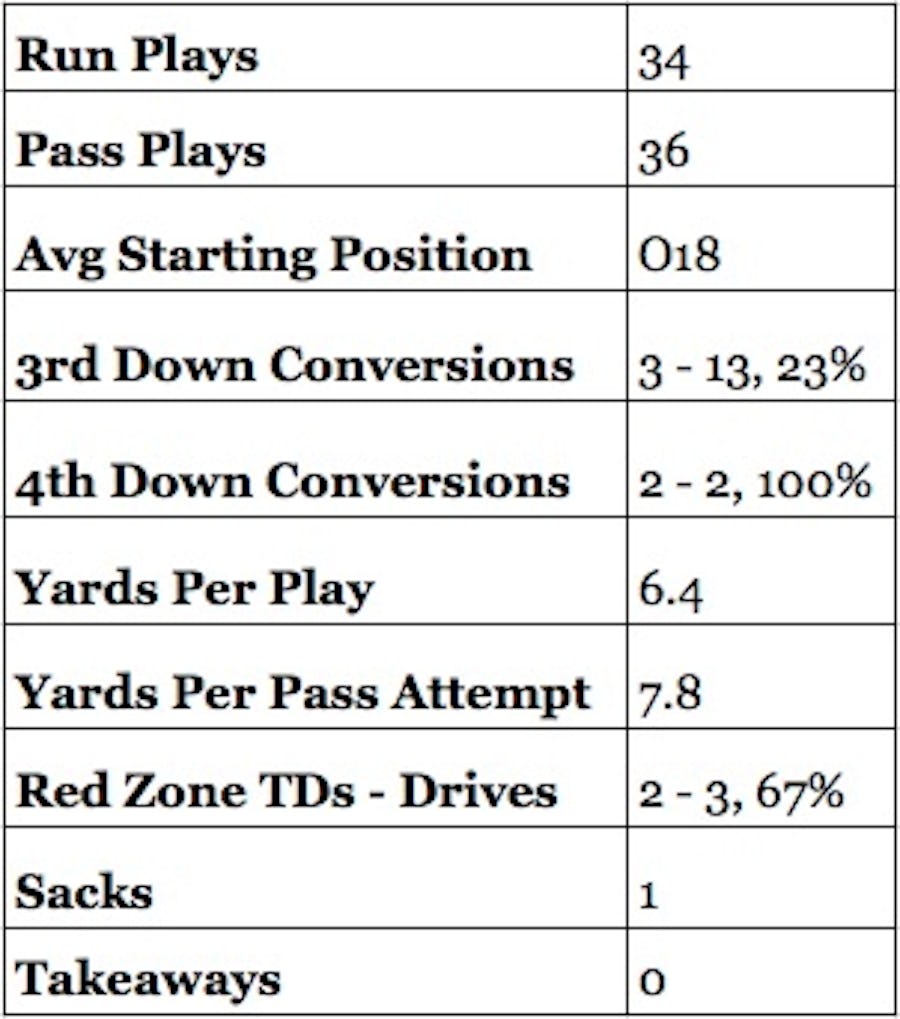
DATA - WEEK 8 - Philadelphia
Once again, we see that the Cowboys were beaten up pretty badly by an offense that has not been a world beater and frankly, should have been taken down.
Look how poor the Eagles are when they are forced into 3rd downs and they put the ball in the hands of their QB. He is simply not playing at a very high level. Yet, the Cowboys were gashed on the ground, looked more tired as the night went on, and continued to worsen in the crucial late stages.
And, perhaps more disappointingly, they had another chance to feast on a backup tackle which has now happened pretty much every week since Greg Hardy returned. Against New England, left tackle Nate Solder fell in the the 2nd Quarter and was lost for the season. They were able to play Marcus Cannon as he tried left tackle with live ammunition. Then, the next week, Marshall Newhouse was the right tackle - no sacks conceded. Then, Russell Okung couldn't play left tackle for Seattle and was replaced by a guy named Alvin Bailey who also conceded no sacks. And then, this week, Dennis Kelly was making his first start at right tackle as Jason Peters couldn't go. Lane Johnson moved to left and Dennis Kelly played 78 snaps and gave up 0 sacks. So, you avoid Russell Okung and Jason Peters and the only thing you get is a Greg Hardy interception and and a Greg Hardy sack? 1 takeaway and 1 sack in 2 games against non-starters? And nothing from anyone not named Hardy?
Just poor.
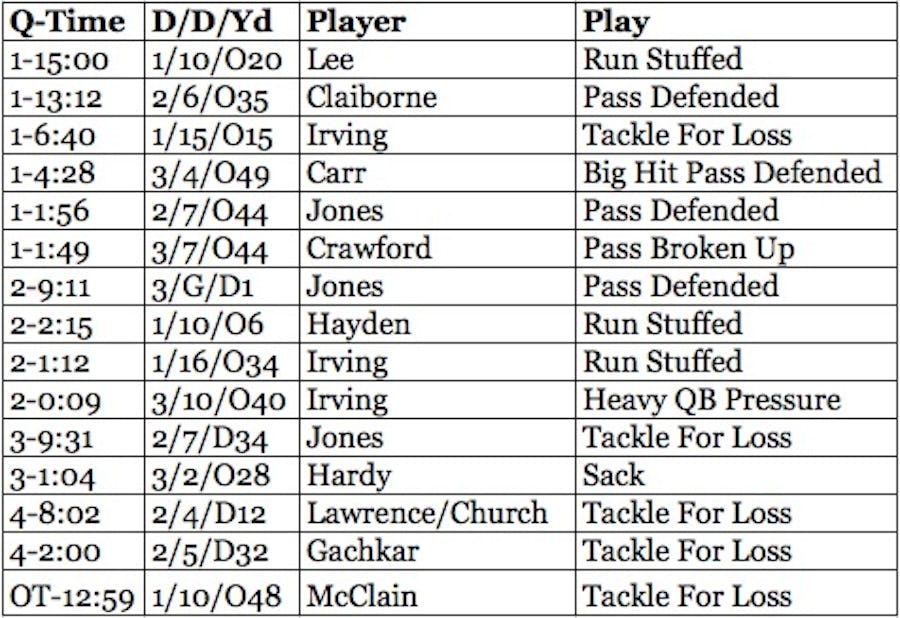
SPLASH PLAYS - WEEK 8
That isn't to say the team isn't playing hard and making plays. Here is a list of the smaller plays that are being made. They are battling their tails off. This week we will point out that David Irving is a very promising piece on the inside and that Byron Jones continues to make some plays - although he was also attacked quite a bit.
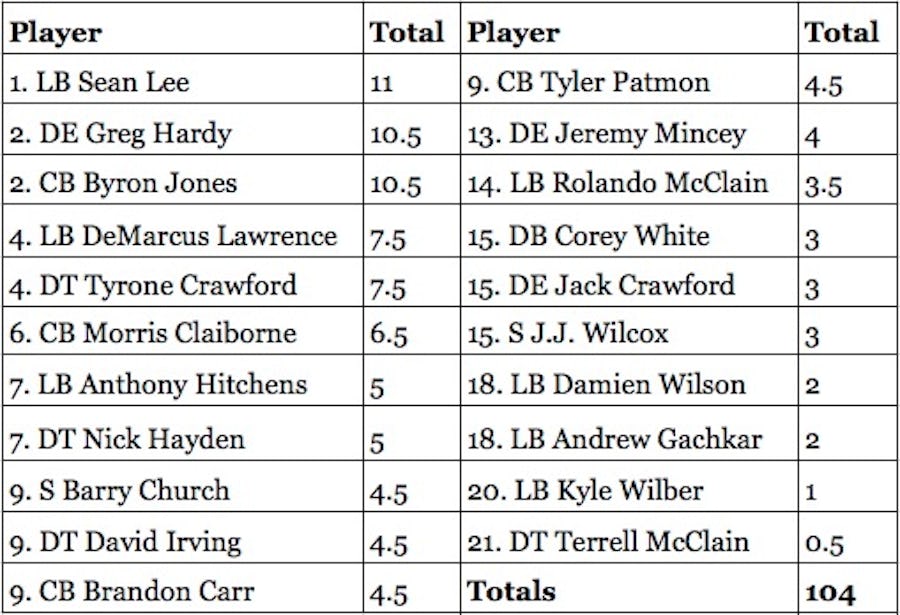
Here are the season totals on the Splash Plays for the season. Again, there is Sean Lee, Greg Hardy, and Byron Jones at the top - 3 guys who played 0 snaps in 2014. The best splash player from last season was Tyrone Crawford and he had 15 last year after 8 games. I wish I knew why he seems to be far behind last year's quality.
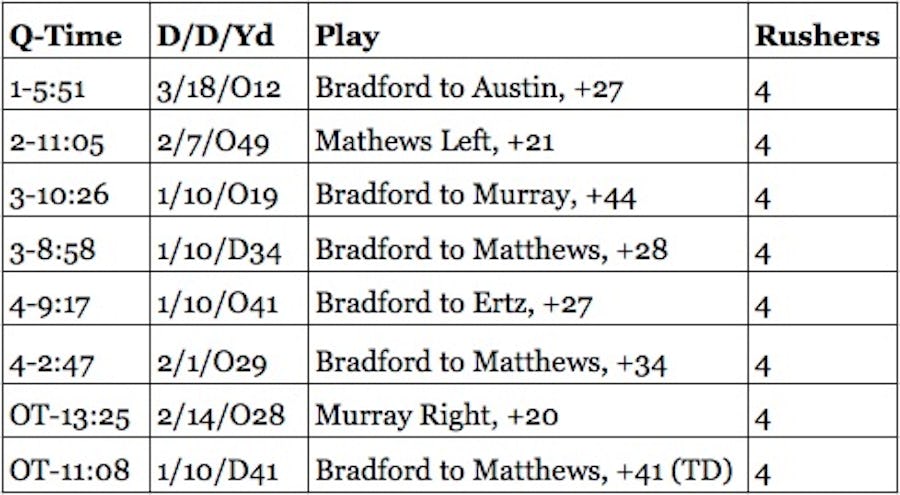
EXPLOSIVES - WEEK 8
Last week I pointed out the Cowboys need to get back to Cole Beasley and they did. Yay! I also pointed out last week that the Cowboys are doing so much better and not yielding explosive plays. Unfortunately, I might have spoken too soon. After allowing just 22 in 7 weeks which was 3rd best in the NFL. And then Sunday night happened. 8! They have up 8 explosives in one night! To Sam Bradford and the low-confidence Eagles offense - most after halftime again.
Poor, poor.
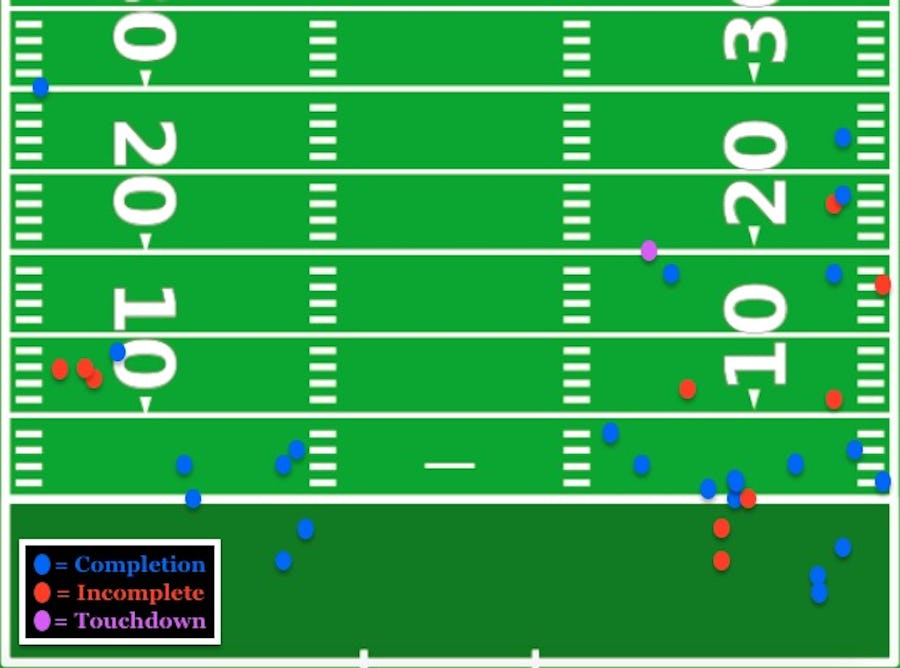
SAM BRADFORD THROW CHART
You likely know where I am on Sam. Great college QB. Not great NFL QB. I think it would be awesome if the Eagles signed him long term - for the Cowboys. But, on Sunday, he likely quieted his critics by making enough throws to keep the Cowboys frustrated. Supplemented by plenty of play action, misdirection, and tempo, he made some plays including a beautiful throw on the wheel route to Murray down the right sideline.
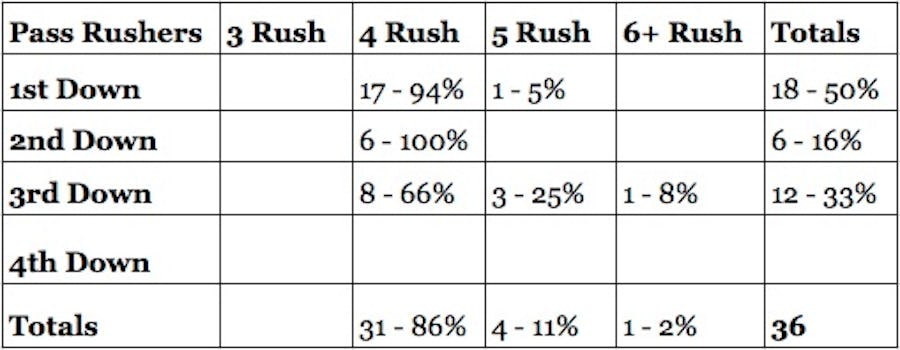
DALLAS PASS RUSHERS
Again, the Eagles had no Jason Peters. You had to rock Bradford a few times. It just never really happened. They were close. But, that is clearly not good for much. They didn't blitz again - that is not what they do.
SUMMARY AND CONCLUSIONS
0 Takeaways and they conceded the most yards of any game this season. They also gave up 8 explosive plays and when they needed to make sure they gave up nothing worse than a field goal in overtime, they couldn't tackle Jordan Matthews on a play they had seen a number of times all night with the man coverage breaking down and then a safety taking a ridiculously poor angle.
They have nobody getting to the QB not named Greg Hardy, regardless of whether or not the opponent has their offensive linemen available.
They appear to have a massive, massive problem at linebacker where Sean Lee is hurt again, Rolando McClain appears to be a burden, and the younger linebackers are attacked the moment they enter the game.
The Eagles had very poor field position all day and yet they put up 33 points, including 26 after halftime.
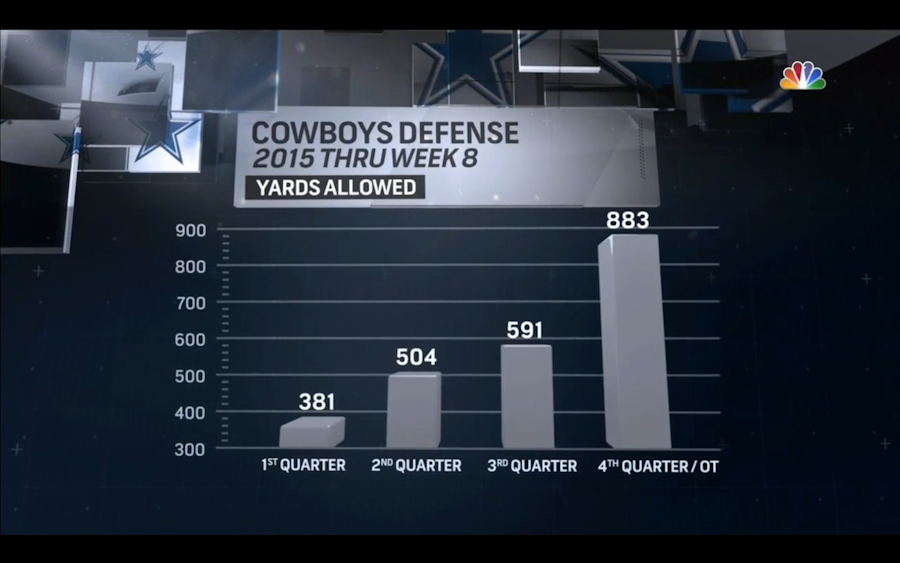
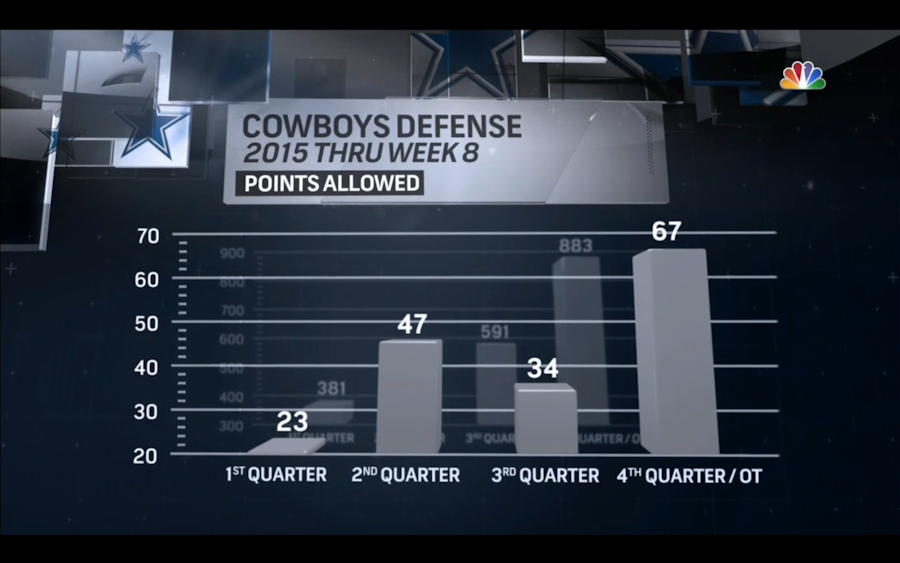
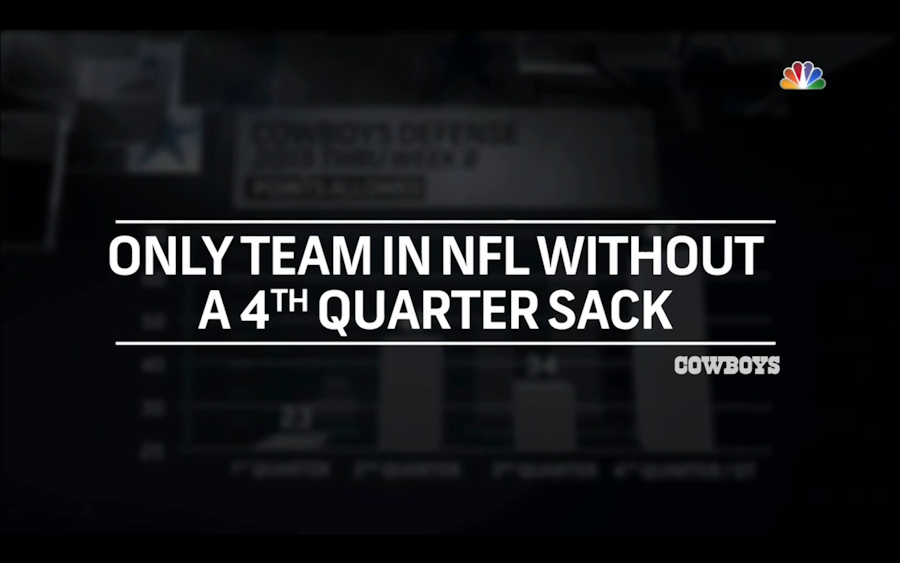
I think NBC gets this week's final word. They did a fantastic job of presenting the facts about this Rod Marinelli defense this season. Perhaps too much of the burden has been placed on them. The offense has not done its part. But, man, the defense was expected to do more than this. The Orlando Scandrick injury hurt, but this much? Look at what they presented on Sunday. Before the Eagles destroyed them late.
Please kindly add 192 more yards to that final column after Sunday.
Please add 19 more points to that final column.
You don't have to add anything to this one.
After absolving the defense from blame for many of the previous games, it appears the target is now back on them.